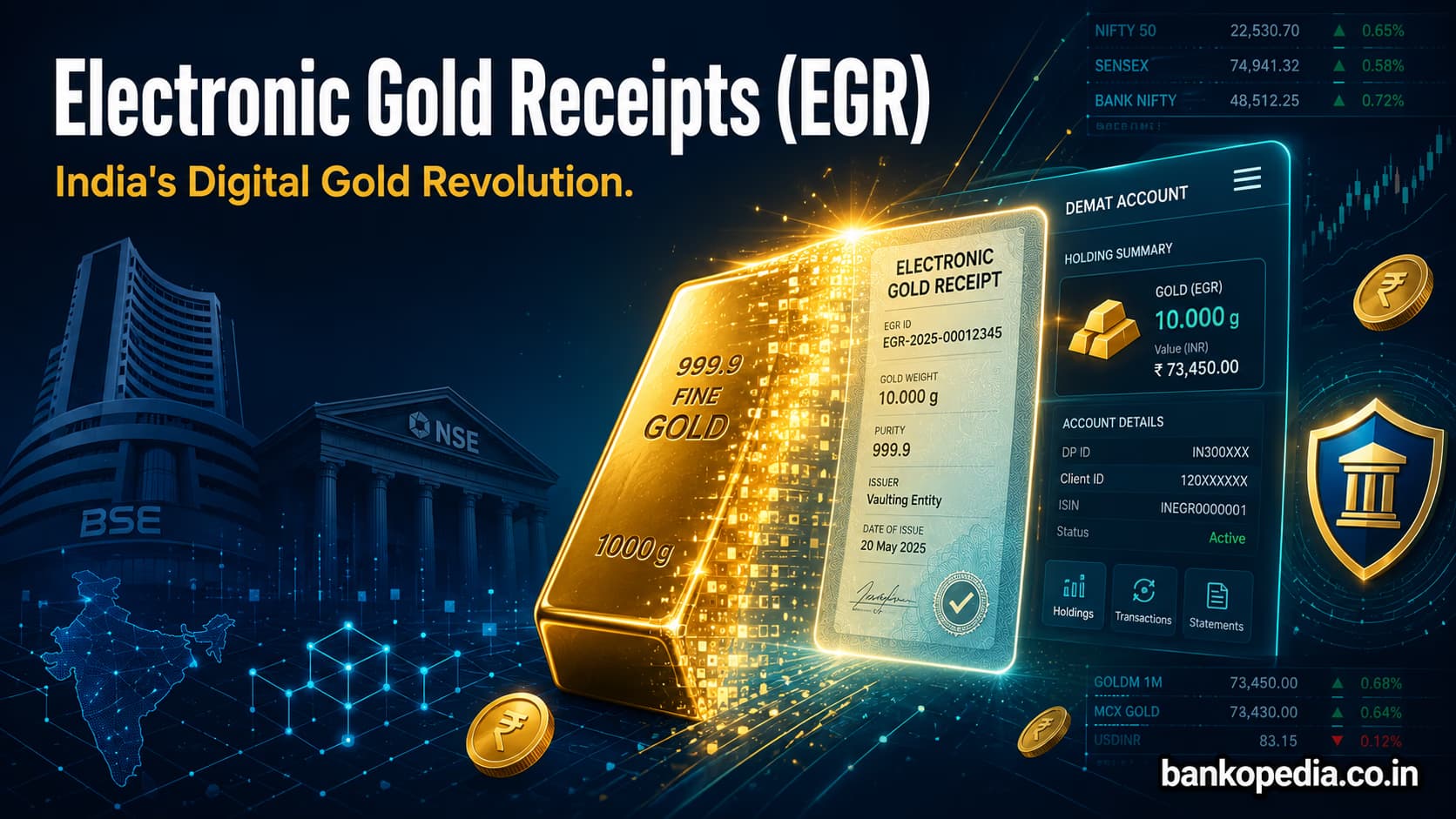
Buy or sell on BSE (since October 2022) and NSE (since May 2026) with T+1 settlement.
Each EGR represents gold of 995 or 999 fineness stored in a SEBI-approved vault.
You can withdraw your gold as physical bars or coins at any time, subject to charges and 3% GST.
Zero GST on exchange transactions; GST of 3% applies only on physical conversion.
Minimum investment: 100 milligrams of gold.
Conversion of physical gold to EGR (or EGR back to physical gold) does not attract capital gains tax.
Introduction
India's relationship with gold is ancient, deep, and enormous in scale. The country is one of the world's largest consumers of the yellow metal, yet most of that gold sits in lockers, jewellery boxes, and family vaults — illiquid, untraded, and unproductive. The Electronic Gold Receipt (EGR) framework, introduced by SEBI, is a bold attempt to change that. It brings gold into the formal securities market, making it as easy to buy, sell, and hold as a share of stock — while keeping the option open to walk away with physical gold whenever you want.
EGRs were commercially launched on BSE on October 10, 2022 and on NSE on May 4, 2026, marking successive milestones in the formalisation of India's gold market.
What Are Electronic Gold Receipts (EGRs)?
An Electronic Gold Receipt (EGR) is a SEBI-regulated digital instrument that represents ownership of physical gold stored in SEBI-accredited vaults. Issued by SEBI-registered Vault Managers and held in a demat account — just like shares or bonds — each EGR is a listed security that trades on BSE and NSE, and can be converted back into physical gold on demand.
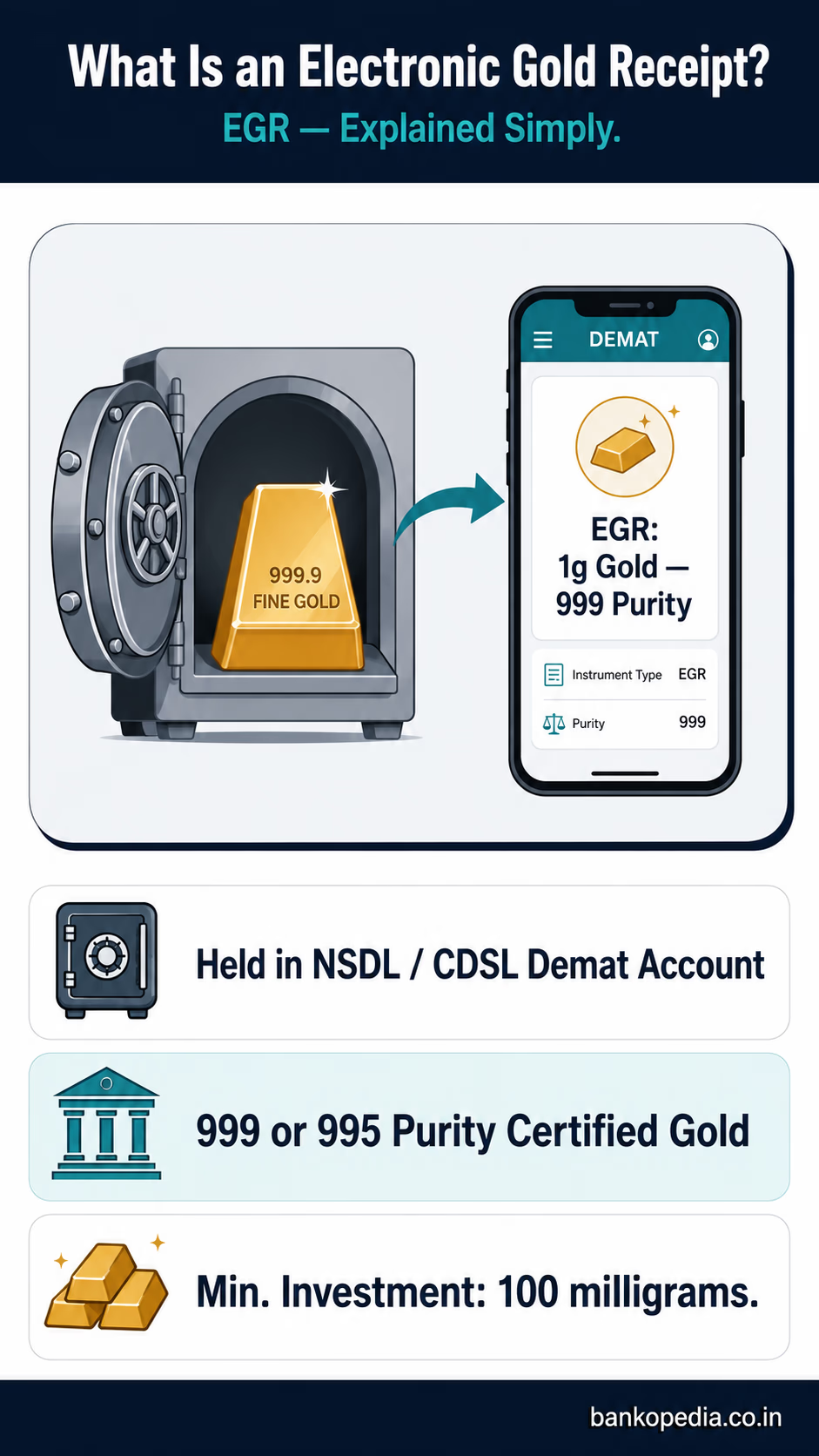
Think of it as a digital warehouse receipt: a paperless certificate that says, "X grams of gold of Y purity are sitting in a regulated vault on your behalf, and you can trade this receipt on a stock exchange or convert it into actual metal at any time."
EGR Full Form and Meaning
EGR stands for Electronic Gold Receipt. The term "receipt" signals that the instrument is backed by actual physical gold sitting in a regulated vault — not a synthetic or derivative product. When you hold one EGR of 1 gram, you are the beneficial owner of exactly 1 gram of gold (995 or 999 purity) held by a SEBI-registered Vault Manager on your behalf.
Why SEBI Introduced the Gold Exchange Framework
India is the world's second-largest gold consumer, yet the domestic gold market has historically been fragmented — characterised by purity concerns, opaque pricing, high transaction costs, and the absence of a regulated spot exchange.
SEBI's Gold Exchange Framework (notified January 10, 2022) was designed to:
Establish a transparent, regulated framework for operationalising a Gold Exchange in India
Bring Indian gold pricing in line with international benchmarks
Provide a fungible, dematerialised vehicle seamlessly convertible to and from physical gold
Reduce systemic risks from unorganised gold trade
Bring investor protection under SEBI's securities framework
The Government of India formally declared EGRs as 'securities' under Section 2(h)(iia) of the Securities Contracts (Regulation) Act, 1956 (SCRA) via Gazette notification S.O. 5401(E) dated December 24, 2021 — the single legal step that enabled EGRs to be traded on stock exchanges, held in demat accounts, and regulated like any listed security.
Key Participants in the EGR Ecosystem
The EGR ecosystem involves five key participants:
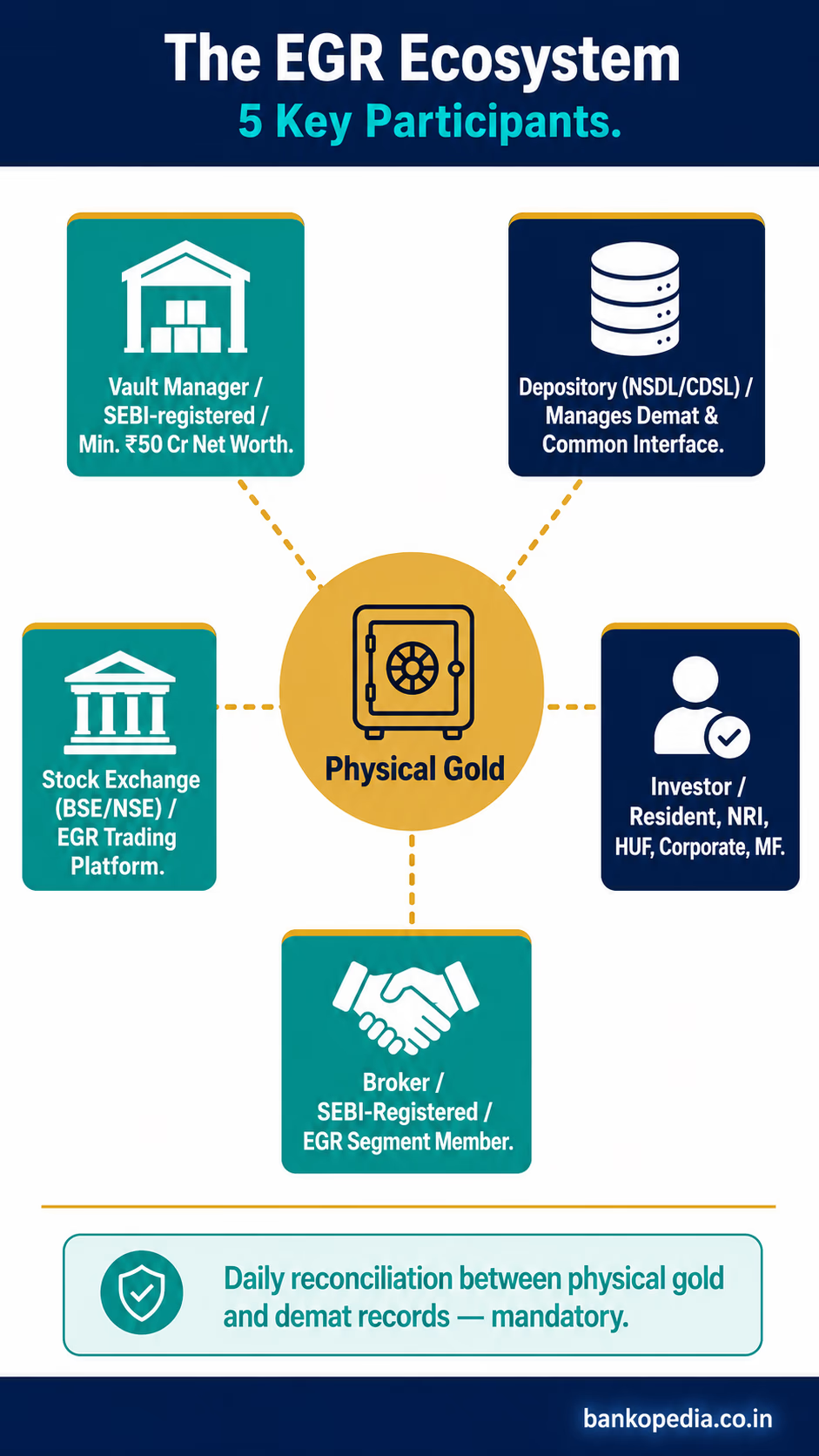
Vault Manager — A SEBI-registered entity with a minimum net worth of ₹50 crore, responsible for storage, safekeeping, and delivery of gold under the SEBI (Vault Managers) Regulations, 2021. Vault Managers must also maintain a Financial Security Deposit (FSD) of at least ₹10 lakh with a Depository before receiving their SEBI registration.
Depository (NSDL / CDSL) — Holds EGRs in electronic form in investors' demat accounts, just as it holds shares and bonds. Depositories also manage the Common Interface — the centralised digital backbone connecting all participants.
Stock Exchange (BSE / NSE) — Provides the trading platform for EGRs through a dedicated EGR segment.
Investor — Can be any resident individual, HUF, NRI, trust, corporate, mutual fund, or institution with a valid demat account.
Broker — A SEBI-registered stockbroker with membership in the EGR segment, through whom investors place buy/sell orders.
How Does EGR Work? The Three-Tranche Lifecycle
The entire lifecycle of an EGR is divided into three sequential phases, or tranches.
Tranche 1 — Creation: Physical Gold Deposited with the Vault Manager
The lifecycle begins when physical gold of qualifying purity (995 or 999 fineness) is deposited with a SEBI-registered Vault Manager, or alternatively, you simply buy EGRs directly on the exchange without ever depositing physical gold.
If depositing:
The investor initiates a deposit request through the Depository system (NSDL or CDSL), selecting a Vault Manager, vault location, quantity, and purity.
Physical gold is delivered to the vault between 10:00 AM and 3:00 PM. The Vault Manager verifies identity documents, packing list, customs clearance papers, and a letter of indemnity from the refiner.
Gold must meet either the LBMA Good Delivery Standard or the India Good Delivery Standard and must originate from accredited refineries or nominated agencies.
The Vault Manager assays the gold, certifies purity and weight, records all details into the Common Interface, and creates the EGR.
The Depository assigns an ISIN (formatted as G + Purity, e.g., G999 or G995) and credits the EGR to the investor's demat account.
Gold deposited by 3:00 PM is available for trading from the next trading day. Gold deposited after 3:00 PM is tradeable from the second working day.
A crucial safeguard: no EGR can be created without corresponding physical gold in the vault. The Vault Manager and Depositories reconcile physical gold stocks with EGR records at the end of every single trading day.
Tranche 2 — Trading: EGR Listed on NSE/BSE Gold Exchange Segment
Once in the demat account, EGRs trade just like any listed security:
Traded on BSE and NSE during market hours (9:00 AM to 11:30 PM / 11:55 PM Monday to Friday, to align with international gold market timings).
Prices track the domestic gold spot price in real time.
Settlement occurs on a T+1 basis: pay-in by 2:00 PM on T+1, pay-out by 4:30 PM on T+1.
The buyer receives EGRs in their demat account one business day after the trade.
No GST is applicable on exchange-based buy or sell transactions.
Fungibility and Inter-operability are two important built-in features:
Fungibility means your EGR is not tied to a specific gold bar. Only aggregate quantity and purity matter.
Inter-operability means you can deposit gold at one vault location and withdraw from a different location of the same or a different Vault Manager (subject to availability).
Tranche 3 — Withdrawal: Conversion of EGR Back to Physical Gold
At any point, the investor can convert EGRs back into physical gold:
Submit a withdrawal request through your broker's trading platform or Depository Participant, specifying the number of EGRs, Vault Manager, vault location, and ISIN. The request is valid for three working days.
The Depository verifies your EGR holdings, vault availability, and that all dues are cleared; it then freezes the EGRs.
The Vault Manager verifies identity and releases the gold between 10:00 AM and 3:00 PM.
On delivery, the Vault Manager simultaneously extinguishes the corresponding EGRs; the Depository removes them from your demat account.
GST at 3% applies on the value of gold at the time of physical withdrawal. Withdrawal and delivery fees also apply.
Important: If there is a quality dispute at the point of withdrawal, an empanelled assayer (accredited by the Clearing Corporation) is called in. Assaying costs are borne by the investor. If the gold fails the quality test, the accredited refinery compensates the investor. Once physical gold leaves the vaulting system, no further quality or quantity disputes are entertained.
EGR Denominations and Contract Sizes
EGRs are available in multiple weight denominations to suit investors of all sizes, with contracts for both 999 and 995 purity gold:
Weight | EGR: 999 Purity | EGR: 995 Purity |
|---|
1 kg | GLD1KG99 | GLD1KG95 |
100 g | GOLD100G99 | GOLD100G95 |
10 g | GOLD10G99 | GOLD10G95 |
1 g | GOLD1G99 | GOLD1G95 |
100 mg | GLD100MG99 | GLD100MG95 |
The minimum investment is 100 milligrams of gold, making EGRs accessible to small retail investors. The trading unit cannot be smaller than 1/10th of the deposit unit — for example, depositing a 100 g bar can create either one 100 g EGR or ten 10 g EGRs.
How to Buy Electronic Gold Receipts in India: Step-by-Step
Step 1: Choose a SEBI-Registered Broker with EGR Access
Not all brokers currently offer EGR trading. Check whether your broker has membership in the BSE or NSE EGR segment.
Step 2: Ensure a Demat Account Is Active
A demat account with NSDL or CDSL is mandatory to buy and hold EGRs. If you have a demat account for equity trading, the same account is used.
Step 3: Place a Buy Order on the Exchange's Gold Segment
Log in to your trading platform, navigate to the EGR / Gold Exchange segment, select the denomination (e.g., 1 g or 10 g EGR) and purity (999 or 995), check the live price, and place an order exactly as you would for any stock.
Step 4: EGR Credited to Demat (T+1 Settlement)
After execution, EGRs are credited to your demat account on T+1 (the next business day). The EGR is now visible in your demat holdings and can be sold on the exchange at any time during market hours.
Who Can Buy EGRs?
EGRs can be purchased by any investor with a valid demat account and access to a SEBI-registered broker with EGR segment membership. Eligible categories include:
Resident individuals
Hindu Undivided Families (HUF)
Non-Resident Indians (NRI)
Trusts and foundations
Corporates and institutions
Mutual funds and Portfolio Management Service (PMS) providers
Fees and Charges on EGR
Trading Costs: When you buy or sell EGRs on the exchange, you pay standard brokerage (per your broker's tariff), exchange transaction charges, and depository/demat charges — the same structure as equities.
Storage (Vaulting) Charges: The Vault Manager levies an ongoing fee for storing your gold. As per CDSL's published information, storage charges are approximately ₹15 per kg per day per Beneficial Owner (BO). These are collected by the Depository at the end of each month, on sale of the EGR, or on withdrawal — whichever comes first. Vault Managers must give 15 working days' notice before revising charges.
Withdrawal and Delivery Charges: When converting EGRs to physical gold, a withdrawal fee and delivery fee apply, collected by the Vault Manager directly from the beneficial owner.
Assaying Charges: If you request a purity test at the time of withdrawal, the assaying cost is borne by you.
GST at 3%: Applicable on the full value of gold at the time of physical conversion (withdrawal). Zero GST on exchange buy/sell transactions.
Key Features: How EGR Differs from Digital Gold and Gold ETFs
India offers several ways to invest in gold digitally, but EGR occupies a unique and well-regulated position.
Digital Gold (platforms like Jar, Gullak, MMTC, SafeGold, etc.) allows individuals to buy tiny quantities for as little as ₹10. However, digital gold operates entirely outside SEBI's purview and is unregulated per SEBI guidelines. There is no statutory investor protection, no mandated purity certification framework, and no regulatory oversight of the entities holding the gold.
Gold ETFs / Gold Mutual Funds solve the regulation issue — they are SEBI-regulated and exchange-traded. However, you cannot convert them into physical gold. Your investment always exists as a fund unit redeemable only in cash.
EGRs close this gap by combining:
The same statutory investor protections as any listed security
Physical gold backing with SEBI-mandated purity (995 or 999 fineness)
The ability to take physical delivery of the actual metal at any time
Exchange liquidity and transparent, real-time pricing
Flexibility across multiple weight denominations (100 mg to 1 kg)
Vault Safety and Investor Protections
The physical layer of the EGR system is built to rigorous standards set by SEBI:
Vault Infrastructure: Recognised vaults must have CCTV, IR cameras, vibration and smoke sensors, panic switches, DVR systems, mantraps, electromagnetic door locks, biometric scanners, metal detectors, and high-security steel doors. They must be accessible by armoured vehicles. Gold for EGR purposes is stored in separate, clearly demarcated racks.
Insurance: Vault Managers must maintain comprehensive insurance covering theft, fire, burglary, fraud, negligence, and force majeure events. The insured value is marked to market on an ongoing basis.
Reconciliation: Daily reconciliation between physical gold stocks and Depository records is mandatory. If reconciliation fails, no fresh deposits or withdrawals are permitted from that vault until the discrepancy is resolved.
Inspections: Depositories carry out physical verification of vault gold stocks at least once every fortnight and conduct a full annual inspection of each Vault Manager. Surprise inspections are also conducted as needed.
Loss Replenishment: In the event of loss or damage to gold, the Vault Manager is liable to replenish the gold within 24 hours, with equivalent purity and weight from LBMA or India Good Delivery standard sources.
Financial Security Deposit (FSD): Each Vault Manager maintains an FSD of at least ₹10 lakh with a Depository — the first fund available to compensate investors for proven losses caused by the Vault Manager.
Risk Management Framework
The EGR risk management framework closely mirrors the equity cash segment.
Mark-to-Market (MTM) Losses are collected before the start of each trading day on the gross open position of the member.
VaR (Value at Risk) Margins are designed to cover potential losses on 99.9% of trading days, based on 6 standard deviations of price movement with a minimum initial margin of 9%. VaR margins are collected upfront and updated at least three times daily.
Extreme Loss Margin (ELM) is a minimum of 1% of the gross open position, collected in real-time.
Price Bands: Initial price band is ±10% of the previous day's closing price, relaxable in 5% increments. A pre-open call auction session runs from 8:45 AM to 9:00 AM with a ±5% price band.
Block Deals: A block deal window operates from 3:05 PM to 3:20 PM, with a minimum order size of ₹10 crore and a price within ±1% of the VWAP.
Settlement Guarantee Fund: Clearing Corporations maintain a separate Core SGF for the EGR segment with a minimum corpus of ₹10 crore.
EGR as Collateral: EGRs are accepted as collateral with a 20% haircut and no upper concentration limit — a notable advantage over Gold ETF/bullion collateral, which is capped at 30% of total collateral.
Taxation of Electronic Gold Receipts in India
Capital Gains Tax: STCG or LTCG
EGRs are listed securities on NSE/BSE and are taxed accordingly:
Holding Period | Tax Treatment |
|---|
Less than 12 months | Short-Term Capital Gain (STCG) — added to total income, taxed at applicable slab rate |
More than 12 months | Long-Term Capital Gain (LTCG) — taxed at flat 12.5% without indexation |
Physical Gold ↔ EGR Conversion: Zero Capital Gains Tax
As per amendments effective from April 1, 2024, the conversion of physical gold into an EGR — or from an EGR back into physical gold — by a SEBI-registered Vault Manager is not treated as a "transfer" under Section 47 of the Income Tax Act. This means no capital gains tax is triggered at the point of conversion in either direction.
GST Treatment
Transaction | GST Applicability | Rate |
|---|
Buying EGRs on the stock exchange | No | Nil |
Selling EGRs on the stock exchange | No | Nil |
Converting EGR to physical gold (withdrawal/delivery) | Yes | 3% |
EGR vs SGB vs Gold ETF vs Digital Gold vs Physical Gold
Parameter | EGR | SGB | Gold ETF | Digital Gold | Physical Gold |
|---|
Regulator | SEBI | RBI | SEBI | Unregulated | Self-custody |
Form | Electronic receipt in demat | Govt bond | MF unit | Digital balance | Coins/bars |
Demat Required | Yes | Optional | Yes | No | No |
Backed by | Physical gold in SEBI vault | Govt. of India | Physical gold | Issuer | Self |
Where Traded | BSE / NSE | NSE / BSE (secondary) | NSE / BSE | App only | Jewellers |
Interest | None | 2.5% p.a. | None | None | None |
Lock-in | None | 5 yrs early exit / 8 yrs maturity | None | None | None |
Convertible to Physical | Yes | No | No | Depends on issuer | N/A |
Liquidity | Moderate (growing) | Low pre-maturity | High | High | High |
GST on Purchase | None | None | None | 3% | 3% |
GST on Physical Conversion | 3% | N/A | N/A | 3% | N/A |
Min. Investment | 100 mg | 1 gram | ~1 unit (~₹50–70) | ₹10 | Varies |
Risks and Limitations of EGR
No investment product is without drawbacks, and EGR is no exception.
Vault Manager Risk: While SEBI's regulatory framework (including the ₹50 crore net-worth requirement, mandatory insurance, and FSD) significantly mitigates this risk, a residual risk exists if a Vault Manager faces operational or financial difficulties.
Liquidity Risk: As a product launched commercially in 2022, EGR trading volumes are still building. Bid-ask spreads can be wider, particularly for larger orders.
Ongoing Storage Costs: EGRs incur storage, withdrawal, and vaulting fees for as long as you hold the gold — costs that do not apply to Gold ETFs or SGBs.
No Interest Income: Unlike SGBs (which pay 2.5% p.a.), EGRs earn no interest.
SGB Comparison: With new SGB issuances suspended since 2024, investors who relied on SGBs for gold allocation need alternatives. EGR offers SEBI regulation, exchange liquidity, and physical convertibility — but cannot replicate the 2.5% annual interest or the tax-free maturity benefit of SGBs.
Should You Invest in EGR? An Investor-Profile Framework
The Physical Gold Investor: If you want real gold ownership but are tired of making charges, locker costs, purity anxiety, and jewellery illiquidity, EGR is well-suited. You get a SEBI-backed claim on certified physical gold with the option to take physical delivery whenever you want. The 3% GST on conversion is the primary trade-off — though you would have paid 3% GST upfront buying physical gold anyway.
The Gold ETF / Mutual Fund Investor: EGR slots in naturally alongside existing gold ETF holdings. It trades on the same platforms with T+1 settlement and lives in the same demat account. The only meaningful difference: EGRs let you take physical delivery; ETFs do not.
The SGB-Suspended Investor: With new SGB issuances halted since 2024, EGR is among the strongest regulated alternatives for new gold allocation going forward — offering SEBI oversight, exchange liquidity, and physical convertibility, even if it lacks the SGB's interest income and tax-free maturity.
The Trader: For investors wanting short-to-medium-term positions in gold price movements, EGR offers real-time pricing, T+1 settlement, and the same exchange infrastructure as equities — without the derivatives complexity of commodity futures.
Grievance Redressal and Investor Protection
Vault Managers and Depositories maintain formal Investor Charters with defined grievance resolution timelines:
Quantity/weight complaints: Resolved within 1 working day. Failure results in suspension of EGR operations at that vault until resolution.
Quality/purity complaints: Directed to an empanelled assayer. If gold fails the quality test, the accredited refinery compensates the investor.
Other operational complaints: Resolved within 7 working days.
Investors can also file complaints against Vault Managers on the SEBI SCORES platform (https://scores.gov.in). Vault Managers must publish monthly complaint data on their websites by the 7th of the following month.
FAQs
What is the full form of EGR? EGR stands for Electronic Gold Receipt. It is a SEBI-regulated instrument representing ownership of physical gold held in accredited vaults and traded in dematerialised form on stock exchanges.
Who regulates Electronic Gold Receipts in India? EGRs are regulated by SEBI under the Gold Exchange Framework (January 10, 2022) and the SEBI (Vault Managers) Regulations, 2021.
When did EGR launch on BSE and NSE? BSE launched the EGR segment on October 10, 2022. NSE launched its EGR segment on May 4, 2026.
Can I convert my EGR into physical gold? Yes. Submit a withdrawal request through your broker or Depository Participant at any time. The Vault Manager arranges delivery of physical gold (bar or coin, per the denomination). GST at 3% and applicable withdrawal/delivery charges apply.
What is the minimum investment in EGR? The minimum investment is 100 milligrams of gold on both BSE and NSE.
Is EGR safer than digital gold? Yes. Digital gold is unregulated and carries issuer risk, whereas EGRs are SEBI-regulated and subject to strict Vault Manager norms including mandatory insurance, FSD, and fortnightly physical inspections.
Do I need a demat account to buy EGR? Yes, a demat account with NSDL or CDSL is mandatory.
Does converting physical gold to EGR (or EGR back to physical gold) trigger capital gains tax? No. As per amendments effective from April 1, 2024, such conversions are not treated as a "transfer" under Section 47 of the Income Tax Act. No capital gains tax is triggered.
How do I track EGR prices? EGR prices are publicly visible in real time on both BSE and NSE and track the domestic gold spot price per gram.
What are the storage charges for keeping gold with a Vault Manager? Storage charges are levied by the Vault Manager for storing gold. As per CDSL's published information, charges are approximately ₹15 per kg per day per Beneficial Owner (BO).
Conclusion: A Framework Built for Scale and Trust
The EGR framework is one of the most comprehensive and investor-friendly gold investment structures India has ever introduced. Every layer — from the standardisation of physical gold to the safety specifications of vaults, from the daily reconciliation process to the T+1 settlement cycle — reflects a determined effort to bring the discipline of securities regulation to the gold market.
The SEBI Master Circular of June 2024 (No. SEBI/HO/MRD/MRD-PoD-1/P/CIR/2024/87) consolidates and strengthens this framework, updating provisions on Vault Manager governance, investor grievance timelines, and risk management parameters.
For India's gold market, EGR represents a shift from an informal, fragmented system to a transparent, regulated, and liquid marketplace. Whether you are accumulating gold for the long term, trading it actively, or simply looking for a SEBI-backed alternative to physical gold, EGRs offer a credible, regulated, and practical route — with your metal always sitting safely in a SEBI-supervised vault, ready to be delivered when you want it.
Source: SEBI Master Circular for Electronic Gold Receipts (EGRs), Circular No. SEBI/HO/MRD/MRD-PoD-1/P/CIR/2024/87, dated June 24, 2024. Available at www.sebi.gov.in under "Master Circulars" > "Electronic Gold Receipts."
This article is for informational purposes only and does not constitute investment advice. Please consult a SEBI-registered investment adviser before making investment decisions.