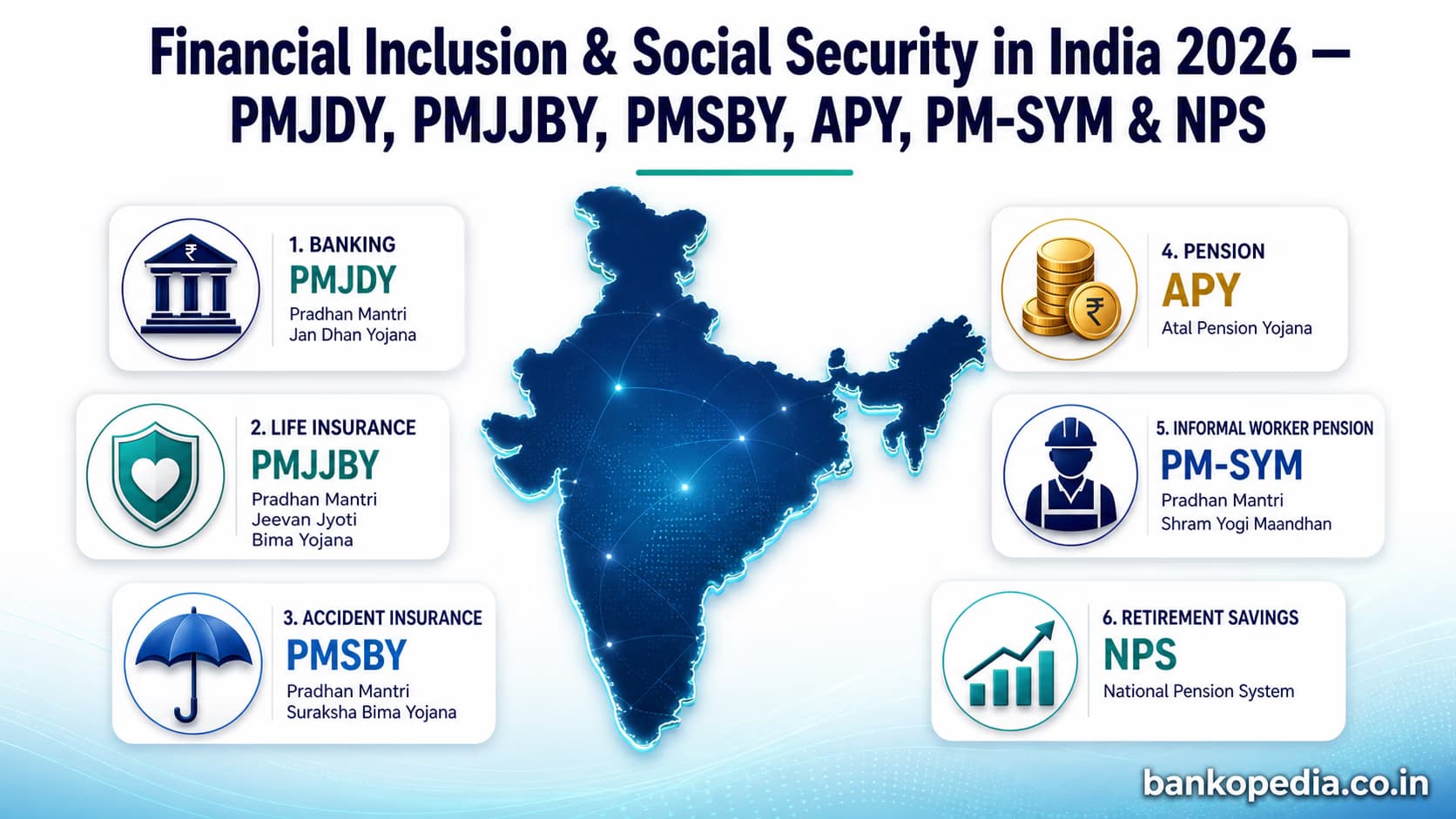
India's financial inclusion ecosystem is built around six flagship government schemes, each designed to address a specific gap:
PMJDY — universal access to basic banking services
PMJJBY — low-cost life insurance for the working population
PMSBY — accidental death and disability cover for all bank account holders
APY — guaranteed pension for informal and low-income workers
PM-SYM — contributory pension for unorganised sector workers
NPS — market-linked, long-term retirement savings for all citizens
This pillar guide on Bankopedia covers every one of these schemes comprehensively — their features, eligibility, benefits, enrollment process, recent updates for 2026, and how they interconnect. Whether you are a first-time bank account holder, a gig economy worker, a salaried professional, or a financial advisor, this guide gives you everything you need to make informed decisions about India's most important social security programs.
Read each section carefully, use the comparison table to identify which schemes apply to you, and follow the step-by-step enrollment guide to take action today.
Pradhan Mantri Jan Dhan Yojana (PMJDY): Banking for Every Indian
What Is PMJDY?
Launched on 28 August 2014 by Prime Minister Narendra Modi, the Pradhan Mantri Jan Dhan Yojana is the world's largest financial inclusion initiative. Its core goal is to ensure that every Indian household has access to a basic savings bank account, along with a suite of financial services including credit, insurance, and pension.
PMJDY is the foundation on which all other government schemes for financial inclusion and social security in India are built. Without a bank account, citizens cannot receive Direct Benefit Transfers (DBT), cannot enrol in PMJJBY or PMSBY, and cannot contribute to APY. PMJDY solves this foundational problem.
Key Features of PMJDY
Zero-balance savings account — no minimum balance requirement
RuPay Debit Card — free debit card with ₹1 lakh or ₹2 lakh accident insurance cover (separate from PMSBY)
Overdraft facility — up to ₹10,000 for eligible account holders (enhanced from ₹5,000 in 2018)
Life insurance cover — ₹30,000 life cover (only for accounts opened between 15 August 2014 and 31 January 2015)
Mobile banking — access via *99# USSD-based service, even on feature phones
Direct Benefit Transfer (DBT) — all government subsidies deposited directly into the account
Interest on deposits — same as savings accounts (typically 2.7%–4% p.a.)
Eligibility
Any Indian citizen aged 10 years and above
No prior bank account required
Simplified KYC norms — Aadhaar card is sufficient for most cases
Minors aged 10–18 can open accounts with simplified KYC
Documents Required
PMJDY in 2026: Current Status
As of 2025–26, the government has extended the PMJDY scheme indefinitely, recognising it as a permanent pillar of India's financial architecture. New features include integration with the Unified Payments Interface (UPI) and expansion of the overdraft facility to all eligible women account holders on a priority basis. The scheme is supervised by the Department of Financial Services, Ministry of Finance, with implementation through public sector banks, regional rural banks (RRBs), and cooperative banks.
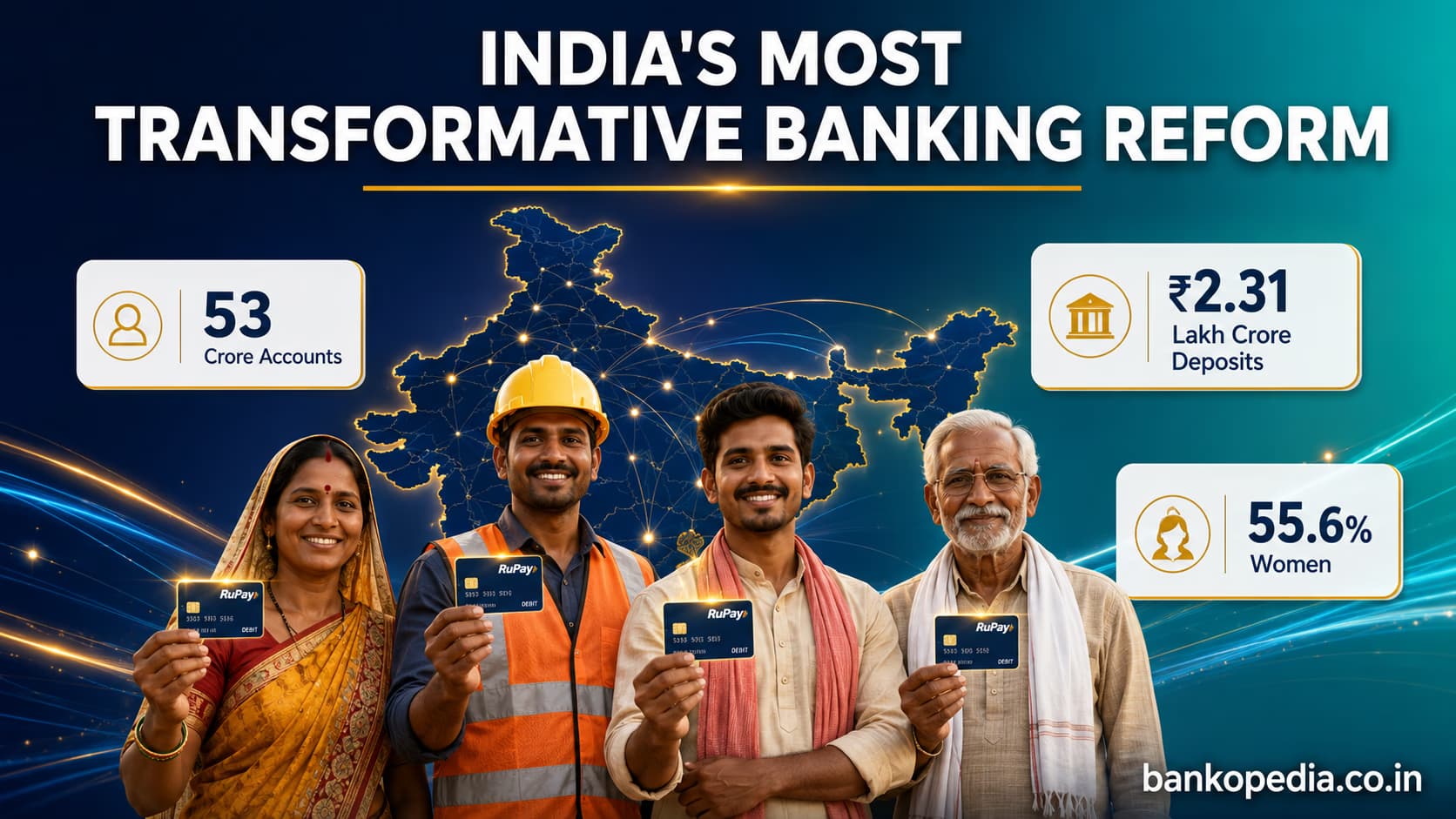
Key Stat: As of March 2026, 67% of PMJDY accounts are in rural and semi-urban areas, and 56% are held by women — demonstrating the scheme's reach into India's most underserved communities.
Pradhan Mantri Jeevan Jyoti Bima Yojana (PMJJBY): Affordable Life Insurance
What Is PMJJBY?
Launched in May 2015, the Pradhan Mantri Jeevan Jyoti Bima Yojana is a government-backed, renewable one-year term life insurance scheme. It provides life insurance coverage to individuals who may otherwise be completely uninsured — and at a premium so low that it removes the cost barrier entirely for most Indian families.
Key Features
Sum assured: ₹2 lakh on death (any cause)
Premium: ₹436 per year (revised from ₹330 in June 2022), auto-debited from bank account
Policy term: 1 June to 31 May (annually renewable)
Insurance type: Pure term life insurance — no maturity or survival benefit
Administered by: Life Insurance Corporation of India (LIC) and other private life insurers, regulated by IRDAI
Eligibility
Age: 18 to 50 years
Must have a savings bank account linked to Aadhaar
Must give consent for auto-debit of premium
Can continue till age 55 years if enrolled before age 50
Exclusions
Why PMJJBY Matters
India's life insurance penetration remains below 4% of GDP, compared to a global average of over 7%. For a family in which the primary earner dies unexpectedly, the ₹2 lakh payout can mean the difference between survival and destitution. At ₹436/year — less than ₹1.20 per day — there is virtually no comparable product in the private market. Over 20 crore people are currently enrolled, and the government has paid out thousands of crore rupees in claims since inception.
Pradhan Mantri Suraksha Bima Yojana (PMSBY): Accident Insurance at ₹20/Year
What Is PMSBY?
Also launched in May 2015 alongside PMJJBY, the Pradhan Mantri Suraksha Bima Yojana provides accidental death and disability insurance. It is one of the cheapest insurance products anywhere in the world — and arguably one of the most important for a country where road accidents alone claim over 1.5 lakh lives every year.
Key Features
Accidental death cover: ₹2 lakh
Permanent total disability cover: ₹2 lakh (e.g., loss of both eyes, both hands, or both feet)
Permanent partial disability cover: ₹1 lakh (e.g., loss of one eye and one limb)
Annual premium: ₹20 per year (revised from ₹12; auto-debited from bank account)
Policy period: 1 June to 31 May, annually renewable
Administered by: Public sector general insurance companies and other eligible insurers, regulated by IRDAI
Eligibility
Exclusions
PMSBY and PMJJBY: A Powerful Combination
Together, PMJJBY and PMSBY offer ₹4 lakh of combined life and accident coverage for just ₹456 per year. No private insurer can match this. Every Indian with a bank account between the ages of 18 and 50 should be enrolled in both schemes — this is one of the most straightforward and impactful financial decisions any individual can make.
Atal Pension Yojana (APY): Guaranteed Retirement Income for the Unorganised Sector
What Is APY?
The Atal Pension Yojana, launched in May 2015, is India's flagship guaranteed pension scheme for workers in the unorganised sector. Unlike NPS, which is market-linked, APY provides a guaranteed minimum pension after the age of 60. It is regulated and administered by the Pension Fund Regulatory and Development Authority (PFRDA).
Pension Amounts and Contributions
Subscribers can choose a guaranteed monthly pension of ₹1,000, ₹2,000, ₹3,000, ₹4,000, or ₹5,000 at age 60. The monthly contribution depends on the pension amount chosen and the age of entry. The earlier you join, the lower the monthly contribution.
Entry age: 18 to 40 years
Contribution period: Minimum 20 years
Monthly contribution range: ₹42 (entry at 18, ₹1,000 pension) to ₹1,454 (entry at 40, ₹5,000 pension)
Key Benefits
Guaranteed pension for life after age 60
On the subscriber's death, the spouse receives the same pension for life
On both deaths, the nominee receives the accumulated pension corpus
Contributions are eligible for tax deduction under Section 80CCD(1)
Government co-contribution of 50% of subscriber's contribution (up to ₹1,000/year) for eligible subscribers who joined between 1 June 2015 and 31 March 2016
Eligibility
Indian citizen aged 18 to 40 years
Must have a savings bank account linked with Aadhaar and mobile number
Must not be or have ever been an income tax payer (as of 1 October 2022 — taxpayers are no longer eligible for new enrolments)
Not covered under any statutory social security scheme
APY is particularly well-suited for domestic workers, daily wage labourers, farmers, self-employed individuals, and small traders who have no employer-sponsored retirement plan.
PM Shram Yogi Maan-Dhan (PM-SYM): Pension for India's Informal Workforce
What Is PM-SYM?
Launched in February 2019, the Pradhan Mantri Shram Yogi Maan-Dhan scheme is a voluntary and contributory pension scheme specifically for unorganised sector workers — the vast majority of India's working population. According to NSSO estimates, over 42 crore workers are employed in India's informal economy. PM-SYM is designed to provide them with a dignified retirement income.
Key Features
Guaranteed pension: ₹3,000 per month after age 60
Contributory model: Subscriber and Government of India contribute equally (50:50)
Entry age: 18 to 40 years
Monthly contribution: ₹55 to ₹200 depending on age of entry (government matches this)
Implemented by: Ministry of Labour and Employment, through LIC as the Fund Manager
Administered through: Common Service Centres (CSCs) across India
Eligibility
Age: 18 to 40 years
Monthly income: ₹15,000 or below at the time of entry
Must be an unorganised sector worker (construction worker, rickshaw puller, agricultural worker, home-based worker, street vendor, etc.)
Must not be a member of EPFO, ESIC, or NPS (government funded)
Must not be an income tax payer
Must have an Aadhaar number and a savings bank account/Jan Dhan account
Death and Disability Benefits
If the subscriber dies before age 60, the spouse can continue the scheme by paying 50% of the contribution
If the subscriber becomes permanently disabled before 60, the spouse may continue the scheme
On exit, the subscriber receives their contributions plus interest at savings bank rate
PM-SYM addresses one of the most critical and overlooked gaps in India's social security architecture. For the first time, a street vendor or construction labourer earning ₹12,000/month can retire with a guaranteed ₹3,000 monthly pension — for as little as ₹55/month in contributions.
National Pension System (NPS): India's Flagship Retirement Savings Scheme
What Is NPS?
The National Pension System (NPS) is India's most comprehensive, market-linked, long-term retirement savings scheme. Originally launched for Central Government employees in 2004 and extended to all Indian citizens in 2009, NPS is regulated by the Pension Fund Regulatory and Development Authority (PFRDA). It operates on a Defined Contribution (DC) model — meaning the final corpus depends on contributions made and market returns generated by professional Fund Managers.
Two Types of NPS Accounts
Tier I Account: Mandatory for government employees; primary retirement account with tax benefits; withdrawal restrictions apply until age 60
Tier II Account: Voluntary savings account; no withdrawal restrictions; available only if Tier I is active; no exclusive tax benefit (except for Central Government employees)
Asset Classes in NPS
Equity (E): Investments in equity and equity-related instruments; higher risk, higher return potential
Corporate Bonds (C): Investment in fixed income instruments of corporates; moderate risk
Government Securities (G): Central and state government securities; lowest risk
Alternative Investment Funds (A): REITs, InvITs, AIFs; limited exposure allowed
Tax Benefits Under NPS
Section 80CCD(1): Up to ₹1.5 lakh (within the overall 80C limit)
Section 80CCD(1B): Additional ₹50,000 deduction exclusively for NPS contributions — over and above 80C
Section 80CCD(2): Employer contribution to NPS — up to 10% of salary (14% for Central Govt employees) — fully deductible
Withdrawal Rules
At age 60: Minimum 40% of corpus must be used to purchase annuity; remaining 60% can be withdrawn as lump sum (tax-free)
Partial withdrawal: Allowed after 3 years for specific purposes (children's education, purchase of first home, medical treatment)
Premature exit: After 3 years, 80% must be annuitised and 20% withdrawn as lump sum
For more details on what happens when you pause or stop making contributions, see our dedicated article: What Happens If You Stop NPS Contributions?
NPS vs. Other Pension Schemes
NPS is the most flexible and potentially highest-returning pension option in India. It suits salaried professionals, self-employed individuals, and anyone with a long investment horizon. The combination of equity exposure, professional fund management, and unmatched tax benefits (up to ₹2 lakh/year in deductions) makes NPS especially valuable for those in higher income brackets.
Comparison Table: All Major Government Schemes at a Glance
Scheme | Launch Year | Type | Eligibility (Age) | Premium / Contribution | Key Benefit | Regulated By | Best For |
|---|
PMJDY | 2014 | Banking | 10+ years | Nil (Zero Balance) | Basic bank account, RuPay card, OD up to ₹10,000, DBT access | RBI / Ministry of Finance | Unbanked citizens |
PMJJBY | 2015 | Life Insurance | 18–50 years | ₹436/year (auto-debit) | ₹2 lakh life cover (any cause of death) | IRDAI / LIC | Working-age adults without life cover |
PMSBY | 2015 | Accident Insurance | 18–70 years | ₹20/year (auto-debit) | ₹2 lakh accidental death/disability cover | IRDAI / General Insurers | All bank account holders |
APY | 2015 | Pension | 18–40 years | ₹42–₹1,454/month | Guaranteed ₹1,000–₹5,000/month pension at 60 | PFRDA | Informal sector, non-taxpayers |
PM-SYM | 2019 | Pension | 18–40 years | ₹55–₹200/month (govt matches) | ₹3,000/month guaranteed pension at 60 | Min. of Labour / LIC | Unorganised workers earning ≤₹15,000/month |
NPS | 2004 / 2009 | Pension (Market-Linked) | 18–70 years | Min. ₹500/month (Tier I) | Market-linked corpus; tax benefit up to ₹2 lakh/year; 60% tax-free withdrawal at 60 | PFRDA | Salaried, self-employed, high earners |
How to Enrol: Step-by-Step Guide for Every Scheme
Step 1: Open a PMJDY Account (Foundation for All Schemes)
Visit your nearest public sector bank (SBI, PNB, Bank of Baroda, etc.), regional rural bank, or cooperative bank
Carry your Aadhaar card and one passport-size photograph
Fill in the PMJDY account opening form (available at branches and on bank websites)
Submit the form — the account is typically opened on the same day
Receive your RuPay debit card within 7–10 working days
Link your mobile number and Aadhaar to the account
Step 2: Enrol in PMJJBY and PMSBY
Visit your bank branch or log in to your bank's internet/mobile banking portal
Navigate to the insurance section and select PMJJBY and/or PMSBY
Give your written or digital consent for auto-debit of premium (₹436 for PMJJBY; ₹20 for PMSBY)
Nominate a beneficiary (name, relationship, date of birth)
Enrolment is confirmed immediately; policy certificate emailed/provided
Alternatively: Enrol through your bank's mobile banking app — most major banks now support digital enrolment in under 5 minutes.
Step 3: Open an APY Account
Visit your bank branch or use net banking / mobile banking
Fill in the APY registration form with Aadhaar details, nominee information, and desired pension amount (₹1,000–₹5,000)
Based on your age, the bank will calculate your monthly contribution
Set up a standing instruction for monthly auto-debit from your savings account
Your Permanent Retirement Account Number (PRAN) will be generated within a few days
Step 4: Register for PM-SYM
Visit your nearest Common Service Centre (CSC) — over 3.5 lakh CSCs are operational across India
Carry Aadhaar card and savings bank account/Jan Dhan passbook
The CSC Village Level Entrepreneur (VLE) will complete registration online on the PM-SYM portal (maandhan.in)
First contribution is paid at the CSC; subsequent contributions are auto-debited from bank account
You can also self-register at maandhan.in using your mobile number and Aadhaar
Step 5: Open an NPS Account
Online (eNPS):
Visit enps.nsdl.com or enps.karvy.com (KFintech)
Complete eKYC using Aadhaar OTP or PAN + bank details
Choose your pension fund manager (SBI Pension Funds, HDFC Pension, ICICI Pru Pension, Kotak Pension, etc.)
Select investment mix (Active Choice or Auto Choice)
Make first contribution online (minimum ₹500 for Tier I)
Receive your PRAN (Permanent Retirement Account Number) via email/SMS within 2 working days
Offline: Visit any Point of Presence (PoP) — including most banks and post offices — with KYC documents.
Pro Tip: If you are a salaried individual, ask your HR department to set up NPS contributions through payroll. Employer NPS contributions under Section 80CCD(2) offer tax savings above and beyond the standard 80C limit — a benefit not available with any other investment instrument.
Recent Updates & Future Outlook 2026
PMJDY Expansion
The overdraft facility has been enhanced and extended to all eligible account holders, with a special focus on women entrepreneurs
Integration with UPI and the Bharat Bill Payment System (BBPS) has made PMJDY accounts more functional for daily transactions
Digital literacy programmes under the DIGIDHAN Mission are running in parallel to increase active usage of PMJDY accounts
PMJJBY and PMSBY Claim Settlement Improvements
IRDAI has mandated 30-day claim settlement timelines for both schemes
Digital claim filing is now available through most bank mobile apps, reducing processing time significantly
A dedicated grievance redressal portal has been launched by IRDAI for insurance scheme complaints
APY — Subscriber Base Expansion
PFRDA's target is to reach 10 crore APY subscribers by 2027
Banks have been directed to proactively offer APY to all new savings account holders aged 18–40
The exclusion of income taxpayers (effective October 2022) has been maintained to ensure the scheme targets the intended beneficiaries
NPS 2.0 — Upcoming Reforms
The government is evaluating a minimum guaranteed return option within NPS — a hybrid between APY-style guarantees and market-linked NPS returns
PFRDA is working on streamlining exit and annuity options, including a systematic lump sum withdrawal (SLW) option post-60
The Union Budget 2024–25 increased the employer NPS contribution deduction limit under 80CCD(2) from 10% to 14% of salary for private sector employees under the new tax regime, aligning it with government employee benefits
Digital onboarding for NPS via DigiLocker and face authentication (without physical visit to PoP) is being rolled out nationally
PM-SYM — Renewed Push in 2026
State governments have been urged to undertake targeted outreach campaigns through gram panchayats and urban local bodies
The scheme's digital interface at maandhan.in has been revamped for mobile-first access
Integration with the e-Shram portal — which already has over 30 crore registered informal workers — is expected to significantly accelerate PM-SYM enrolments
The Big Picture: India's Social Security Vision for 2030
The Indian government's stated goal is to ensure universal social security coverage for all citizens by 2030. This involves not just coverage on paper but active usage of banking services, regular premium payments, and growing pension corpora. The convergence of PMJDY (banking), PMJJBY/PMSBY (insurance), and APY/PM-SYM/NPS (pension) creates a comprehensive three-pillar social security framework — modelled in part on best practices from countries like South Korea, Brazil, and Mexico.
NABARD continues to play a key role in extending financial inclusion to agricultural households through Self-Help Groups (SHGs) and Kisan Credit Cards, complementing these six core schemes.
Conclusion & Actionable Advice
Government schemes for financial inclusion and social security in India represent one of the most ambitious and impactful policy initiatives in the country's history. From opening the first bank account to building a retirement corpus over decades, these six schemes — PMJDY, PMJJBY, PMSBY, APY, PM-SYM, and NPS — together form a complete financial safety net for every Indian citizen, regardless of income level or employment status.
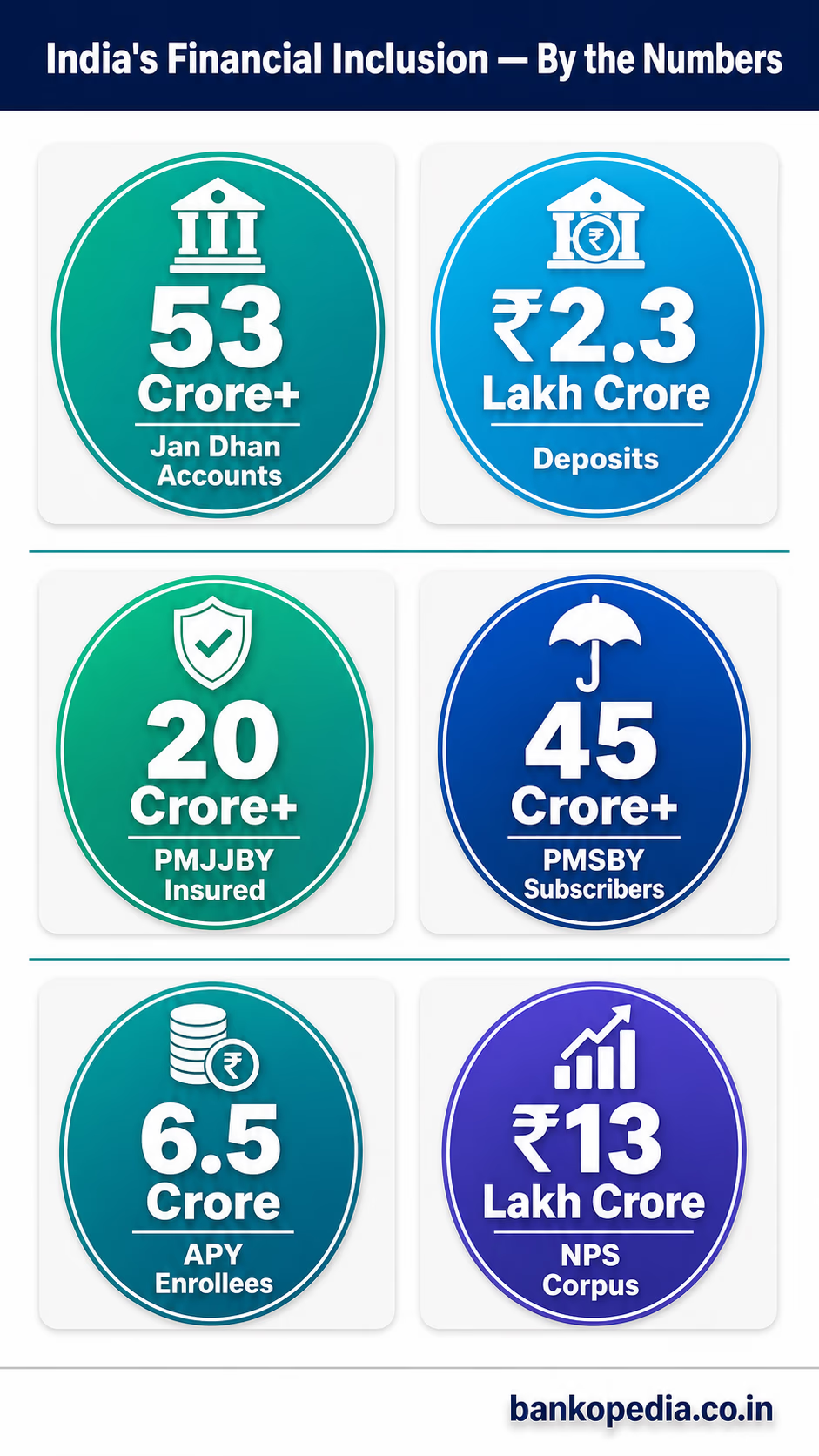
The scale is staggering. Over 53 crore Jan Dhan accounts. Over 45 crore PMSBY subscribers. A growing NPS corpus of ₹13 lakh crore+. Yet despite the reach, millions of eligible citizens remain unenrolled — often simply due to lack of awareness or inaction.
Here is your action plan:
If you don't have a bank account: Open a PMJDY account today — it costs nothing and unlocks everything else
If you have a bank account but no insurance: Enrol in PMJJBY and PMSBY immediately — ₹456/year buys you ₹4 lakh of combined life and accident cover
If you are an informal worker aged 18–40: Choose between APY (for guaranteed pension up to ₹5,000/month) and PM-SYM (if you earn under ₹15,000/month and want ₹3,000/month guaranteed)
If you are a salaried or self-employed professional: Open an NPS account, maximize the ₹50,000 deduction under 80CCD(1B), and ask your employer about 80CCD(2) contributions
If you are already enrolled in NPS: Make sure you understand what happens if you stop contributing — read our detailed guide: [What Happens If You Stop NPS Contributions?]
Financial security is not a luxury — it is a right that every Indian citizen deserves. The government has built the infrastructure. All you need to do is use it.
→ Start today. Visit your nearest bank branch or log in to your mobile banking app and take the first step toward a financially secure future.
Frequently Asked Questions (FAQs)
Can I be enrolled in multiple schemes simultaneously? Yes. In fact, it is strongly recommended. PMJDY (bank account) is the foundation. You can simultaneously enrol in PMJJBY, PMSBY, and either APY or NPS. If you are an unorganised worker earning under ₹15,000/month, you can enrol in PM-SYM as well. These schemes are designed to complement each other, not compete.
What is the difference between APY and PM-SYM? Both offer guaranteed pensions. APY offers ₹1,000–₹5,000/month based on your choice and contribution, while PM-SYM offers a fixed ₹3,000/month. PM-SYM is specifically for unorganised workers earning ≤₹15,000/month, while APY has no income cap (though those who are or have been taxpayers are ineligible since 1 October 2022). APY is administered by PFRDA; PM-SYM by the Ministry of Labour through LIC.
What happens if I miss a PMJJBY or PMSBY premium payment? If your bank account does not have sufficient balance for the auto-debit, the policy lapses for that year. You can reinstate it in subsequent years by paying the due premium, subject to good health declaration and other conditions. It is strongly advised to maintain adequate balance in your account on the auto-debit date (typically 25 May–31 May each year).
Is NPS better than EPF for retirement? Both have merit. EPF offers guaranteed returns (currently 8.25% p.a.) and employer contribution of 12% of basic salary — with no market risk. NPS is market-linked with higher potential long-term returns, greater investment flexibility, and superior tax benefits (especially the additional ₹50,000 under 80CCD(1B)). For most salaried employees, using both EPF and NPS is the optimal strategy.
Can NRIs (Non-Resident Indians) enrol in these schemes? NRIs can open an NPS account (Tier I) as long as they hold Indian citizenship. However, PMJDY, PMJJBY, PMSBY, APY, and PM-SYM are primarily targeted at resident Indian citizens with domestic bank accounts. NRIs should check with their specific bank and the relevant regulatory authority for current eligibility norms.
What happens to my APY account if I die before age 60? In case of the subscriber's death, the spouse can continue APY contributions and receive the full pension benefit at age 60. If the spouse also dies, the entire accumulated pension corpus is returned to the nominee. This makes APY a family-friendly pension product.
Is the ₹2 lakh life cover under PMJDY separate from PMJJBY? Yes. The ₹30,000 life cover available to PMJDY account holders (from LIC) and the ₹2 lakh RuPay accident cover are separate from PMJJBY (₹2 lakh life cover) and PMSBY (₹2 lakh accident cover). However, PMJDY account holders should still enrol in PMJJBY and PMSBY for full coverage, as the default PMJDY cover may not be active for all accounts or may have limited applicability.
What is the tax treatment of pension received under APY or PM-SYM? Pension received under APY and PM-SYM is taxable as income in the hands of the recipient, similar to any other pension income. However, given that the target beneficiaries are typically low-income workers, the pension amounts (₹1,000–₹5,000/month) generally fall well within the basic exemption limit of ₹2.5 lakh–₹3 lakh/year under the old or new tax regime respectively.
What happens if I stop contributing to NPS before age 60? Stopping NPS contributions has specific implications for your account status, minimum balance requirements, and withdrawal options. This is a nuanced topic that depends on how long you have been contributing and the type of account you hold. For a complete explanation, read our detailed guide: [What Happens If You Stop NPS Contributions?]
Where can I file a complaint if my PMJJBY or PMSBY claim is rejected? First, approach your bank's grievance redressal officer. If unresolved within 30 days, escalate to the respective insurance company's regional office. If still unresolved, file a complaint with IRDAI's online complaint portal (igms.irda.gov.in) or contact the Insurance Ombudsman for your region. You may also approach the Banking Ombudsman under RBI if the bank is at fault in claim processing.
This article is published by Bankopedia (bankopedia.co.in) — India's trusted source for banking, finance, and government scheme information. All data referenced is as of 2025–26. Please verify current scheme details with the relevant government ministry, bank, or regulatory authority before making financial decisions.