F&O Trading in India: A Complete Guide for Beginners on Futures and Options
India's derivatives market has grown into one of the largest in the world by contract volume, yet a significant portion of retail participants who enter the arena of futures and options trading in India do so without fully understanding the instruments they are trading. The National Stock Exchange (NSE) regularly ranks among the top global exchanges for equity derivatives turnover, a testament to how deeply F&O has penetrated the Indian retail investment psyche. However, with that growth comes sobering data: SEBI's September 2024 study revealed that more than 93% of individual F&O traders in India — over 9 out of 10 — incurred net losses between FY22 and FY24, with aggregate losses exceeding ₹1.8 lakh crores. Against the backdrop of BSE aggressively expanding its derivatives franchise and new-age brokers receiving venture capital backing to offer investor guidance, the need for foundational literacy in F&O has never been more urgent. This article is designed to bridge that gap — explaining the mechanics, the regulatory framework, and the risk management principles that every beginner must internalise before placing a single derivatives trade.
What Are Futures and Options? Key Differences Explained for Futures and Options Trading India Beginners
At their core, both futures and options are derivative contracts — financial instruments whose value is derived from an underlying asset. That underlying asset could be an equity share, a stock index (such as Nifty 50 or Sensex), a commodity, or even a currency pair. Understanding the structural difference between the two contract types is the foundation of any serious engagement with F&O markets.
Futures Contracts
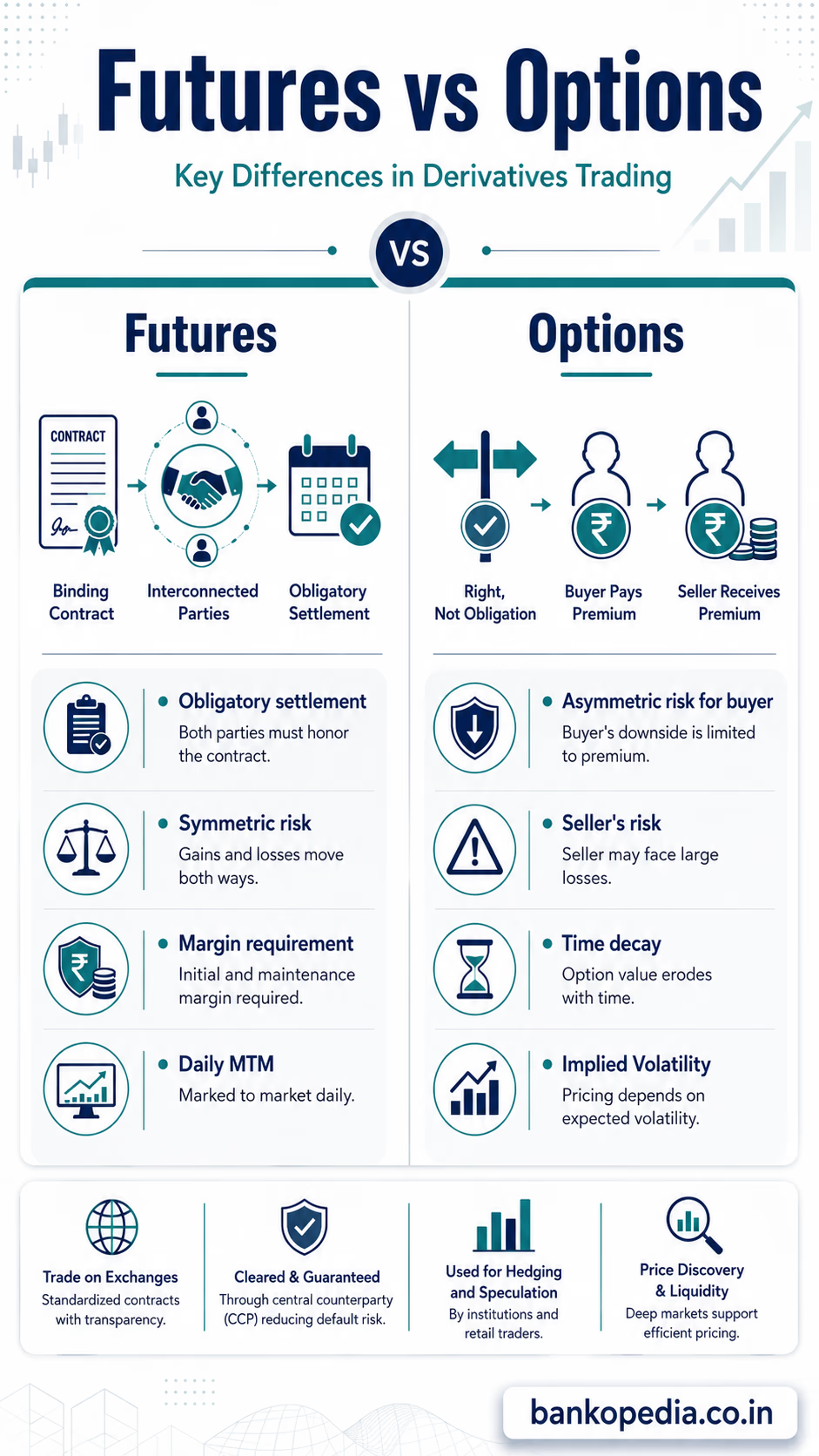
A futures contract is a legally binding agreement between two parties to buy or sell a specified quantity of an underlying asset at a predetermined price on a future date. Both the buyer and the seller are obligated to honour the contract at expiry. For example, if you buy one lot of Nifty Futures at 24,000 with a lot size of 65 units, you are committing to "purchase" the index equivalent at that level on the expiry date. Profits or losses are marked-to-market (MTM) on a daily basis, meaning gains and losses are credited or debited from your account every trading session.
Futures vs. Options: A Snapshot Comparison
"Options give you the right without the obligation; futures give you both the right and the obligation. That single distinction shapes every risk and reward calculation a trader must make."
While futures are straightforward in their linearity, options trading involves multiple "Greeks" — Delta, Gamma, Theta, Vega, and Rho — that influence the price of an option beyond just the movement of the underlying asset. Beginners often underestimate this complexity, treating options like lottery tickets rather than structured probability instruments.
How F&O Contracts Are Traded on NSE and BSE
In India, the two primary exchanges for equity derivatives are the National Stock Exchange (NSE) and the Bombay Stock Exchange (BSE). NSE has historically dominated equity F&O with its flagship Nifty 50 and Bank Nifty contracts, while BSE has been aggressively expanding its derivatives product suite with Sensex and Bankex contracts. Recent market developments indicate that BSE's derivatives volumes have surged dramatically — with the exchange reportedly multiplying its market capitalisation roughly 40 times over five years, partly driven by this F&O expansion. However, SEBI's evolving regulatory stance on weekly options expiries and contract rationalisation could reshape the competitive dynamics between the two exchanges.
The Trading Mechanism
F&O contracts are traded on a T+1 margin settlement basis through SEBI-registered stockbrokers. Here is how the typical workflow unfolds:
Account activation: Traders must have a demat and trading account with F&O segment enabled. Brokers are required by SEBI to conduct a suitability assessment for F&O activation.
Contract selection: Traders choose the underlying (e.g., Reliance Industries), contract type (futures or options), expiry month (near-month, mid-month, or far-month), and strike price (for options).
Margin deposit: Before placing a trade, adequate margin must be available in the trading account. SEBI mandates that margins be collected upfront by brokers — a rule tightened considerably since 2020.
Order placement: Orders are placed through broker terminals or mobile apps and routed to NSE or BSE for matching via the exchange's order-matching engine.
Daily MTM settlement: The clearing corporation (NSE Clearing Limited or BSE Clearing Corporation) computes MTM gains/losses at end of day and adjusts trader accounts.
Expiry or square-off: Traders either exit before expiry by taking the opposite position or allow the contract to expire, resulting in cash settlement for most index contracts.
Contract Specifications: What You Must Know
Every F&O contract has standardised specifications mandated by the exchange and regulated by SEBI. These include the lot size (minimum trading unit), tick size (minimum price movement), expiry calendar, and settlement method. For instance, Nifty 50 futures have a lot size of 65 units (effective January 1, 2026, revised downward from 75 to reflect index growth), which means at a Nifty level of 24,000, a single lot represents a notional contract value of ₹15,60,000 — a figure that starkly illustrates the leverage embedded in derivatives. The required margin, however, may only be around ₹1.5–2 lakh, creating a leverage ratio of nearly 8–10 times.
SEBI's Regulations to Protect Retail Investors in F&O
The Securities and Exchange Board of India (SEBI) has been increasingly proactive in regulating F&O markets, driven by the alarming loss data from retail participants. Several landmark regulatory interventions have reshaped how derivatives are traded in India.
The October 2024 Circular: Rationalising Weekly Options
In one of its most significant interventions, SEBI issued a circular in late 2024 mandating that each exchange offer weekly options expiry on only one benchmark index. This effectively reduced the proliferation of multiple weekly expiries across Nifty, Bank Nifty, Finnifty, Midcap Nifty, and Sensex — contracts that had collectively turned Indian options markets into near-daily speculative arenas. SEBI's concern was explicit: the abundance of short-duration contracts was encouraging hyper-speculation among retail traders who were consistently losing money to institutional and algorithmic players exploiting time decay.
Upfront Margin Collection and Peak Margin Rules
Before 2020, many brokers allowed intraday leverage on F&O positions that far exceeded what the exchanges mandated. SEBI's phased implementation of peak margin norms put an end to this practice, requiring brokers to collect the full exchange-stipulated margin upfront, even for intraday trades. This was a structural shift that reduced systemic risk but also reduced speculative capacity for undercapitalised retail traders.
Mandatory Risk Disclosure and Suitability
SEBI mandates that brokers display a prominent risk disclosure — informing prospective F&O traders that the majority of retail participants lose money — before activating the derivatives segment on any trading account. Additionally, brokers are required to assess whether F&O trading is suitable for a client based on income, trading experience, and risk appetite. With venture capital flowing into new-age brokers who are building investor guidance platforms, the quality of pre-trade education is expected to improve, though the regulatory mandate remains the baseline.
Position Limits and Insider Trading Safeguards
SEBI imposes strict position limits at client, proprietary, and market-wide levels to prevent any single entity from cornering a derivatives market. For instance, a single client's combined futures and options position in a stock cannot exceed the lower of 1% of the free-float market capitalisation or ₹500 crore. These limits are monitored in real time by the exchanges. Furthermore, SEBI's Prohibition of Insider Trading (PIT) Regulations extend to derivatives — trading options or futures of a company while in possession of unpublished price-sensitive information (UPSI) constitutes a serious offence with criminal penalties.
Increased Contract Size Requirements
SEBI has also revised the minimum contract size for new derivative contracts upward to ₹15 lakh (from the earlier ₹5 lakh), specifically as a deterrent to casual retail speculation. The underlying philosophy is that F&O should remain primarily a hedging tool for sophisticated investors and institutions, not a mass-market gambling instrument.
Risk Management: Margin Calls, Stop-Losses, and Position Sizing
Even experienced traders acknowledge that risk management — not market prediction — is what separates sustainable traders from those who blow up their accounts. For anyone serious about futures and options trading in India, the following principles are non-negotiable.
Understanding Margin Calls
A margin call occurs when the mark-to-market losses on your open F&O positions erode your account balance below the maintenance margin threshold. When this happens, your broker will issue a margin call — a demand to deposit additional funds immediately to restore the required margin level. Failure to do so results in the broker squaring off your positions, often at the worst possible time and price. In volatile market conditions, margin calls can arrive with frightening speed. For example, during an unexpected rate-sensitive announcement or a corporate earnings shock — both increasingly relevant given that all eyes are currently on the timing of a potential RBI rate action — a single day's adverse move can trigger cascading margin calls for leveraged traders.
Best practices to avoid margin calls:
Never deploy more than 50–60% of your trading capital as active margin; keep a buffer.
Monitor MTM daily, not just at expiry.
Understand the span margin and exposure margin components that together constitute the total required margin.
Stop-Loss Orders: Discipline Over Conviction
A stop-loss is a pre-set order to exit a position if the price moves adversely beyond a defined threshold. In F&O, where leverage amplifies both gains and losses, trading without a stop-loss is not a strategy — it is a path to ruin. Yet many retail traders abandon stop-losses because they believe the market will "come back." This psychological trap is especially dangerous in options selling, where a sudden spike in volatility can deliver losses that dwarf the premium collected.
Practical stop-loss guidelines for F&O:
Futures: Define your maximum acceptable loss in rupee terms before entry and set a stop-loss accordingly at the order level.
Options buying: A common rule is to exit if the option loses 40–50% of the entry premium.
Options selling: Use a stop-loss of 2–3x the premium collected; if you sold a call at ₹50, exit if it reaches ₹100–150.
Position Sizing: The Most Underrated Skill
Position sizing determines how many lots you trade relative to your total capital. Even the best trading strategy will fail if position sizes are recklessly large. A commonly used framework is the 1–2% rule: risk no more than 1–2% of your total trading capital on any single trade.
Consider this example: If your total F&O capital is ₹5,00,000, your maximum loss per trade should not exceed ₹5,000–₹10,000. This means you select lot sizes and strike distances that keep potential losses within this boundary. Traders who violate this principle — often driven by overconfidence after a string of profitable trades — invariably face a single catastrophic loss that negates months of gains. With India Inc. posting a 25% profit surge in Q4 FY26 yet seeing margin pressures building, even apparently "safe" directional bets on earnings can unravel violently.
Hedging: Using F&O as Intended
It is worth reemphasising that derivatives were originally designed as hedging instruments. A mutual fund holding a large equity portfolio can buy Nifty Put options to protect against a market downturn. An importer expecting to pay in US dollars can hedge currency risk via USD/INR futures on NSE. Using F&O for such purposes — reducing portfolio risk rather than amplifying speculative bets — aligns with their economic rationale and significantly changes the risk profile of participation.
Conclusion: Should Retail Investors Trade F&O?
The honest answer is that most retail investors should not actively speculate in F&O without a structured education, a tested trading plan, and strict risk management protocols. SEBI's regulatory tightening — from reducing weekly expiries to mandating upfront margins and enlarging minimum contract sizes — reflects a regulatory consensus that F&O is not suitable for casual market participants. The data is unambiguous on this point: SEBI's September 2024 report confirmed that 93% of individual F&O traders lost money between FY22 and FY24, with collective losses exceeding ₹1.8 lakh crores.
That said, derivatives are not inherently evil instruments. Used correctly, they are powerful tools for hedging, income generation through covered strategies, and expressing nuanced market views that plain equity investing cannot accommodate. The problem is not the instrument — it is the lack of preparation among those who wield it.
If you are a beginner drawn to futures and options trading in India, start with paper trading (simulated trading without real money) to understand how contracts move. Study the Greeks before buying a single option. Read SEBI circulars and NSE's educational resources. Build your knowledge before your position. The Indian derivatives market is not going anywhere — but your capital, if mismanaged, certainly can.
Bankopedia recommends that readers consult a SEBI-registered investment adviser before initiating F&O positions. This article is for educational purposes only and does not constitute investment advice.