Table of Contents
For millions of small business owners in India, the single biggest barrier to growth has never been ambition — it has been access to timely, affordable credit. Traditional lenders relied on collateral, ITRs, and audited balance sheets: tools that routinely failed the informal or semi-formal MSME. A kirana owner with ₹80 lakh in annual sales, regular supplier payments, and a loyal customer base could still be turned away by a bank simply because she had no audited financials. That asymmetry — rich real-world business activity on one side, thin formal documentation on the other — has defined MSME credit exclusion for decades.
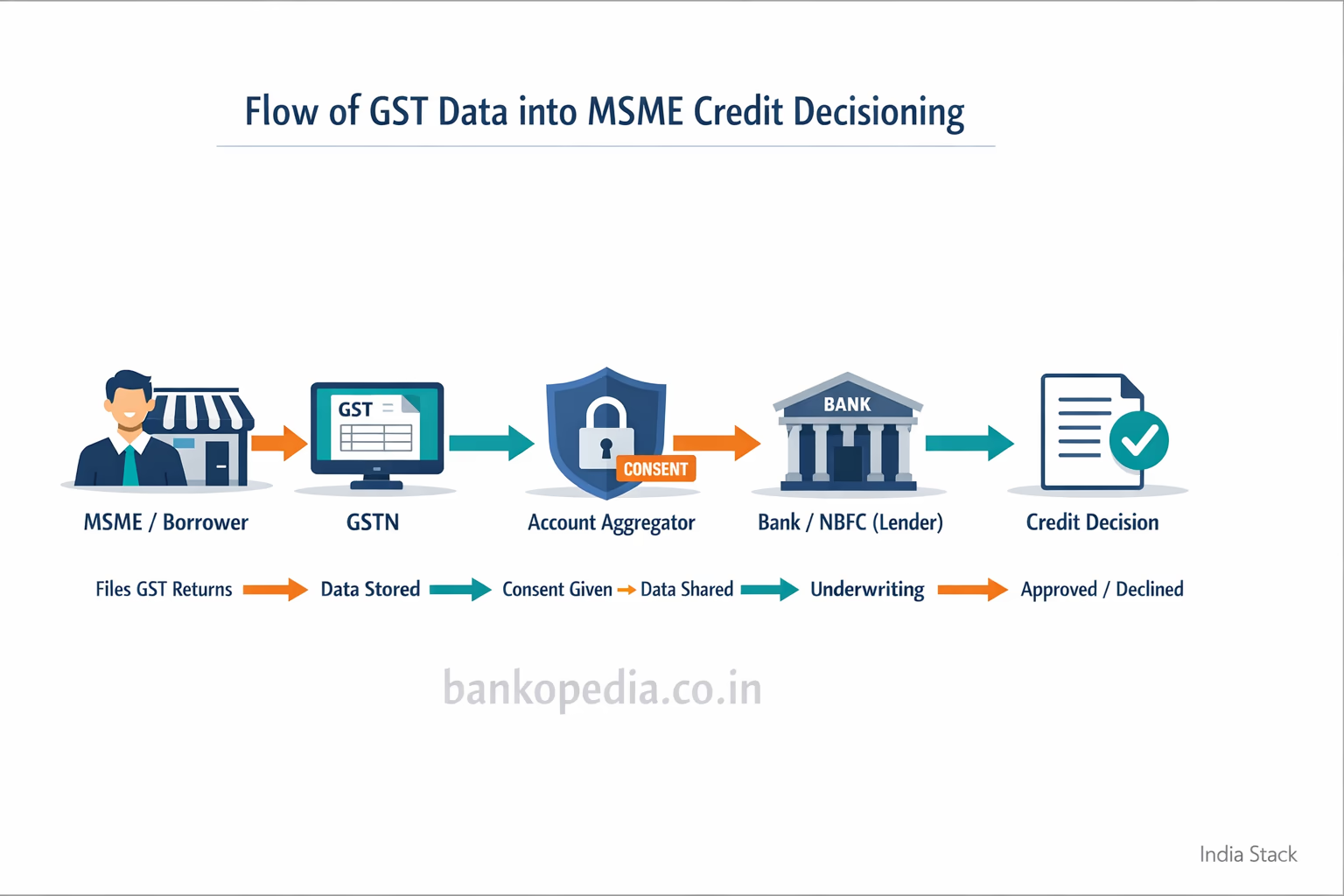
That changed when the Goods and Services Tax arrived in July 2017. By mandating periodic digital filings from every registered supplier in the country, GST inadvertently created the most granular, real-time financial dataset ever assembled for Indian businesses. Every sale, every purchase, every input tax credit claim, and every month of filing regularity now lives in a government database — structured, timestamped, and increasingly accessible to lenders. Today, this data sits at the centre of a quiet revolution in how banks and NBFCs evaluate GST data in MSME lending and make GST-based credit decisioning work at scale.
What Is GST Data — and Why Does It Matter for Credit?
Before exploring how lenders use it, it is important to understand what GST data actually contains and why it carries more evidential weight than most traditional credit documents.
The Key GST Returns
GSTR-1 is the outward supply statement filed monthly (or quarterly under QRMP) by every regular GST taxpayer. Every registered business must declare its sales invoices here, broken down by B2B transactions (with counterparty GSTINs), B2C sales, export invoices, advance receipts, and credit or debit notes. For a lender, GSTR-1 is essentially a verified, government-hosted sales ledger that is far harder to fabricate than a self-certified income statement.
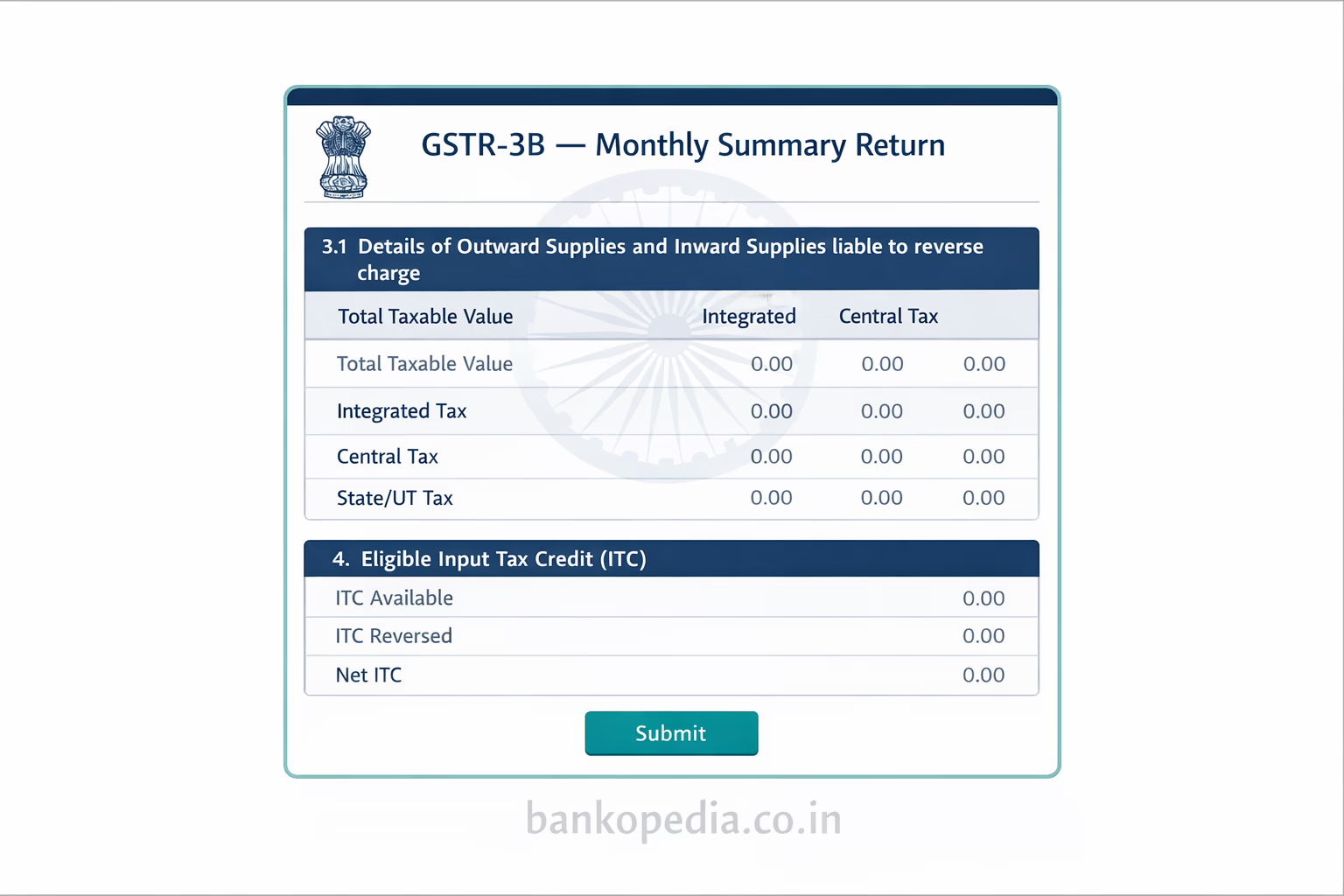
GSTR-3B is the monthly summary return through which a taxpayer self-declares total outward and inward supplies and remits tax after adjusting input tax credit (ITC). It captures the net GST liability paid into the exchequer each month. Crucially, GSTR-3B reconciles with GSTR-1: persistent gaps between the two returns — where a business declares high sales in GSTR-1 but low output tax in GSTR-3B — flag potential discrepancies that lenders (and the tax authority) treat as red flags.
GSTR-9 is the annual return that consolidates the full year’s outward and inward supply data. For lenders assessing multi-year lending proposals or term loans, GSTR-9 provides a single-file summary of annual performance that can be cross-checked against monthly GSTR-1 and GSTR-3B filings.
e-Invoicing (mandatory for businesses above prescribed turnover thresholds, progressively expanded since 2020) goes a step further — every B2B invoice is assigned an Invoice Reference Number (IRN) by the GST Network in real time, making the data tamper-evident and instantly verifiable. An IRN-stamped invoice cannot be backdated or fabricated after the fact.
The Composition Scheme — A Lending Blind Spot
Businesses with turnover below the prescribed threshold can opt for the Composition Scheme, which replaces regular returns with a simplified quarterly statement (CMP-08) and an annual return (GSTR-4). While this reduces compliance burden for small traders, it also gives lenders significantly less granular data — no buyer-wise breakdowns, no ITC details, and quarterly rather than monthly frequency. This creates a structural data gap for lenders trying to underwrite composition taxpayers using GST alone, and means those businesses may need to supplement their GST record with additional documentation.
The GSTN: India’s Central Data Repository
All these returns flow into the Goods and Services Tax Network (GSTN), a not-for-profit entity that serves as the IT backbone of India’s GST system. The GSTN stores registration details, filing histories, turnover data, and compliance records for every registered taxpayer — a database of extraordinary depth, regularity, and national coverage (GSTN, n.d.). The GSTIN itself — the 15-digit unique identification number assigned at registration — anchors a business’s entire GST identity and enables lenders to verify legal entity details, jurisdiction, and registration status before pulling a single return.
How Lenders Access GST Data: The Account Aggregator Framework
Access to GST data for lending purposes is governed by a consent-based architecture established by the Reserve Bank of India. This is not a free-for-all; data flows only with the explicit, auditable, and revocable consent of the borrower.
The Account Aggregator (AA) System
The Account Aggregator framework is a regulated data-sharing infrastructure that connects Financial Information Providers (FIPs) — entities that hold financial data — with Financial Information Users (FIUs), such as banks and NBFCs seeking that data for credit assessment. A licensed AA acts as a secure, encrypted conduit between the two. Critically, the AA is a consent manager, not a data custodian: it routes data but never stores, analyses, or commercialises it independently.
In November 2022, the RBI formally notified GSTN as a Financial Information Provider under the AA framework (Reserve Bank of India, 2022). This was a landmark policy moment. It meant a business owner could consent to share their GSTN-held filing data — GSTR-1, GSTR-3B, and registration details — directly with a lender through an AA, without paper printouts, CA certifications, notarised copies, or manual portal downloads. The friction that once made GST-based underwriting operationally impractical at scale was removed at a stroke.
The Consent Journey — Step by Step
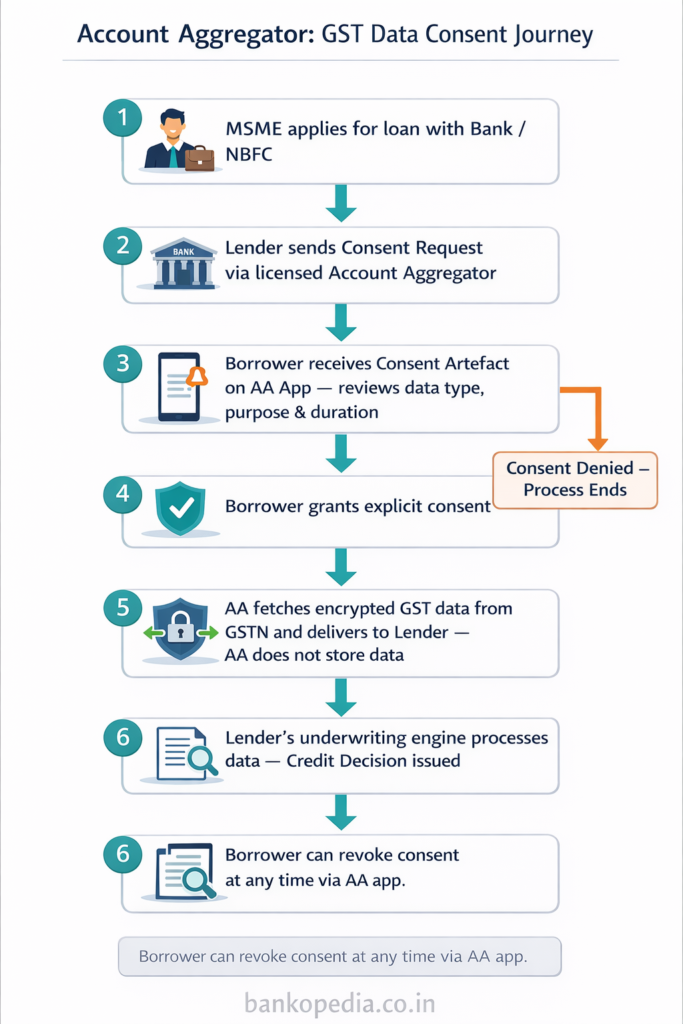
- The MSME applies for a loan with a participating lender (an FIU registered under the AA framework).
- The lender sends a consent request through a licensed AA, specifying exactly which data types, which time periods, and for what purpose the data will be used.
- The borrower receives a notification on their AA-linked mobile app and reviews the consent artefact — what data, with whom, for how long.
- On explicit approval, the AA fetches the consented data from GSTN and delivers it — end-to-end encrypted — to the lender.
- The lender’s underwriting system processes the data; the borrower can view, pause, or revoke consent at any time through the same AA interface.
This end-to-end flow is designed to be both frictionless for lenders and empowering for borrowers. The AA never stores the data; it merely routes it under consent (GSTN, n.d.; Reserve Bank of India, 2022).
Standardising the Data: The Sahamati/ReBIT Schema
The ReBIT (Reserve Bank Information Technology Pvt. Ltd.) and Sahamati, the industry alliance supporting the AA ecosystem, published a standardised GST data schema in June 2023 to ensure consistent, machine-readable data delivery across lenders and AAs (Sahamati, 2023). This schema precisely defines how GSTR-1 line items, GSTR-3B summary fields, and GSTIN registration metadata are structured when transmitted — removing the inconsistency that plagued manual GST document collection and enabling lenders to build automated underwriting engines that process AA-sourced data without human intervention.
GSTIN Verification as a First Gate
Before any return data is even pulled, lenders perform GSTIN verification — confirming that the GSTIN supplied by the borrower corresponds to the correct legal entity, is currently active (not suspended or cancelled), and matches the PAN and address on file. This basic verification step, now automatable via the AA or GSTN API, filters out identity fraud and ensures the dataset being analysed genuinely belongs to the applicant business.
Role of GST Data in Credit Decisioning
With consent-based data access established, how do lenders actually translate raw GST filings into a credit decision?
[Insert Image: Dashboard showing GST turnover & compliance metrics — alt text: “Fintech credit scoring dashboard displaying GST turnover trends and compliance score for MSME loan underwriting”]
1. Turnover Analysis and Revenue Triangulation
The most immediate use is revenue verification. A lender compares the turnover declared across GSTR-1, GSTR-3B, the business’s bank statements, and — where available — the ITR. Consistent figures across multiple independent sources strongly corroborate the borrower’s claimed income. Significant and unexplained divergences trigger deeper scrutiny or outright decline.
Unlike self-reported financials, GST-based turnover data carries a unique evidential credibility: it was filed with a government authority under legal obligation, in a regular and structured format, and — where e-invoicing applies — validated at source by GSTN before the invoice was even sent to the buyer. A forged CA-certified balance sheet is not detectable from a PDF; a forged GSTR-1 is detectable the moment it is cross-referenced against the counterparty’s GSTR-2A.
2. Cash-Flow Pattern Recognition and Loan Structuring
Month-on-month GSTR-3B data reveals seasonality, growth trajectory, and cash-flow stability — vital inputs for structuring loan amounts, tenors, and EMI schedules. A textile exporter with strong Q3 filings but near-zero Q1 activity presents a very different risk profile from a food-processing firm with steady year-round volumes, even if their annual turnover is identical. GST data enables lenders to design bullet repayments or step-up EMI structures that match real cash-flow cycles rather than imposing uniform monthly obligations that strain businesses during lean quarters.
Lenders also track the growth rate of GST-declared turnover across 12 to 24 months. A business showing consistent year-on-year growth is typically rated more favourably than one with erratic or declining filings, even at a higher absolute turnover level.
3. GST Compliance Scoring
Filing regularity is itself a powerful proxy for financial discipline and business health. Lenders assess a multi-dimensional compliance score that typically includes:
- Filing frequency and timeliness: Does the business file on time every month, or are there repeated late filings, nil filings, or gaps?
- ITC-to-output ratio: Unusually high input tax credit claims relative to output tax can signal inflated purchase invoices — a common form of GST fraud that also inflates the apparent scale of operations.
- GSTR-1 vs. GSTR-3B reconciliation: Material differences between declared outward supplies in GSTR-1 and the summary figures in GSTR-3B indicate either filing errors or deliberate underreporting of tax liability.
- Tax payment history: Whether the business consistently settles its GST liability in cash or perpetually relies on ITC drawdowns speaks to underlying liquidity health.
- Supplier ecosystem health: In B2B lending, the compliance profile of key customers and suppliers — verifiable via their GSTINs appearing in the borrower’s GSTR-1 — can affect the borrower’s own risk score. A borrower dependent on suppliers who file irregularly faces supply-chain disruption and ITC reversal risk.
4. Fraud Detection and Anomaly Flagging
GST data is a powerful fraud-detection instrument when combined with network analysis. Lenders and their analytics systems look for several specific patterns:
- Round-tripping and circular invoicing: Networks where the same set of GSTINs appear repeatedly across supplier and buyer roles without genuine economic substance — often structured to inflate apparent turnover for lending purposes.
- Sudden turnover spikes: A business that files minimal or nil activity for 18 months and suddenly reports large turnover in the three months before a loan application warrants close scrutiny of the underlying invoices and counterparties.
- Mismatched GSTIN registrations: Verifying that the GSTIN on all submitted documents matches the registered legal entity name, address, and PAN prevents basic identity fraud.
- Inactive or recently revived GSTINs: A GSTIN that was suspended or cancelled and recently reinstated may indicate past compliance failure — a signal lenders factor into risk scoring alongside the nature of the cancellation.
5. Invoice Financing and Trade Finance
For working capital products — particularly invoice discounting and bill discounting — individual invoice-level data from GSTR-1 and e-invoice data from the Invoice Registration Portal (IRP) enables invoice financing with precision not previously achievable. A lender can advance funds against specific, verified receivables, with the e-invoice IRN serving as cryptographically unique, tamper-evident proof of the underlying transaction. The buyer’s GSTIN in the invoice enables the lender to independently verify the counterparty’s existence and GST status before advancing funds.
For a detailed exploration of how invoice financing connects to institutional platforms and the regulatory framework governing them, read our comprehensive pillar guide on TReDS (Trade Receivables Discounting System): TReDS Guide.
Benefits and Challenges of GST-Based Credit Decisioning
Benefits
- Faster loan approvals. Automated data ingestion via Account Aggregator replaces weeks of manual document collection and verification with near-real-time underwriting pipelines. In-principle approvals that once took 10–15 working days can now be generated within hours for well-filed businesses.
- Expanded credit access. Businesses without audited financials — the vast majority of MSMEs, particularly those in the ₹25 lakh to ₹5 crore turnover band — can now present a credible, multi-year financial history through their GST record alone. This fundamentally shifts the inclusion boundary for formal credit.
- Lower NPAs through better underwriting. Richer, verified data enables more accurate risk pricing and reduces adverse selection. Lenders can identify cash-flow mismatches, declining trends, or compliance deterioration before disbursement rather than discovering them after default.
- Reduced fraud. Government-validated, IRN-stamped invoice data is far harder to manipulate than self-submitted PDFs or printed bank statements. Fake turnover is detectable through counterparty cross-referencing against their own GST filings.
- Better loan structuring. Seasonality and cash-flow pattern data enables lenders to design repayment schedules aligned to the borrower’s actual business cycle, reducing repayment stress and improving portfolio performance.
- Lower operational costs. Eliminating physical document collection and manual data entry reduces the cost of credit appraisal significantly for smaller ticket sizes where manual underwriting is otherwise uneconomical.
Challenges
- Incomplete or irregular filings. A significant share of GST-registered MSMEs file irregularly, file nil returns during slow periods, or opt for the Composition Scheme with limited data disclosure. These gaps reduce the depth of analysis a lender can perform and may disadvantage otherwise creditworthy businesses.
- Data privacy and borrower awareness. The AA framework ensures legally structured consent, but MSMEs — particularly those in Tier 2 and Tier 3 cities — need greater literacy about what data they are consenting to share, with whom, for how long, and what their revocation rights are.
- Thin history for new registrants. A GSTIN registered in the past 12–18 months has too short a filing history for meaningful trend analysis. Lenders must supplement GST data with bank statements or alternative data sources for such applicants.
- Sectoral exclusions. Agriculture, unregistered suppliers below the GST threshold, and several exempt services fall entirely outside the GST net. For lenders serving farmers, small artisans, or service providers in exempt categories, GST data is simply unavailable.
- System dependencies and data freshness. Credit decisions based on AA-sourced GST data are only as good as the currency and accuracy of what GSTN holds. Filing delays, portal downtimes, or lags in GSTN reconciliation can introduce errors or outdated information into underwriting pipelines.
The Regulatory Framework Underpinning GST-Based Lending
RBI Digital Lending Guidelines (2022)
The RBI’s guidelines on digital lending, effective from September 2022 and clarified through a detailed FAQ circular, impose strict obligations on all lenders and their technology partners (Lending Service Providers) using third-party data sources (Reserve Bank of India, 2022b). Key requirements include: explicit and documented borrower consent for every data pull, transparent disclosure of data use purpose and retention periods, prohibition of data sharing with any party not authorised under the loan agreement, and maintenance of a full audit trail for every data access event. Any lender using AA-sourced GST data must operate within these guardrails — there is no exemption for data deemed publicly available or government-sourced.
Priority Sector Lending Obligations
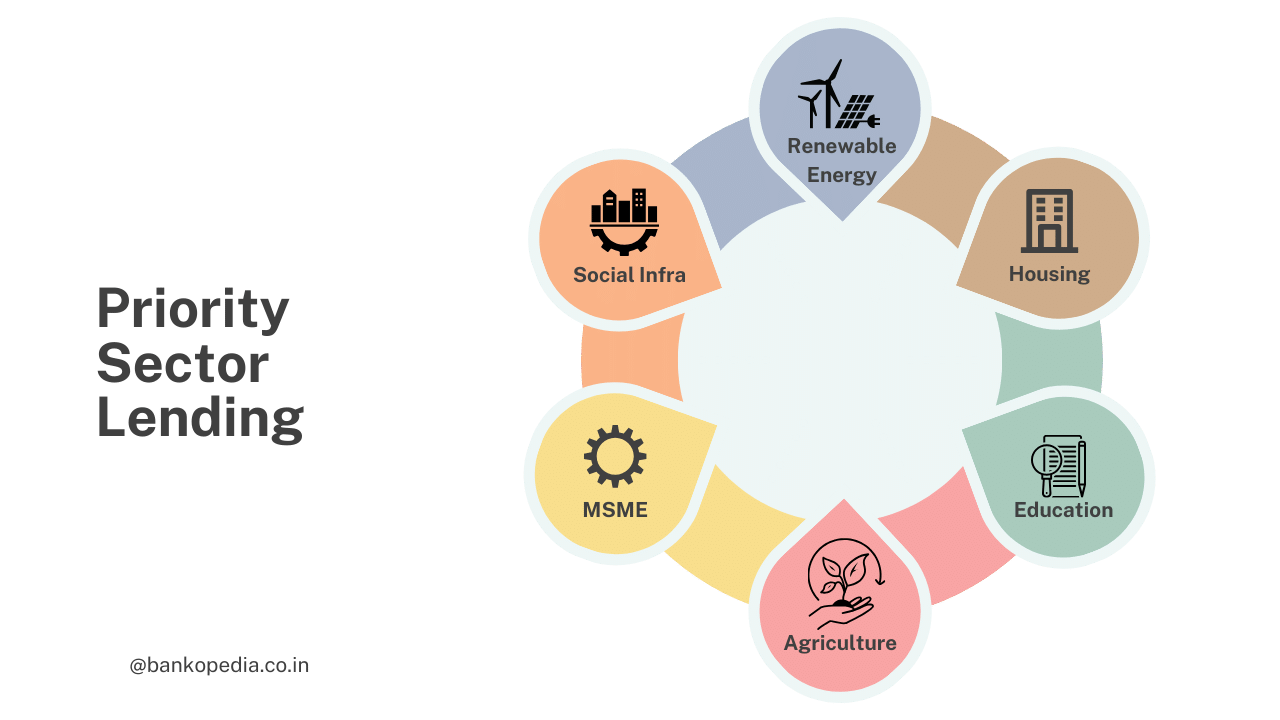
The RBI’s Master Direction on lending to Micro, Small, and Medium Enterprises reinforces the longstanding policy imperative to expand institutional credit access to this sector (Reserve Bank of India, n.d.). MSMEs classified under the revised definition — based on investment and turnover thresholds updated under the Aatmanirbhar Bharat framework — qualify for priority sector classification, which all scheduled commercial banks are mandated to maintain in their lending portfolios. GST-based underwriting directly serves this objective by enabling lenders to assess the creditworthiness of MSMEs that formal appraisal methods would otherwise exclude, expanding the addressable market for PSL-compliant lending without compromising credit discipline.
Together, these frameworks create a regulatory environment where GST-based credit decisioning is not merely permitted — it is structurally encouraged as a mechanism for deepening financial inclusion while protecting data rights and systemic integrity.
Future Trends: Where GST-Based Lending Is Headed
Unified Lending Interface (ULI)
The RBI has announced the Unified Lending Interface — an ambitious platform designed to aggregate diverse data sources (land records, dairy cooperative data, satellite-derived agricultural assessments, and AA data including GST) into a single consent-based underwriting pipeline accessible to all regulated lenders. ULI represents the logical culmination of the GST-based lending thesis: a borrower’s entire financial and economic footprint, from tax filings to bank flows to alternative data, accessible through one standardised, interoperable interface. For MSME lenders, ULI promises to collapse the cost and complexity of multi-source underwriting into a single API call.
AI and Machine Learning Scoring Models
As longitudinal GST datasets accumulate — lenders now have access to six-plus years of filing history for many businesses — the conditions are in place for machine-learning credit models trained specifically on GST behavioural patterns. Unlike point-in-time assessments, these models can detect deteriorating compliance trends months before a default event: missed filings, declining output tax despite flat turnover, sudden increases in credit note issuances, or shifts in the supplier and customer GSTIN network. Early warning systems built on these signals can trigger proactive account management long before a loan turns NPA.
OCEN Integration and Embedded Credit
The Open Credit Enablement Network (OCEN) protocol aims to democratise credit access by enabling any marketplace, fintech, or platform to embed standardised loan products into their existing workflows. GST Suvidha Providers (GSPs) — licensed intermediaries who already have deep, consented relationships with MSMEs for GST filing support — are natural OCEN participants. An MSME using a GSP for monthly filing assistance could, through OCEN, be offered a pre-approved working capital limit based on live GST data, with disbursement triggered automatically. The entire credit journey — assessment, offer, acceptance, disbursement — could happen within the same filing platform the business already uses every month.
Continuous Post-Disbursement Monitoring
Beyond loan origination, forward-thinking lenders are exploring continuous portfolio monitoring using recurring AA data pulls consented at origination. A borrower who agrees to monthly or quarterly GST data sharing enables the lender to track turnover and compliance health throughout the entire loan tenor. A lender observing three consecutive months of declining GSTR-3B turnover and missed GSTR-1 filings in a portfolio account can reach out proactively — offering restructuring, additional liquidity, or relationship support — rather than waiting for a missed EMI to trigger collection. This shift from reactive to predictive portfolio management is perhaps the most transformative long-term application of GST data in MSME lending.
Conclusion: What This Means for MSMEs
GST data has completed a remarkable journey — from a tax compliance instrument that small businesses resented as an administrative burden to a financial identity asset that can unlock credit on terms previously unavailable to them. For India’s MSME sector, which contributes a significant share of GDP and employs hundreds of millions of people, this is not a marginal improvement. It is a structural shift in who gets to participate in formal credit markets.
For MSMEs, the implication is clear and actionable: your GST filing record is now your credit record. Every return filed on time, every reconciliation completed accurately, every ITC claim substantiated, and every e-invoice correctly raised is a building block in a financial history that lenders can now read, verify, and act upon — without asking you for a single paper document.
If you are an MSME owner seeking working capital, equipment finance, or invoice discounting, here is what you can act on today:
- Audit your filing record before you apply. Reconcile GSTR-1 and GSTR-3B for at least the past 24 months. Unexplained differences are visible to lenders through AA data pulls and will be questioned during underwriting.
- Register with a licensed Account Aggregator. Understand what data a lender will access when you consent, exercise your rights to specify time periods and data types, and familiarise yourself with the revocation process.
- Engage a qualified GST practitioner. Irregularities in ITC claims, late filing patterns, or GSTIN status issues that are addressable today can meaningfully improve your credit profile before a loan application is submitted.
- Migrate to e-invoicing if eligible. Even if you are not yet mandated, voluntarily adopting e-invoicing signals compliance maturity to lenders and makes your invoice data verifiable in real time.
- Explore invoice financing for working capital. If you have strong B2B trade receivables backed by IRN-validated e-invoices, invoice discounting through AA-connected lenders or TReDS platforms may offer faster, more cost-effective working capital than a conventional term loan.
The era of the collateral-first MSME loan is giving way to the era of the data-first MSME loan. GST is the foundation of that transformation — and every MSME with a clean, consistent filing record is already better positioned than they may realise.
References
GSTN Official. (n.d.). Account Aggregator. Goods and Services Tax Network. https://www.gstn.org.in/account-aggregator
Reserve Bank of India. (2022, November). Notification: GSTN as Financial Information Provider under Account Aggregator framework [RBI/2022-23/158]. https://www.rbi.org.in/scripts/NotificationUser.aspx?Id=12412&Mode=0
Reserve Bank of India. (2022b, September 2). Digital lending — Frequently Asked Questions [Circular dated 02 Sep 2022]. https://www.rbi.org.in/commonman/english/scripts/FAQs.aspx?Id=3413
Reserve Bank of India. (n.d.). Master Direction — Reserve Bank of India (Priority Sector Lending — Targets and Classification) Directions. https://www.rbi.org.in/Scripts/BS_ViewMasDirections.aspx?id=11060
Sahamati. (2023, June). GSTN data schema release for the Account Aggregator ecosystem. https://sahamati.org.in/blog/
RXIL. (n.d.). TReDS — Trade Receivables Discounting System. https://www.rxil.in/treds/