Key Takeaways
- The Monetary Policy Committee (MPC) — a six-member statutory body under the RBI Act, 1934 — is mandated to keep CPI inflation at 4% (±2%).
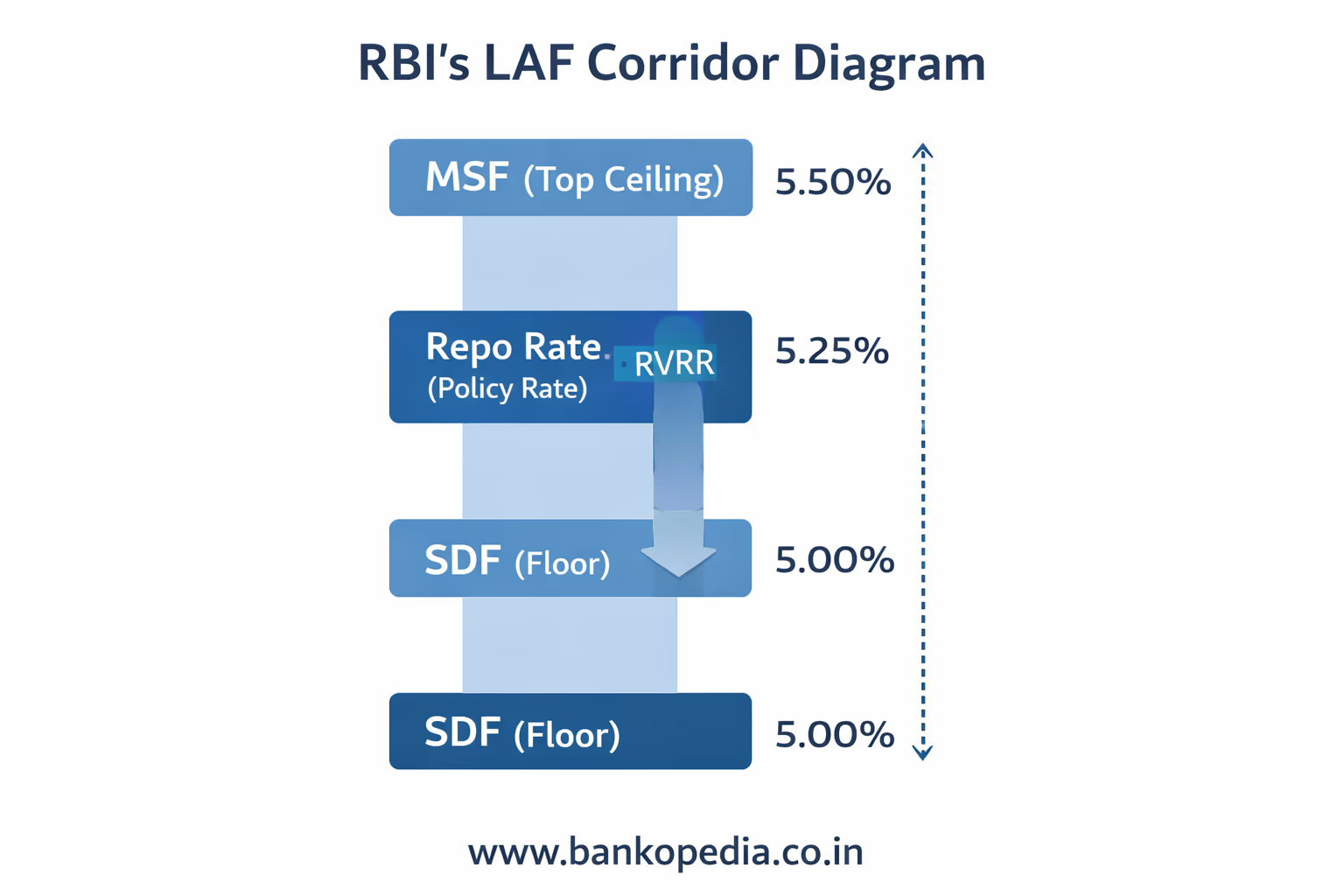
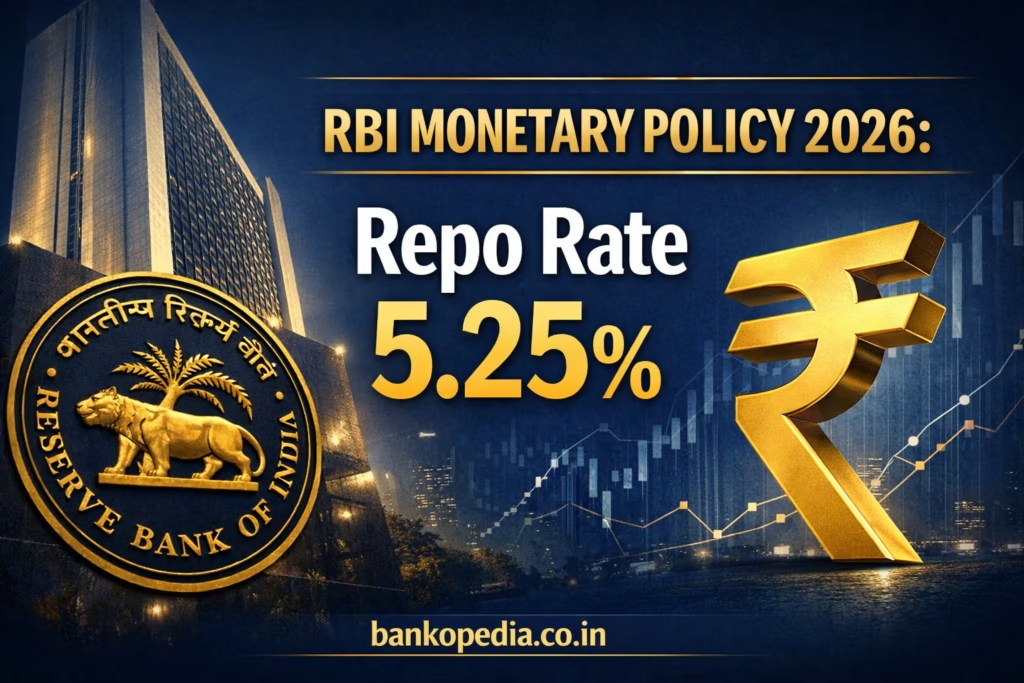
- As of February 2026, the repo rate is 5.25%, the SDF (floor) is 5.00%, and the MSF/Bank Rate (ceiling) is 5.50%, defining a 50 bps LAF corridor.
- CRR stands at 3.00% and SLR at 18.00%.
- The MPC meets six times a year (bi-monthly). Its rate decisions are binding on the RBI.
- All new floating-rate loans to retail and MSME borrowers must be linked to an External Benchmark Lending Rate (EBLR) — typically the repo rate — making policy rate changes directly visible in EMIs.
Introduction: Why One RBI Decision Can Change Crores of EMIs
Table of Contents
In February 2026, the Reserve Bank of India cut the repo rate by 25 basis points — from 5.50% to 5.25%. That single decision set off a chain reaction across India’s banking system: over ₹50 lakh crore of outstanding floating-rate loans became eligible for repricing within the next quarterly reset cycle.
For a home loan borrower with ₹50 lakh outstanding, it means roughly ₹700–800 lower EMI every month without filing a single application.
That is the power of RBI monetary policy.
But what goes into that decision? Who decides it, on what legal authority, using which tools, and through what mechanisms does it travel from a Mumbai boardroom to a borrower’s bank account in Meerut or Madurai?
This guide answers all of it — for JAIIB/CAIIB aspirants, working bankers managing ALCO desks, and MSME owners who want to understand why their loan rates move.
What Is RBI Monetary Policy?
RBI monetary policy refers to the set of actions taken by the Reserve Bank of India to:
- Manage money supply and liquidity in the financial system
- Keep inflation within a defined target band
- Ensure adequate credit flows to support economic growth
In plain terms: the RBI tightens money (raises rates, absorbs liquidity) when inflation runs high, and eases money (cuts rates, injects liquidity) when growth needs a push. The balance between these two goals defines Indian monetary policy at any point in time.
Legal Framework: The Statutory Backbone
RBI’s authority to conduct monetary policy rests on the Reserve Bank of India Act, 1934, significantly strengthened by the Finance Act, 2016, which embedded the Monetary Policy Committee (MPC) under Section 45ZB.
The Inflation Targeting Mandate
India follows a flexible inflation targeting (FIT) framework. The RBI is required to maintain Consumer Price Index (CPI) inflation at 4%, with a tolerance band of ±2% (i.e., 2%–6%).
This is not a goal — it is a legal obligation. If CPI inflation stays above 6% (or falls below 2%) for three consecutive quarters, the RBI must invoke Section 45ZN and formally submit a report to the Central Government explaining:
- Why the target was missed
- What remedial actions are being taken
- The estimated timeline to return to target
This accountability mechanism was a landmark institutional reform in Indian central banking.
The Monetary Policy Committee (MPC): Who Decides the Repo Rate?
The MPC is a six-member committee that takes all repo rate decisions by majority vote:

| Member | Background |
|---|---|
| RBI Governor | Chairperson; holds casting vote in case of tie |
| Deputy Governor (Monetary Policy) | RBI internal |
| One RBI Officer | Nominated by the RBI Central Board |
| Three External Members (×3) | Appointed by the Central Government for 4-year terms |
The three external members bring an independent perspective, insulating rate decisions from internal institutional bias. Crucially, MPC decisions are binding on the RBI — the Governor cannot override a majority outcome, though the casting vote provides a tiebreaker.
CAIIB Exam Tip: Memorise the MPC composition split (3 internal + 3 external), the casting vote mechanism, and the Section 45ZN failure reporting provision — these appear frequently in ABM and BFM papers.
Current RBI Policy Rates (February 2026)
| Instrument | Rate | Last Change |
|---|---|---|
| Repo Rate | 5.25% | February 2026 (−25 bps) |
| Standing Deposit Facility (SDF) | 5.00% | February 2026 (−25 bps) |
| Marginal Standing Facility (MSF) | 5.50% | February 2026 (−25 bps) |
| Bank Rate | 5.50% | February 2026 (−25 bps) |
| Reverse Repo Rate | 3.35% | May 2020 (unchanged) |
| Cash Reserve Ratio (CRR) | 3.00% | Maintained since 2023 |
| Statutory Liquidity Ratio (SLR) | 18.00% | Maintained since 2020 |
Understanding the LAF Corridor
The Liquidity Adjustment Facility (LAF) corridor defines the operating band for overnight rates in India’s money market:
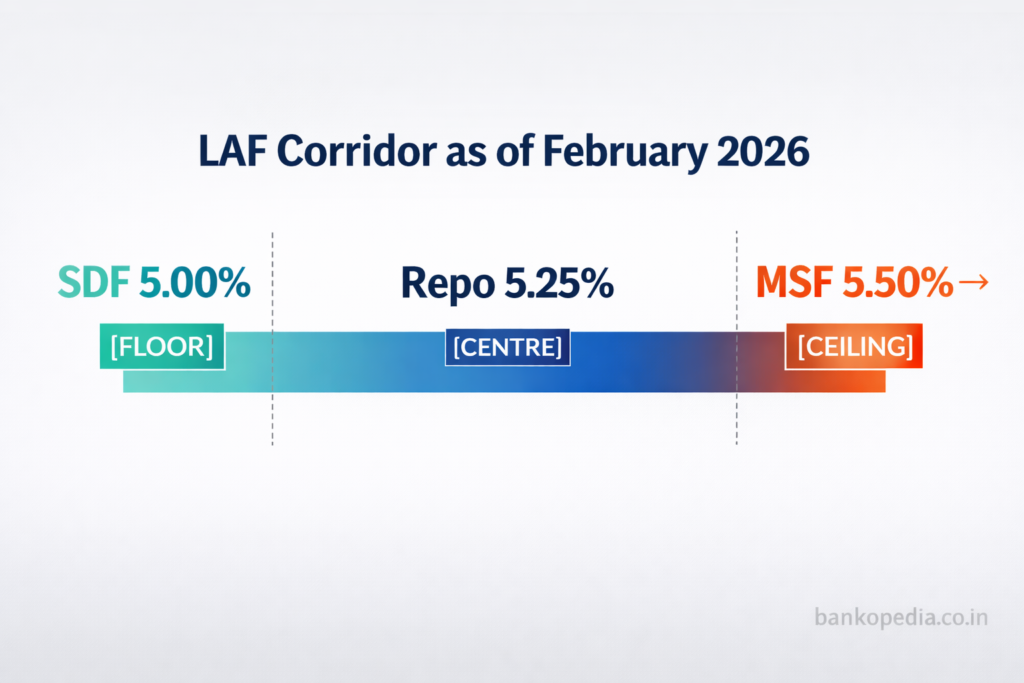
SDF 5.00%  ←  FLOOR
Repo 5.25% ←  POLICY RATE (midpoint)
MSF 5.50% ← CEILING- SDF (Standing Deposit Facility): Banks park surplus funds with the RBI. Introduced in April 2022, it replaced the reverse repo rate as the primary liquidity absorption tool.
- Repo Rate: RBI lends to banks overnight against government securities.
- MSF (Marginal Standing Facility): Emergency borrowing window for banks at a penal rate (ceiling of the corridor).
- Bank Rate = MSF Rate — always. This is a favourite exam fact.
The corridor width is currently 50 basis points (5.00% to 5.50%), with the repo rate sitting exactly at the centre.
Key Instruments of Monetary Policy
The RBI has both quantitative and qualitative tools at its disposal.
Quantitative Tools
Repo Rate is the primary policy signal. All other rate moves cascade from it — the SDF and MSF shift in lockstep, maintaining the corridor structure.
Cash Reserve Ratio (CRR) requires banks to maintain 3.00% of their Net Demand and Time Liabilities (NDTL) as a cash balance with the RBI. No interest is earned on CRR balances — making a CRR hike a direct cost to banks.
Statutory Liquidity Ratio (SLR) requires banks to invest 18.00% of NDTL in approved government and other liquid securities. Unlike CRR, SLR assets do earn returns (though typically at government security yields).
Open Market Operations (OMOs) involve the outright purchase or sale of government securities to manage durable (structural) liquidity — as opposed to the LAF, which manages day-to-day liquidity.
Quick Calculation for JAIIB/CAIIB: A bank with ₹10,000 crore NDTL must maintain:
- CRR: 3.00% × ₹10,000 crore = ₹300 crore (cash with RBI)
- SLR: 18.00% × ₹10,000 crore = ₹1,800 crore (approved securities)
- Total statutory lock-in: ₹2,100 crore
Qualitative Tools
These include selective credit controls (ceilings on lending to specific sectors), margin requirements, moral suasion (RBI persuading banks through circulars and guidance), and direct action. In 2026, the RBI also actively uses macroprudential tools — countercyclical capital buffers, sector-specific risk weights, and loan-to-value (LTV) norms — to prevent asset bubbles without blunt rate moves.
How Monetary Policy Reaches You: The 5 Transmission Channels
A repo rate cut in Mumbai does not instantly lower EMIs in Chennai. It travels through the economy via five distinct channels:
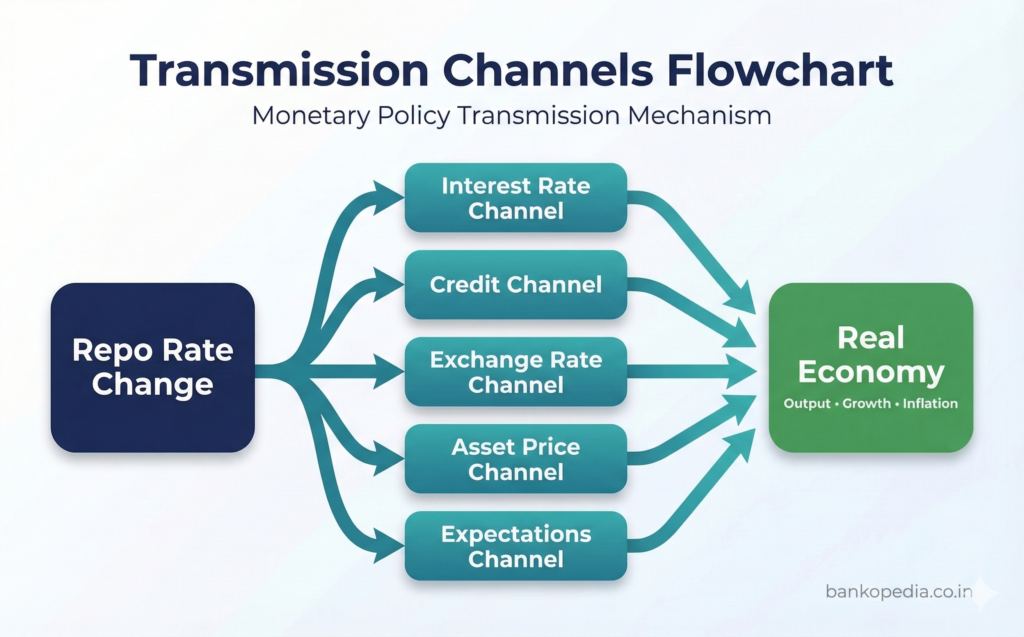
1. Interest Rate Channel
The most direct. When the repo rate falls, the cost of overnight borrowing for banks falls. Banks reduce their EBLR-linked lending rates, lowering EMIs for borrowers. As of early 2026, the median transmission of repo rate changes to new rupee loans has improved to approximately 85% within one quarter for EBLR-linked loans.
2. Credit Channel
Rate cuts improve bank liquidity and profitability, encouraging more lending. Rate hikes tighten liquidity, constraining credit supply — especially to riskier borrowers like MSMEs and startups.
3. Exchange Rate Channel
Higher domestic rates attract foreign portfolio flows, strengthening the rupee. A stronger rupee lowers import costs (especially crude oil), helping contain imported inflation.
4. Asset Price Channel
Lower rates raise the present value of future earnings, boosting equity valuations. Rising asset prices increase household wealth, supporting consumption. In real estate, lower mortgage rates directly stimulate demand.
5. Expectations Channel
Perhaps the most powerful — and the hardest to measure. When the RBI signals a rate cut cycle, businesses start investing in anticipation of cheaper credit. When it signals tightening, inflation expectations are anchored even before a rate hike lands. MPC communication and forward guidance are key tools here.
Real-World Impact: What a 25 bps Cut Means for a Home Loan
The Scenario:
Ramesh took a ₹50 lakh home loan in January 2024 at a floating rate of Repo + 2.50% spread. With the repo rate at 6.50% then, his interest rate was 9.00% and his monthly EMI on a 20-year loan was ₹44,986.
After February 2026’s Rate Cut:
The repo rate dropped to 5.25%. Ramesh’s new interest rate becomes 7.75% (5.25% + 2.50% spread). His revised EMI falls to approximately ₹43,950 — saving him around ₹1,036 per month and over ₹2.26 lakh across the remaining loan tenure.
No paperwork. No branch visit. The rate resets automatically at the next quarterly reset date — this is the EBLR framework working as designed.
For MSME Borrowers: The same logic applies to working capital loans, term loans, and CC/OD facilities linked to external benchmarks. A rate cut cycle directly lowers the effective cost of credit for small businesses.
EBLR vs MCLR: What Governs Your Loan Rate?
Since October 2019, all new floating-rate loans to retail and MSME borrowers must be linked to an External Benchmark Lending Rate (EBLR) — most commonly the repo rate.
| Feature | EBLR | MCLR |
|---|---|---|
| Benchmark | Repo rate (external) | Bank’s own cost of funds (internal) |
| Reset Frequency | Minimum quarterly | Annually (typically) |
| Transmission Speed | Fast — direct linkage | Slow — depends on bank funding costs |
| Applicability | New retail + MSME loans (post Oct 2019) | Legacy loans; new corporate loans |
MCLR-linked loans (common before 2019 and still prevalent for corporate credit) transmit policy changes more slowly — a source of ongoing criticism from the RBI. Borrowers on MCLR-linked loans often see only partial transmission of rate cuts.
JAIIB / CAIIB Exam Preparation Guide
Paper-Wise Relevance
| Paper | Relevant Topics |
|---|---|
| JAIIB — Principles & Practices of Banking (PPB) | MPC composition, repo rate basics, CRR/SLR definitions |
| CAIIB — Advanced Bank Management (ABM) | Monetary policy transmission, NIM impact, ALCO |
| CAIIB — Bank Financial Management (BFM) | LAF corridor, OMOs, forex rate channel, SLR portfolio |
High-Priority Topics for 2026 Exams
- MPC composition: 6 members, 3 internal + 3 external, casting vote with Governor
- LAF corridor: SDF (floor) → Repo (midpoint) → MSF/Bank Rate (ceiling); currently 50 bps wide
- Section 45ZN: Failure reporting when inflation breaches the band for 3 consecutive quarters
- CRR and SLR calculations on NDTL
- EBLR vs MCLR transmission comparison
- Five channels of monetary policy transmission
Practice MCQs
MCQ 1: As of February 2026, what is the width of the LAF corridor?
- A. 25 basis points
- B. 50 basis points ✅
- C. 75 basis points
- D. 100 basis points
Explanation: SDF at 5.00% (floor) to MSF at 5.50% (ceiling) = 50 bps. Repo rate at 5.25% is the midpoint.
MCQ 2: Under Section 45ZN of the RBI Act, 1934, what happens if CPI inflation breaches the tolerance band for three consecutive quarters?
- A. The Governor must resign
- B. The MPC must hike the repo rate immediately
- C. The RBI must submit a report to the Central Government explaining the failure ✅
- D. The monetary policy framework is automatically suspended
MCQ 3: A bank has NDTL of ₹10,000 crore. With CRR at 3.00% and SLR at 18.00%, what is the combined statutory reserve requirement?
- A. ₹1,800 crore
- B. ₹2,100 crore ✅
- C. ₹2,400 crore
- D. ₹3,000 crore
Explanation: CRR = ₹300 crore + SLR = ₹1,800 crore = ₹2,100 crore total.
Frequently Asked Questions
Q1. What is the current repo rate in India? As of February 2026, the repo rate is 5.25% — following a 25 basis point cut announced by the MPC at its February 2026 bi-monthly review. This is the rate at which the RBI lends overnight funds to commercial banks under the LAF.
Q2. How many times does the MPC meet in a year? The MPC meets six times a year on a bi-monthly schedule. Each meeting spans two days, with the rate decision and statement released on the second day.
Q3. What is the difference between SDF and the reverse repo rate? The Reverse Repo Rate (3.35%) is the rate at which the RBI used to borrow from banks under the LAF. Since April 2022, the SDF (Standing Deposit Facility) at 5.00% has replaced it as the active liquidity absorption tool. The reverse repo rate remains in the books but is operationally dormant.
Q4. Does a repo rate cut automatically reduce my home loan EMI? If your loan is on an EBLR-linked floating rate (mandatory for all new retail and MSME loans since October 2019), yes — your lender must pass on the rate cut at the next contractual reset date (at most quarterly). If your loan is on MCLR, the transmission depends on your lender’s own funding cost dynamics and may be partial or delayed.
Q5. What is moral suasion in monetary policy? Moral suasion refers to the RBI’s practice of influencing bank behaviour through informal guidance, speeches, circulars, and direct communication — without using a formal regulatory tool. It is a qualitative instrument frequently used alongside quantitative rate tools.