Table of Contents
The flow of modern commerce relies heavily on trust, credit, and legally binding promises. While digital payments have revolutionized how we transact, traditional financial instruments remain the bedrock of corporate credit, supply chain financing, and large-scale trade.
In India, the Negotiable Instruments Act, 1881 (NI Act) is the definitive piece of legislation governing these transactions. Despite being over a century old, the Act has been continually amended to address contemporary financial realities, including the digital truncation of cheques and strict penalties for payment defaults. Understanding its provisions, the parties involved, and the legal remedies it offers is non-negotiable for business owners, legal professionals, and everyday consumers.
1. Understanding Negotiable Instruments
At its core, the term “Negotiable Instrument” refers to a formal, written document that guarantees the payment of a specific sum of money, either on-demand or at a defined future date, to a specified person or the bearer of the document.
The power of these instruments lies in two fundamental characteristics:
- Transferability: They can be easily transferred from one person to another by mere delivery or by endorsement and delivery.
- Unconditional Title: Unlike standard contracts where a buyer only gets the rights the seller had, a “Holder in Due Course” of a negotiable instrument receives the instrument free from any previous defects in the title. If you receive a cheque in good faith for a legitimate debt, your right to that money is protected, even if the person who gave it to you obtained it under questionable circumstances.
The NI Act essentially creates a specialized legal environment where debt can be traded and transferred with the same ease and legal protection as physical currency.
2. Importance of the Negotiable Instruments Act for Businesses
For businesses ranging from local SMEs to multinational corporations, the NI Act is not just a legal text; it is a financial lifeline. Its importance manifests in several crucial ways:
- Facilitation of Trade Credit: Businesses rarely operate on pure cash. Suppliers provide goods on credit, accepting Promissory Notes or post-dated cheques as a guarantee of future payment. The NI Act gives legal weight to these delayed payments.
- Liquidity and Discounting: If a business holds a Bill of Exchange payable in 90 days, it does not have to wait. It can “discount” this bill with a bank, receiving cash immediately (minus a small fee). The Act’s strict rules on liability make banks comfortable providing this liquidity.
- Minimization of Financial Risk: By setting standard rules for how instruments are created, transferred, and honored, the Act removes ambiguity. Everyone knows exactly what a signature on the back of a cheque means legally.
- Deterrence Against Fraud: With stringent penal provisions—particularly concerning bounced cheques—the Act acts as a powerful deterrent against individuals or companies attempting to issue fraudulent payments.
3. Key Provisions and Presumptions of the Act
The Negotiable Instruments Act operates heavily on “presumptions,” a core legal concept frequently studied by banking professionals preparing for the JAIIB exam. Under Section 118 of the Act, courts automatically presume certain facts to be true until proven otherwise, a mechanism that drastically speeds up commercial litigation.
Essential Legal Presumptions:
- Consideration: It is presumed that every negotiable instrument was made or drawn for “consideration” (meaning value or debt existed). The holder doesn’t have to prove the debt; the defaulter has to prove the debt didn’t exist.
- Date: It is presumed the document was made on the date stamped on it.
- Time of Acceptance: It is presumed a bill was accepted before its maturity date.
- Time of Transfer: It is presumed it was transferred before maturity.
- Holder in Due Course: It is presumed the person holding the instrument acquired it lawfully and in good faith.
The “Holder in Due Course” (Section 9)
This is arguably the most vital concept in the Act. A “Holder in Due Course” (HDC) is someone who takes an instrument for consideration, before it becomes overdue, and without any reason to believe there is a defect in the title of the person transferring it. The HDC holds a privileged position; they can recover the amount from all previous parties, and typical contractual defenses (like fraud between the original two parties) cannot be used against the HDC.
4. Types of Negotiable Instruments Covered
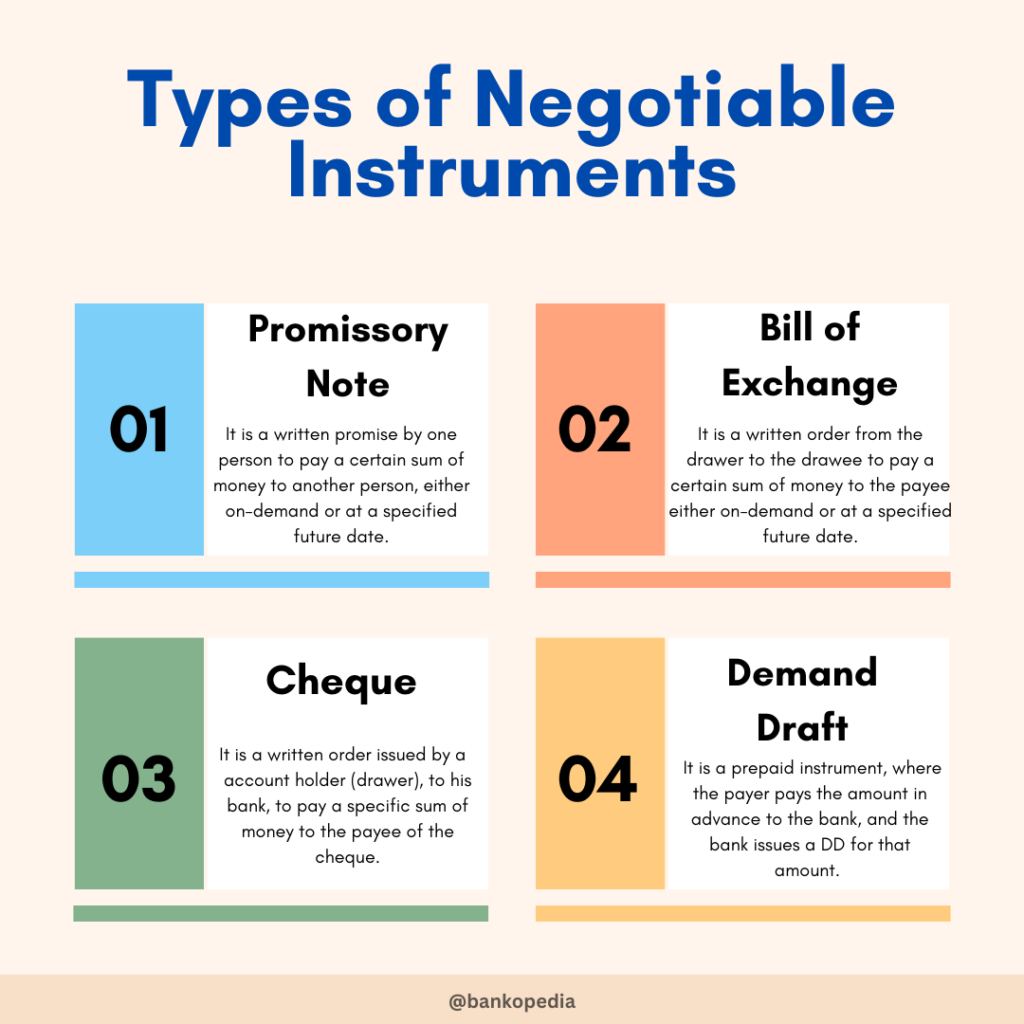
While the financial world has many documents (like bills of lading or share certificates), the NI Act specifically governs three primary instruments.
A. Promissory Notes (Section 4)
A promissory note is a written, unconditional promise made by one person to another, agreeing to pay a certain sum of money on demand or at a fixed future date.
- Common Use: Personal loans, corporate borrowing, and structured debt.
- Note: Banknotes or currency notes are technically promissory notes but are excluded from this specific Act and governed by the Reserve Bank of India.
B. Bills of Exchange (Section 5)
A bill of exchange is a written, unconditional order directing a person to pay a specific sum to a third party. It is primarily used in the trade of goods, especially international trade.
- Common Use: A manufacturer in Mumbai ships goods to a retailer in Delhi. The manufacturer draws a bill on the retailer, ordering them to pay the amount in 60 days. Once the retailer “accepts” (signs) it, it becomes a legally binding negotiable instrument.
C. Cheques (Section 6)
A cheque is a specialized type of bill of exchange that is always drawn on a specified banker and is always payable on demand. The Act has been extensively modernized to include electronic cheques and truncated cheques.
- Common Use: Day-to-day business payments, salary disbursements, and rent.
5. Parties Involved in Negotiable Instruments
The roles and liabilities of individuals change depending on the instrument used. Here is a clear breakdown of the parties:
| Instrument | Primary Parties | Description of Role |
| Promissory Note | Maker Payee | The person who promises to pay. The person to whom the payment is promised. |
| Bill of Exchange | Drawer Drawee Payee | The person who writes the order to pay. The person directed to pay (becomes the ‘Acceptor’ once they sign). The person who receives the money. |
| Cheque | Drawer Drawee Payee | The account holder who writes the cheque. Always the bank where the account is held. The person receiving the funds. |
Additional Parties:
- Endorser: A person who holds an instrument and transfers it to someone else by signing its back.
- Endorsee: The person receiving the instrument via endorsement.
6. How to Create a Valid Negotiable Instrument
A document is not legally negotiable simply because it involves money. To be protected under the Act, it must strictly adhere to the following elements:
- It must be in writing: Oral promises hold no weight under this Act. It can be handwritten, typed, or printed.
- The order or promise must be unconditional: You cannot write, “I promise to pay you ₹50,000 if the shipment arrives undamaged.” The payment obligation must be absolute.
- Signed by the Maker/Drawer: An unsigned cheque or note is merely a piece of paper.
- Certainty of Parties: The person paying and the person receiving must be clearly identifiable.
- Certainty of Sum: The amount must be specific. You cannot write, “I promise to pay ₹10,000 plus a reasonable bonus.”
- Payable in Legal Tender: The instrument must be payable in money only, not in goods or services.
7. Endorsement and Transfer (Negotiation)
“Negotiation” is the legal term for transferring an instrument to another person so that they become the legal holder.
- Bearer Instruments: Instruments payable to “bearer” (whoever holds it) are negotiated by simple delivery. If I hand you a bearer cheque, it is legally yours.
- Order Instruments: Instruments payable to a specific person’s “order” require Endorsement and Delivery.
Types of Endorsements:
- Blank Endorsement: The holder simply signs the back. The instrument effectively becomes a bearer instrument.
- Full (or Special) Endorsement: The holder signs and specifies the new payee (e.g., “Pay to the order of Rahul Desai”).
- Restrictive Endorsement: Restricts further transfer (e.g., “Pay to Rahul Desai only“).
- Sans Recourse Endorsement: The endorser transfers the instrument but legally declines liability if it bounces (e.g., “Pay to Rahul Desai, without recourse to me”).
8. Dishonor and Discharge of Negotiable Instruments
A negotiable instrument is meant to facilitate payment. When that payment fails, the instrument is “dishonored.”
Ways an Instrument is Dishonored:
- Dishonor by Non-Acceptance: Applies only to Bills of Exchange. If the drawee refuses to accept the bill when presented, it is dishonored immediately.
- Dishonor by Non-Payment: The most common form. The promissory note matures, or the cheque is presented to the bank, and the money is not paid (e.g., insufficient funds, account closed, stop payment).
Notice of Dishonor:
When an instrument bounces, the holder must give notice of dishonor to all prior parties they wish to hold liable. If they fail to give this notice within a reasonable time, those prior parties are discharged from their liability.
Discharge of the Instrument:
An instrument is “discharged” (meaning all legal rights and obligations under it end) when:
- The primary liable party pays the amount due.
- The holder intentionally cancels the instrument (e.g., tearing it up).
- The holder releases the liable party from the debt.
9. Legal Remedies: The Power of Section 138
In India, the most frequently invoked part of the Negotiable Instruments Act is Chapter XVII (Sections 138 to 142), which deals exclusively with the bouncing of cheques.
Prior to the introduction of Section 138, a bounced cheque was merely a civil breach of contract. Section 138 made the dishonor of a cheque for discharge of debt a criminal offense.
The Strict Timelines of Section 138:
To successfully prosecute a cheque bounce case, a business must follow an incredibly strict statutory timeline:
- Presentation: The cheque must be presented to the bank within its validity period (currently 3 months from the date of issue in India).
- Notice: Within 30 days of receiving the memo from the bank stating the cheque bounced, the holder must send a legal demand notice to the drawer.
- Wait Period: The drawer is given 15 days from the receipt of the notice to make the payment.
- Filing the Complaint: If the drawer fails to pay within those 15 days, the cause of action arises. The holder then has exactly 30 days to file a criminal complaint before a Magistrate.
Penalties:
If convicted under Section 138, the drawer can face imprisonment for up to two years, a fine extending to twice the amount of the cheque, or both.
10. Recent Amendments and Modernization
The Indian legislature has consistently updated the NI Act to prevent it from becoming a tool for harassment and to adapt to digital banking.
The 2015 Amendment (Jurisdiction)
Previously, businesses had to file cheque bounce cases where the drawer’s bank was located, causing massive logistical nightmares for companies with nationwide operations. The 2015 amendment fixed this: cases are now filed where the payee’s bank branch is located, heavily favoring the victim of the bounced cheque.
The 2018 Amendment (Sections 143A & 148) – Interim Compensation
To stop drawers from dragging out court cases for years just to delay payment, the government introduced Section 143A.
- Section 143A: The court can now order the drawer to pay interim compensation of up to 20% of the cheque amount to the payee during the trial. If the drawer is acquitted later, the payee must refund it with interest.
- Section 148: If the drawer is convicted and appeals to a higher court, the appellate court can order them to deposit a minimum of 20% of the fine/compensation awarded by the lower court before hearing the appeal.
Cheque Truncation System (CTS)
The Act was updated to give legal validity to electronic images of cheques. Under CTS, physical cheques no longer travel from bank to bank. They are scanned at the presenting bank, and the electronic image is routed for clearing, reducing clearing times from days to hours.
11. Practical Case Studies
To understand how the Act operates in the real world, consider the following scenarios:
Case Study 1: The Chain of Endorsement
- Scenario: Supplier A sells steel to Builder B. Builder B issues a promissory note for ₹5,00,000. Supplier A owes money to Transporter C, so A endorses the note to C. On the due date, Builder B refuses to pay C, claiming the steel was defective.
- Outcome: Because Transporter C took the note in good faith for an existing debt, C is a “Holder in Due Course.” The Act states that Builder B cannot use the defense of defective goods against C. Builder B must pay C, and then B can sue A separately for the defective steel.
Case Study 2: The “Stop Payment” Defense
- Scenario: Company X issues a cheque to a vendor but later realizes the vendor’s invoice was inflated. Company X calls their bank and issues a “Stop Payment” instruction. The cheque bounces. Company X claims Section 138 doesn’t apply because it wasn’t due to “insufficient funds.”
- Outcome: The Supreme Court of India has firmly ruled that a “Stop Payment” instruction, if issued to avoid a legally enforceable debt, still attracts Section 138. The vendor can proceed with criminal prosecution.
12. Best Practices for Businesses
To leverage the protections of the NI Act effectively, businesses should implement the following protocols:
- Audit Your Timelines: Because Section 138 cases are thrown out if a single deadline (the 30-15-30 day rule) is missed, businesses must have automated calendaring systems for bounced cheques.
- Establish Underlying Debt: A cheque given as a “security” or a “gift” does not attract Section 138. Always maintain clear invoices, purchase orders, and ledger accounts to prove the cheque was for a legally enforceable debt.
- Corporate Liability: Under Section 141, if a company bounces a cheque, the Directors and anyone in charge of the company’s daily affairs are also personally liable. Ensure compliance checks are rigorous before authorizing payouts.
- Embrace Digital Footprints: When sending demand notices, send them via Registered Post with Acknowledgment Due (RPAD) and email to establish undeniable proof of delivery.
Conclusion
Mastering the Negotiable Instruments Act is not just an exercise for lawyers; it is a fundamental requirement for anyone engaging in commercial transactions. By standardizing the rules of credit, establishing presumptions of validity, and enforcing strict penalties for defaults, the Act ensures that the wheels of commerce keep turning without being bogged down by constant disputes.
Whether you are a startup securing your first round of trade credit, or a large enterprise managing thousands of vendor payments, aligning your operational practices with the latest amendments of the NI Act is your strongest defense against financial fraud and bad debt.