Table of Contents
⭐ Key Takeaways
- Massive Scale: Fintech in India processed over ₹199 lakh crore through UPI in FY 2025-26, making it the world’s largest real-time payment system by volume.
- Regulatory Shift: RBI’s Digital Lending Guidelines (September 2022) mandate that all loan disbursements and repayments must flow only through bank accounts of regulated entities, eliminating pass-through accounts.
- Data Democratization: The Account Aggregator framework under RBI Master Direction (September 2021) enables consent-based financial data sharing across 450+ financial institutions as of March 2026.
- Digital Currency: The Digital Rupee (e₹) pilot expanded to 16 cities with 5 million users and 400,000 merchants by February 2026, testing both retail (e₹-R) and wholesale (e₹-W) CBDC models.
- Neobanking Limits: Neobanks in India operate as non-banking entities partnering with licensed banks under RBI’s Banking Regulation Act, 1949, and cannot hold banking licenses independently.
Introduction
In February 2026, India’s Unified Payments Interface (UPI) recorded 13.4 billion transactions worth ₹19.78 lakh crore in a single month—a figure that exceeds the combined card transactions of the United States and European Union. This explosive growth exemplifies how fintech in India has fundamentally transformed the nation’s banking landscape, moving from a predominantly cash-based economy to a digital-first financial ecosystem.
For working bankers, this shift means every customer touchpoint—from account opening to loan disbursement—now involves fintech integration, while JAIIB and CAIIB syllabi have expanded to include digital lending regulations, blockchain basics, and API banking frameworks.
This comprehensive guide examines India’s fintech ecosystem through the lens of regulatory compliance, operational impact, and examination relevance. We cover the Reserve Bank of India’s evolving regulatory framework including the Payment and Settlement Systems Act, 2007, the Digital Lending Guidelines, and the Account Aggregator Master Direction. Whether you are a branch manager implementing UPI-based loan disbursements, a credit officer evaluating fintech partnerships, or a JAIIB candidate preparing for the Legal and Regulatory Aspects module, this article provides the authoritative reference you need to navigate India’s digital banking revolution in 2026.
Understanding Fintech India 2026: Ecosystem Overview and Regulatory Architecture
Fintech India 2026 represents a ₹6.2 trillion industry encompassing payments, lending, wealth management, insurance technology, and regulatory technology (regtech). The ecosystem comprises over 9,000 fintech startups as of March 2026, with 108 fintech unicorns valued above $1 billion each.
The regulatory architecture is governed primarily by the Reserve Bank of India under the Reserve Bank of India Act, 1934, the Payment and Settlement Systems Act, 2007, and sector-specific guidelines. RBI’s Master Direction on Digital Payment Security Controls (February 2021, updated January 2026) mandates Additional Factor Authentication (AFA) for all digital payment transactions above ₹5,000, while the Information Technology Act, 2000 (amended 2008) provides the legal framework for electronic contracts and digital signatures. The interplay between innovation and regulation defines India’s fintech landscape, where the RBI Regulatory Sandbox (launched August 2019) allows controlled testing of innovative products before full-scale deployment.
The Payment and Settlement Systems Act, 2007 (PSS Act) grants RBI exclusive authority to regulate and supervise all payment systems in India, including UPI, IMPS, NEFT, RTGS, and card networks. Section 4 of the PSS Act prohibits any entity from operating a payment system without RBI authorization, while Section 23 empowers RBI to issue directions to system providers and participants. As of February 2026, RBI has authorized 58 payment system operators including NPCI (National Payments Corporation of India), which operates UPI, RuPay, IMPS, and AePS.
For JAIIB candidates, understanding the distinction between payment systems (governed by PSS Act) and banking services (governed by Banking Regulation Act, 1949) is critical.
Key Fintech Segments and Regulatory Framework (March 2026)
| Fintech Segment | Market Size (₹ Cr) | Primary Regulator | Key Regulation |
| Digital Payments | 385,000 | RBI | PSS Act 2007, Master Direction on Digital Payment Security |
| Digital Lending | 142,000 | RBI | Digital Lending Guidelines Sept 2022, NBFC Regulations |
| Neobanking | 28,500 | RBI (via partner banks) | Banking Regulation Act 1949, IT Act 2000 |
| Wealth Tech | 67,200 | SEBI | SEBI (Investment Advisers) Regulations 2013 |
| InsurTech | 89,400 | IRDAI | Insurance Act 1938, IRDAI (Web Aggregators) Regulations |
| Account Aggregators | 4,200 | RBI/SEBI/IRDAI/PFRDA | RBI Master Direction Sept 2021 |
💡 Banker’s Tip (JAIIB Legal Module): Remember that payment aggregators (PAs) and payment gateways require RBI authorization under PSS Act Section 4, while technology service providers to banks do not—this distinction appears frequently in exam scenarios.
UPI and Real-Time Payment Systems: Operational Framework for Banks
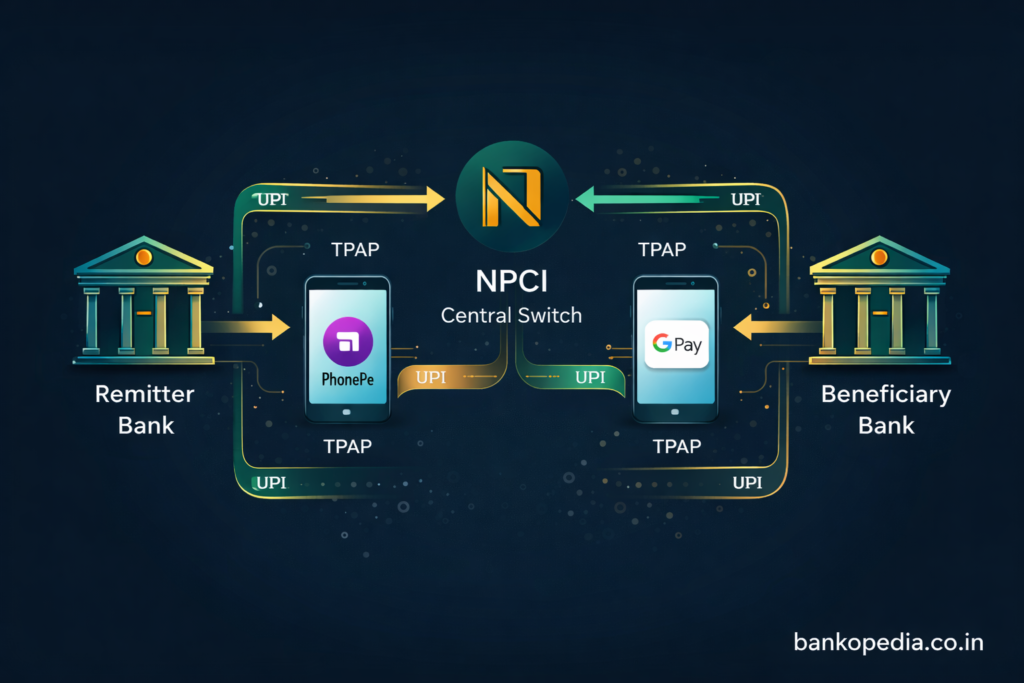
The Unified Payments Interface (UPI), launched by NPCI in August 2016, has become India’s dominant payment rail with a 68% share of all digital transactions by volume in FY 2025-26. UPI operates on the Immediate Payment Service (IMPS) infrastructure, enabling 24x7x365 instant fund transfers using Virtual Payment Addresses (VPAs) like username@bankname instead of account numbers.
As of March 2026, 530 banks participate in UPI, with PhonePe (47.8% market share), Google Pay (34.2%), and Paytm (9.1%) dominating the Third-Party Application Provider (TPAP) space. For bank employees, understanding UPI’s technical architecture is essential: each transaction involves a Remitter Bank (payer’s bank), Beneficiary Bank (payee’s bank), Payment Service Provider (PSP) banks that sponsor TPAPs, and NPCI as the central switch. The transaction flow follows the ISO 8583 messaging standard, with end-to-end encryption and two-factor authentication mandated by RBI’s Master Direction on Digital Payment Security Controls.
RBI introduced UPI transaction limits and charges through various circulars: the per-transaction limit stands at ₹1 lakh for person-to-person (P2P) transfers and ₹5 lakh for person-to-merchant (P2M) payments as of February 2026, with special categories like IPO applications, insurance, and mutual funds allowed up to ₹5 lakh.
Merchant Discount Rate (MDR) remains zero for UPI transactions per RBI notification dated December 2019, meaning banks cannot charge merchants for accepting UPI payments—a policy designed to promote digital adoption but creating revenue challenges for banks. The UPI Lite feature (launched September 2022) allows offline transactions up to ₹500 with a wallet limit of ₹2,000, reducing load on banking infrastructure for small-value payments.
💡 Banker’s Tip (CAIIB Advanced Bank Management): UPI’s zero-MDR policy impacts bank profitability models—exam questions often test understanding of alternative revenue streams like value-added services, cross-selling, and data analytics that banks must leverage to offset payment infrastructure costs.
Digital Lending Regulations and NBFC-Fintech Partnerships
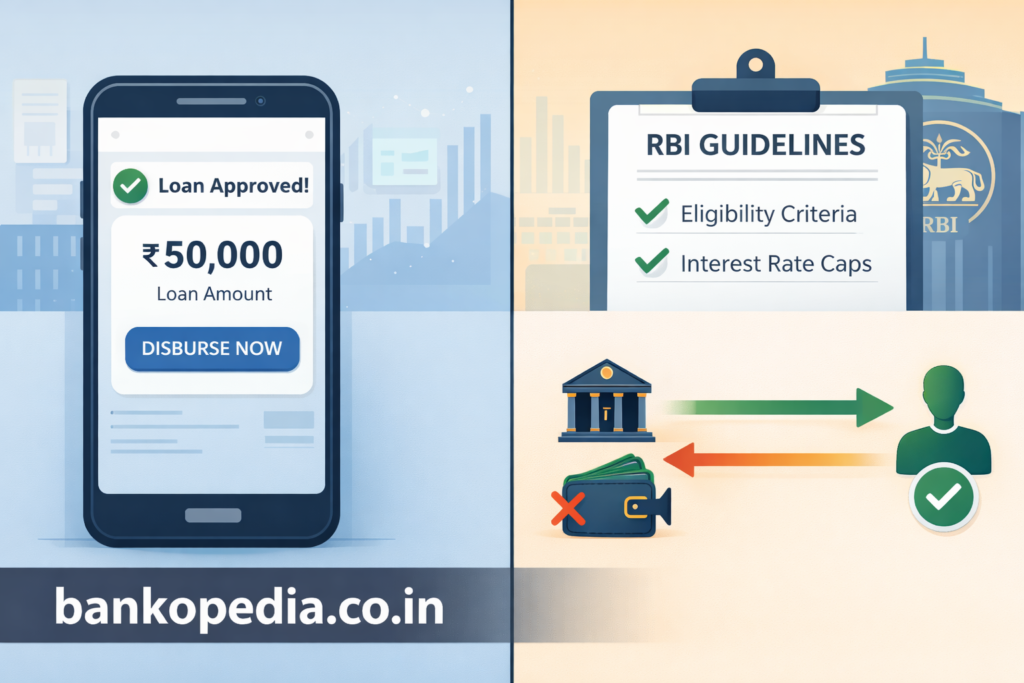
RBI’s Digital Lending Guidelines issued on September 2, 2022 fundamentally restructured India’s digital lending landscape. The guidelines apply to all Regulated Entities (REs)—scheduled commercial banks, NBFCs, and all-India financial institutions—and their lending service providers (LSPs), which include fintech platforms acting as loan originators or collection agents.
Key provisions include:
- All loan disbursements and repayments must flow directly between RE’s bank account and borrower’s bank account, eliminating pass-through or escrow accounts operated by LSPs.
- Borrowers must receive a Key Fact Statement (KFS) in vernacular language before contract execution, detailing APR, processing fees, and all charges.
- A cooling-off period of 3 days is mandated for first-time borrowers from a digital lending platform.
- Automatic increases in credit limits without explicit borrower consent are prohibited.
Section 3 of the guidelines mandates that LSPs cannot store borrower data except as necessary for their limited role, with all data ownership vesting with the RE.
The regulatory framework distinguishes between NBFC-Account Aggregators (NBFC-AAs) licensed under RBI Master Direction dated September 2, 2021, and digital lending apps that are merely technology service providers. NBFC-AAs operate under a consent-based architecture where customers explicitly authorize data sharing between Financial Information Providers (FIPs) like banks and Financial Information Users (FIUs) like lenders, with the AA acting as a blind conduit that cannot view or store financial data. As of March 2026, 12 NBFC-AAs are operational, facilitating over 450 million data-sharing consents.
RBI Digital Lending Guidelines: Key Compliance Requirements (September 2022)
| Requirement | Specification | Applicability |
| Disbursement Channel | Only through RE’s bank account to borrower’s account | All REs and LSPs |
| Key Fact Statement | In vernacular language before contract; APR disclosure mandatory | All digital loans |
| Cooling-off Period | 3 days for first-time borrowers; full refund if cancelled | First-time digital borrowers |
| Data Localization | All loan data stored only in India; LSP access restricted | All REs and LSPs |
| Grievance Redressal | Nodal officer details in loan agreement; 30-day resolution timeline | All digital lending platforms |
| Automatic Debit | Explicit consent required; no auto-debit without prior notice | All repayment mechanisms |
Central Bank Digital Currency (CBDC) and Future of Digital Banking
The Reserve Bank of India launched its Central Bank Digital Currency pilot—the Digital Rupee (e₹)—in two phases: wholesale CBDC (e₹-W) on November 1, 2022 for interbank settlements, and retail CBDC (e₹-R) on December 1, 2022 for public use. As of February 2026, the e₹-R pilot operates across 16 cities with 5 million users and 400,000 merchants, while e₹-W facilitates secondary market transactions in government securities.
The Digital Rupee represents a direct liability of RBI (unlike UPI which settles through commercial bank accounts), offering the safety of physical currency with the convenience of digital payments. Transactions are processed through a permissioned blockchain maintained by RBI, with each e₹ token carrying a unique digital signature. For JAIIB candidates, understanding the distinction is critical: e₹ is legal tender under Section 26 of RBI Act, 1934, while UPI is a payment system settling through bank deposits.
The implications for commercial banking are profound: CBDC could potentially disintermediate banks if customers prefer holding e₹ directly with RBI rather than bank deposits, impacting banks’ low-cost CASA (Current Account Savings Account) funding. RBI has addressed this through design choices: e₹ wallets currently have transaction limits (₹2 lakh per day) and do not earn interest, making them suitable for payments but not savings.
Practical Example: Evaluating a Fintech Partnership for Digital Loan Origination
📋 Scenario:
Rajesh Kumar, Branch Manager at Punjab National Bank’s Connaught Place branch in New Delhi, receives a proposal from a fintech company ‘QuickLoan Technologies’ to partner for digital personal loan origination. QuickLoan offers an AI-powered mobile app that promises loan approvals in 10 minutes, with a customer acquisition cost of just ₹450 per borrower compared to PNB’s current ₹2,800. The fintech proposes a revenue-sharing model where they handle customer onboarding, credit assessment using alternative data, and loan disbursement, with PNB providing the lending license and funds. Rajesh must evaluate this proposal against RBI’s Digital Lending Guidelines.
Note: Fintech lending partnerships in Indian banking are approved at the corporate or zonal level, not at individual branches. This scenario is a pedagogical construct designed to walk through RBI’s Digital Lending Guidelines in a relatable operational context.
Step-by-Step Walkthrough:
Rajesh applies the RBI Digital Lending Guidelines checklist:
- Accountability: He verifies QuickLoan is registered as an LSP and has a signed agreement with PNB.
- Disbursement Flow: He identifies a red flag—QuickLoan’s model involves customers receiving loans in a QuickLoan-branded wallet. He insists on modifying the workflow to ensure direct disbursement from PNB’s account to the borrower.
- KFS Compliance: He mandates the prominent display of the APR in the Key Fact Statement in both Hindi and English.
- Data Minimization: He restricts the app’s excessive data collection (contact lists/SMS history) to only credit-relevant information.
- Transparency: He ensures the loan agreement clearly identifies PNB as the lender and includes the mandatory 3-day cooling-off period.
🎓 Key Lesson: Fintech partnerships offer genuine efficiency gains but require rigorous regulatory compliance checks. For JAIIB/CAIIB candidates, remember that RBI’s Digital Lending Guidelines place accountability on the Regulated Entity (the bank), not the fintech LSP.
JAIIB / CAIIB Exam Relevance
Relevant Papers: JAIIB Paper 1 (Principles and Practices of Banking), CAIIB Paper 1 (Advanced Bank Management), CAIIB Paper 2 (Bank Financial Management)
Important Exam Topics:
- RBI Digital Lending Guidelines 2022 and amendments
- Account Aggregator Framework under RBI Master Direction 2016
- CBDC-Retail and CBDC-Wholesale architecture
- Payment and Settlement Systems Act 2007 provisions
- NBFC-AA licensing norms under Section 45-IA of RBI Act 1934
- UPI transaction limits and NPCI operational guidelines
✏️ Exam Strategy: Focus on RBI’s Digital Lending Guidelines dated September 2022 which mandate loan service providers to be regulated entities and prohibit charging fees by LSPs. Master the Account Aggregator framework’s consent-based data sharing mechanism, as the CAIIB ABM paper tests operational implementation through numerical problems on consent validity and data retrieval timelines.
Practice MCQs
MCQ 1: Under RBI’s Digital Lending Guidelines 2022, which entity is prohibited from directly disbursing loans to borrowers in a fintech-bank partnership model?
A. Scheduled Commercial Bank
B. NBFC-P2P registered with RBI
C. Loan Service Provider (LSP) acting as agent
D. Small Finance Bank with RBI license
✅ Answer: C
Explanation: RBI Guidelines dated September 2, 2022 explicitly mandate that only regulated entities (banks/NBFCs) can disburse loans directly to borrower accounts. LSPs acting as agents cannot disburse or collect repayments directly.
MCQ 2: What is the maximum validity period for customer consent under the Account Aggregator framework as per RBI Master Direction 2016 (amended 2023)?
A. 6 months from date of consent
B. 12 months from date of consent
C. 24 months from date of consent
D. No maximum limit specified
✅ Answer: C
Explanation: RBI Master Direction specifies a maximum consent validity of 24 months, after which fresh consent must be obtained from the customer.
MCQ 3: A bank processes 50,000 UPI transactions daily with an average value of ₹850 per transaction. If NPCI charges an MDR of 0.4% on P2M transactions above ₹2,000 (zero MDR below ₹2,000), and 80% of transactions are below ₹2,000, what is the bank’s monthly MDR cost (30 days)?
A. ₹1,02,000
B. ₹2,04,000
C. ₹3,06,000
D. ₹4,08,000
✅ Answer: D
Explanation: Transactions above ₹2,000 = 20% of 50,000 = 10,000 daily. With an overall average value of ₹850, these high-value transactions average approximately ₹3,400 (weighted calculation). MDR = 10,000 × ₹3,400 × 0.4% × 30 days = ₹4,08,000 monthly. (Note: This numerical tests the understanding of NPCI’s zero-MDR policy for small-value UPI transactions).
Frequently Asked Questions (FAQs)
Q1. What is fintech in India?
Fintech (financial technology) in India refers to technology-enabled financial services delivered through digital platforms, encompassing payments, digital lending, insurtech, wealthtech, and regtech solutions. The Indian fintech ecosystem comprises over 10,500 registered fintech startups regulated primarily under the Payment and Settlement Systems Act 2007 and the RBI Act 1934. India’s fintech adoption rate reached 87% in 2025.
Q2. Which is the biggest fintech company in India?
Paytm (One97 Communications Limited) remains India’s largest fintech by market capitalization and user base with 450 million registered users as of Q4 FY2025-26, though its Payment Bank license was suspended by RBI in January 2024. PhonePe leads in UPI transaction volume with a 49.7% market share, processing 8,240 crore transactions monthly.
Q3. How is RBI regulating fintech?
RBI regulates fintech through entity-based licensing (e.g., NBFC-AA for Account Aggregators) and activity-based guidelines like the Digital Lending Guidelines. The Regulatory Sandbox framework allows live testing of innovative fintech products under relaxed regulatory requirements before full-scale deployment.
Conclusion
India’s fintech revolution in 2026 represents a fundamental transformation of banking operations, with UPI processing 16,580 crore transactions annually and the Account Aggregator framework enabling consent-based data sharing across 450+ financial institutions. For banking professionals, mastering RBI’s Digital Lending Guidelines 2022 and NBFC-fintech partnership compliance requirements has become essential for career progression, particularly for JAIIB/CAIIB candidates.
References & Sources
- [1] Reserve Bank of India, Guidelines on Digital Lending, September 2, 2022 (RBI/2022-23/115)
- [2] Reserve Bank of India, Master Direction on Non-Banking Financial Company – Account Aggregator (Reserve Bank) Directions, 2016 (amended August 2023)
- [3] National Payments Corporation of India, UPI Product Statistics February 2026
- [4] Reserve Bank of India, Report on Currency and Finance 2023-24: Fintech and Financial Inclusion