
⭐ Key Takeaways
- Updated Structure: The JAIIB exam now definitively comprises four mandatory papers: Indian Economy & Indian Financial System (IE&IFS), Principles & Practices of Banking (PPB), Accounting & Financial Management (AFM), and Retail Banking & Wealth Management (RBWM).
- Eligibility Criteria: Candidates must be active employees in the banking and finance industry. While any regular employee is eligible, understanding specific bank-promoted criteria (like 2 years of service for certain internal promotions) is vital.
- Scoring System: Each paper carries 100 marks (100 MCQs × 1 mark). The passing mark is 50 out of 100 per paper, or a minimum of 45 in each subject with an overall aggregate of 50% across all four papers in a single attempt.
- Examination Cycles: The Indian Institute of Banking & Finance (IIBF) conducts JAIIB exams twice yearly (May and November cycles) in an online, objective-type format.
- Preparation Timeline: A systematic, structured preparation covering IIBF primary study materials, RBI Master Circulars, and rigorous mock test practice over 3-4 months yields an 85%+ success rate on the first attempt.
Introduction: The Rising Value of JAIIB in Modern Banking
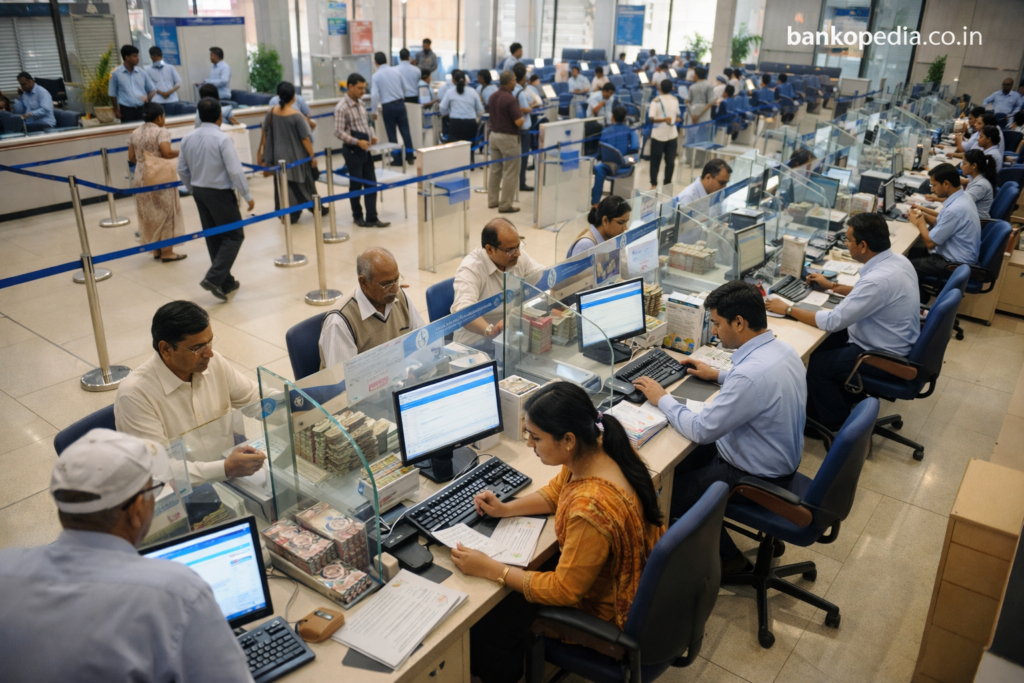
As of early 2026, over 4.5 lakh bank employees across India hold the Junior Associate of Indian Institute of Bankers (JAIIB) certification. It is no longer just an optional credential; it has evolved into the most essential professional qualification for anyone looking to build a long-term, lucrative career in Indian banking. The upcoming JAIIB Exam 2026 is pivotal for ambitious professionals.
The most recent JAIIB exam cycles witnessed record-breaking registrations, reflecting the certification’s critical role in career progression. For professionals in public sector banks (PSBs), the JAIIB Exam 2026 is often a strict prerequisite for promotion from clerical grades to Scale-I officer, or from Scale-I to Scale-II. For those in the private sector, completing the certification triggers immediate, tangible rewards—often translating to salary increments ranging from ₹8,000 to ₹15,000 per month, alongside preferential placements in specialized departments like credit analysis, treasury, and risk management.
With the Indian Institute of Banking & Finance (IIBF) introducing sweeping syllabus revisions to align with global banking standards, understanding the complete preparation roadmap has never been more vital. The transition to a four-paper structure was designed to ensure that modern bankers are equipped not just with operational knowledge, but with deep macroeconomic insights and wealth management strategies.
This comprehensive guide covers every aspect of JAIIB Exam 2026 preparation for the upcoming examination cycles. We will break down detailed eligibility criteria, paper-wise syllabus weightage, proven study strategies from top-scoring candidates, time management techniques for exhausted working bankers, and practice MCQs aligned with the latest IIBF exam pattern. Whether you are a newly joined clerk aspiring for officer-level roles or a Scale-I officer targeting accelerated promotions, this guide provides the authoritative framework to clear all four JAIIB papers in your first attempt, especially with the JAIIB Exam 2026 approaching.
Understanding JAIIB Exam 2026: Structure, Eligibility, and Registration
The JAIIB examination underwent its most significant structural reform in recent years when IIBF overhauled the curriculum to reflect the realities of digital banking, advanced financial management, and macroeconomic trends, making the JAIIB Exam 2026 more relevant than ever.
This guide will help you excel in the JAIIB Exam 2026 and secure your future.
The Four-Paper Framework
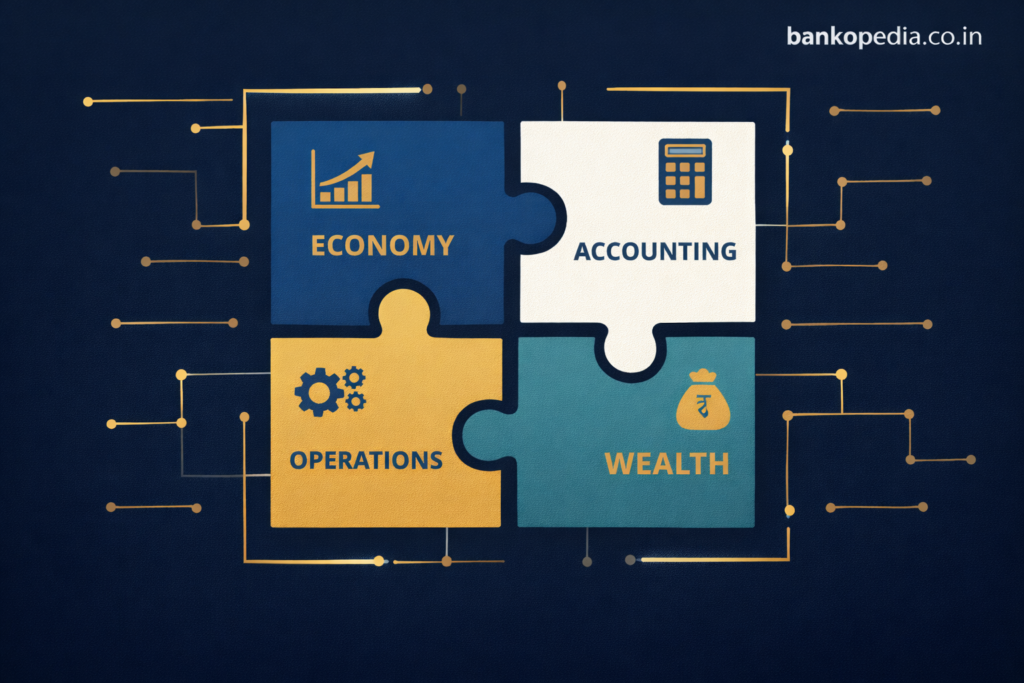
The JAIIB Exam 2026 is crucial for advancing your career in the banking sector.
Replacing the legacy three-paper system, candidates must now clear the following four papers:
- Paper I: Indian Economy & Indian Financial System (IE&IFS)
- Paper II: Principles & Practices of Banking (PPB)
- Paper III: Accounting & Financial Management for Bankers (AFM)
- Paper IV: Retail Banking & Wealth Management (RBWM)
Each paper comprises 100 multiple-choice questions carrying 100 marks in total. Candidates are given 120 minutes per paper. The passing requirement is 50 marks in each paper individually. However, IIBF provides a generous aggregate rule: if a candidate secures at least 45 marks in each subject and an aggregate of 50% (200 out of 400 marks) across all papers in a single attempt, they are declared successful.
Candidates must clear all four papers within a rolling three-year window (maximum of 5 attempts). If a candidate fails to clear the exam within this time limit, they must re-enroll afresh, and previously cleared papers will lapse.
Eligibility and Registration
The JAIIB exam is exclusively open to ordinary members of the IIBF. To become an ordinary member, you must be an employee of a recognized banking or financial institution in India.
- Service Requirements: While basic eligibility begins upon joining a bank, many public sector banks require 1 to 2 years of continuous service for the certification to be considered valid for immediate internal promotion cycles.
- Registration Process: Registration typically opens 60 to 90 days before the May and November examination cycles through the IIBF portal (www.iibf.org.in).
- Fees: The standard examination fee for the first attempt at all four papers is approximately ₹4,000 (excluding GST). Subsequent attempts incur a lower fee per attempt.
- Mode of Exam: Conducted entirely in an online, objective-type mode at designated test centers across India.
JAIIB Exam 2025: Key Parameters at a Glance
| Paper Code | Paper Name | Questions | Duration | Pass Marks |
| Paper-I | Indian Economy & Indian Financial System | 100 MCQs | 120 minutes | 50/100 |
| Paper-II | Principles & Practices of Banking | 100 MCQs | 120 minutes | 50/100 |
| Paper-III | Accounting & Financial Management | 100 MCQs | 120 minutes | 50/100 |
| Paper-IV | Retail Banking & Wealth Management | 100 MCQs | 120 minutes | 50/100 |
💡 Banker’s Tip: Always register for all four papers in a single cycle. Taking advantage of the aggregate rule (scoring 45+ in tough subjects and 60+ in easier ones like PPB to hit the 200 mark total) is the most common strategy used by first-attempt clearers.
Paper-Wise Syllabus Breakdown and Weightage Distribution
To succeed in JAIIB, you must allocate your study time based on module weightage and historic difficulty levels.
Paper-I: Indian Economy & Indian Financial System (IE&IFS)
This paper sets the macroeconomic foundation. It moves away from day-to-day banking to test a banker’s understanding of the broader economic environment.
- Economic Architecture (25%): Overview of the Indian economy, sectors of the economy, economic planning, and NITI Aayog.
- Economic Concepts (30%): Supply and demand, money supply, inflation, business cycles, and GDP concepts.
- Financial System (25%): Role of RBI, SEBI, IRDAI, and PFRDA. Understanding money markets and capital markets.
- Financial Products (20%): Factoring, forfaiting, lease finance, and venture capital.
- Strategy: Focus heavily on the functions of regulatory bodies and basic macroeconomic formulas (GDP, GNP, NNP).
Paper-II: Principles & Practices of Banking (PPB)F
This is the core operational paper and is generally considered the most familiar to working bankers.
- General Banking Operations (35%): Banker-customer relationship, KYC/AML guidelines under PMLA 2002, operational aspects of deposit accounts, and grievance redressal.
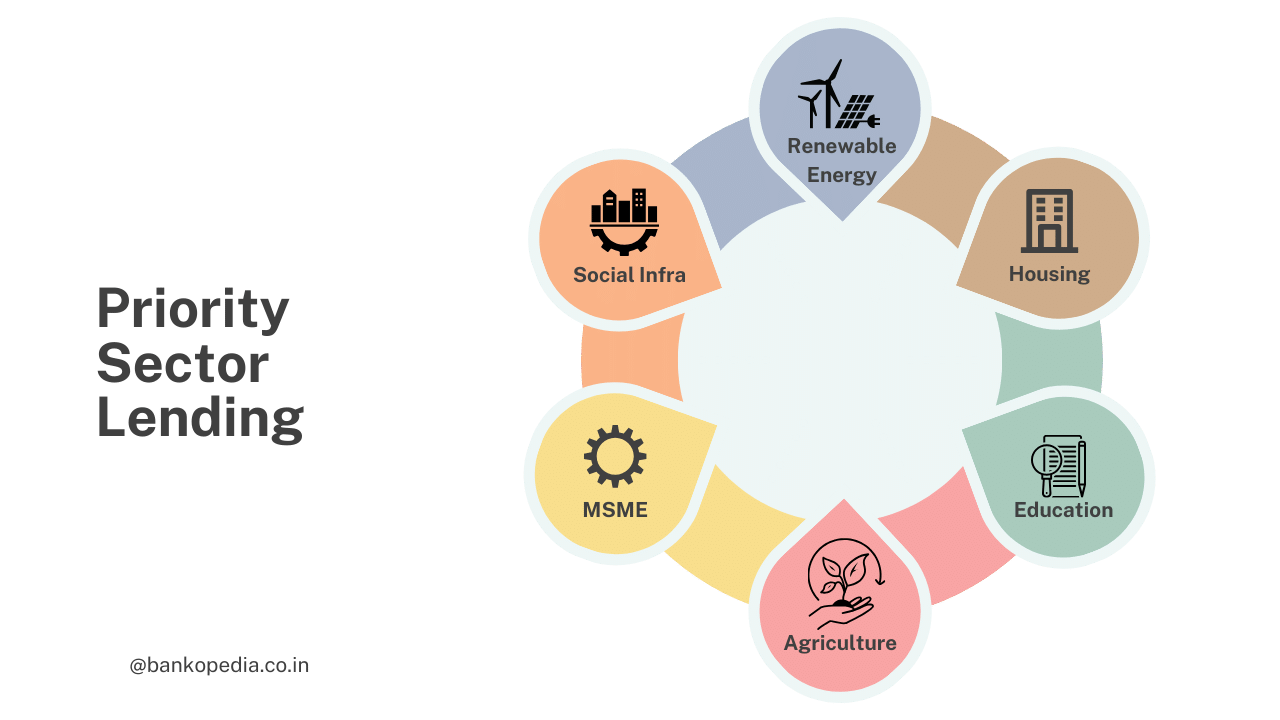
- Lending Operations (30%): Principles of lending, appraisal of credit facilities, priority sector lending (PSL) norms, MSME financing, and NPA management.
- Banking Technology (20%): Core Banking Systems (CBS), digital payment ecosystems (UPI, NEFT, RTGS), cyber security, and data protection.
- Ethics in Banks (15%): Ethical foundations, business ethics, and corporate governance.
- Strategy: Memorize the latest RBI Master Directions on KYC, Priority Sector Lending targets, and ethical frameworks.
Paper-III: Accounting & Financial Management for Bankers (AFM)
Historically the most feared paper, AFM requires conceptual clarity and numerical practice.
- Accounting Principles (25%): Basic accounting standards, double-entry bookkeeping, trial balance, and rectification of errors.
- Financial Statements (30%): Preparation of final accounts, balance sheet equations, company accounts, and bank audit basics.
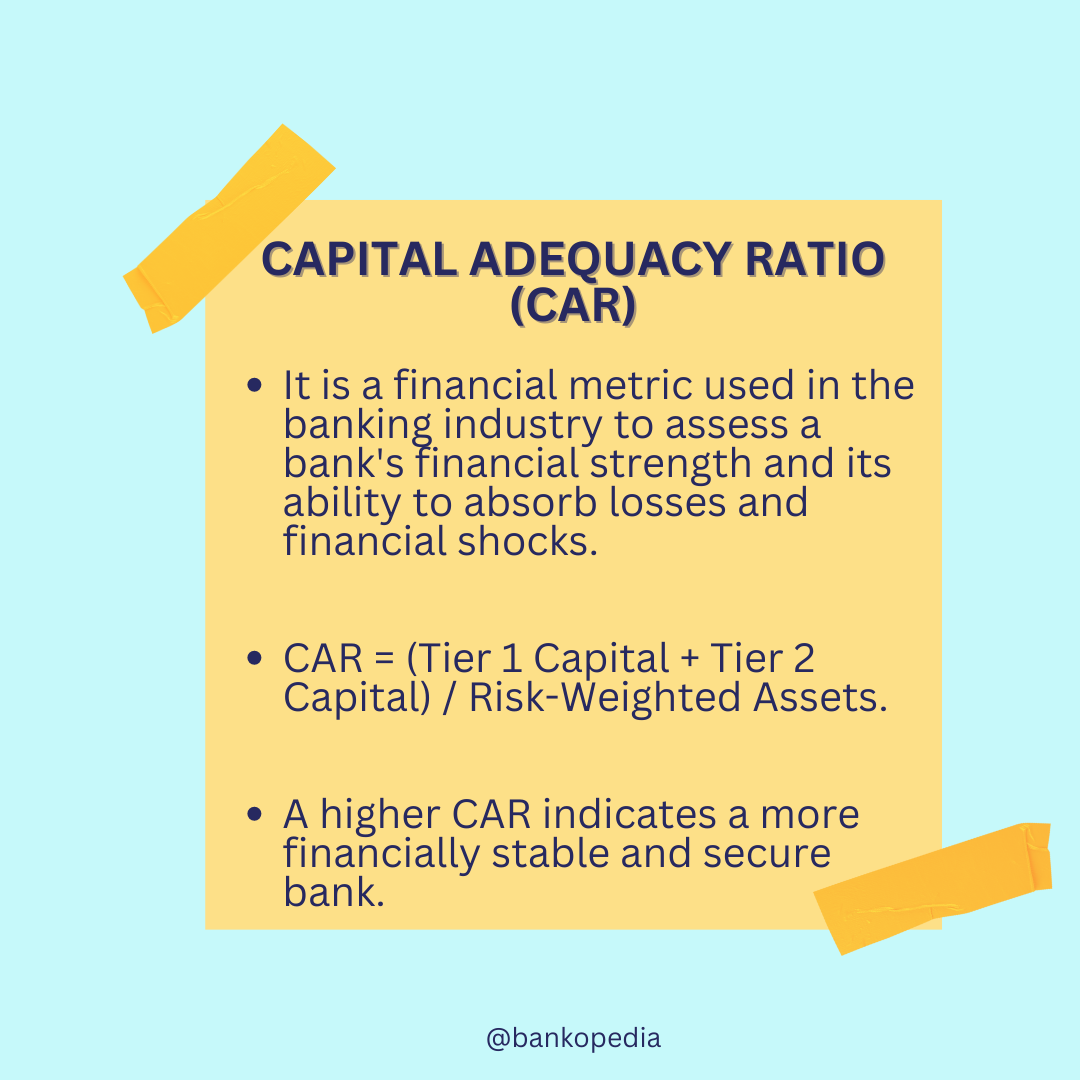
- Financial Management (25%): Ratio analysis, working capital management, capital budgeting (NPV, IRR), and yield to maturity (YTM) calculations.
- Costing & Taxation (20%): Marginal costing, standard costing, and basics of GST and Income Tax.
- Strategy: Do not memorize theory at the expense of solving numericals. Spend 60% of your time mastering Ratio Analysis and Capital Budgeting formulas.
Paper-IV: Retail Banking & Wealth Management (RBWM)
This paper is highly practical and scoring, as it mirrors modern branch banking realities.
- Retail Banking Landscape (20%): Evolution, branch profitability, and customer segmentation.
- Retail Products (35%): Home loans, vehicle loans, personal loans, credit cards, and the recovery process (SARFAESI basics).
- Marketing (20%): Delivery channels, CRM, and marketing mix in retail banking.
- Wealth Management (25%): Investment products, mutual funds, insurance (bancassurance), and tax planning.
- Strategy: Leverage your daily branch experience. Focus study efforts purely on the Wealth Management module, which may be unfamiliar to general banking staff.
Proven 16-Week Study Strategy and Time Management

Finding time to study while balancing a demanding banking job—often involving late evenings and month-end pressures—is the biggest hurdle candidates face. A systematic 16-week preparation plan yields optimal results.
The 16-Week Framework
Phase 1: Foundation Building (Weeks 1-4)
- Goal: Complete the first reading of Macmillan Education (IIBF official) study materials or reliable third-party summary notes.
- Time Commitment: 2 hours daily during weekdays (early morning is recommended before branch fatigue sets in), and 4-5 hours on weekends.
- Focus: Read like a novel. Do not memorize yet; just understand the concepts, especially for IE&IFS and AFM.
Phase 2: Concept Strengthening (Weeks 5-8)
- Goal: Module-wise revision, rigorous note-making, and initial MCQ practice.
- Time Commitment: 2.5 hours weekdays, 5 hours weekends.
- Focus: Dedicate this entire phase to Paper III (AFM) numericals and Paper I (IE&IFS) macroeconomic concepts. Solve at least 50 chapter-wise MCQs daily.
Phase 3: Mock Test Practice (Weeks 9-12)
- Goal: Build stamina and identify weak areas.
- Time Commitment: 2 hours weekdays, 6 hours weekends.
- Focus: Take full-length, 120-minute mock tests every Sunday. Analyze your errors on Monday and Tuesday. If you are consistently scoring below 40 in AFM, go back to the basic formulas.
Phase 4: Final Rapid Revision (Weeks 13-16)
- Goal: Memorization of statutory sections, limits, and final mock exams.
- Time Commitment: 3 hours weekdays, 6 hours weekends.
- Focus: Create flashcards for RBI limits (e.g., PSL targets, LTV ratios) and accounting formulas. Rely entirely on your self-made summary notes.
Exam Day Strategy
With 100 questions in 120 minutes, candidates have an average of 72 seconds per question.
- First Pass (45 minutes): Go through the entire paper and solve every question you are 100% sure about. This secures your baseline score.
- Second Pass (45 minutes): Tackle numerical questions (in AFM) and case studies (in PPB) that require calculation or deep reading.
- Third Pass (30 minutes): Attempt the remaining questions. Since there is currently no negative marking in JAIIB, do not leave any question unattempted. Use educated guessing by eliminating the two most unlikely options.
Post-Certification Career Impact and CAIIB Progression Pathway
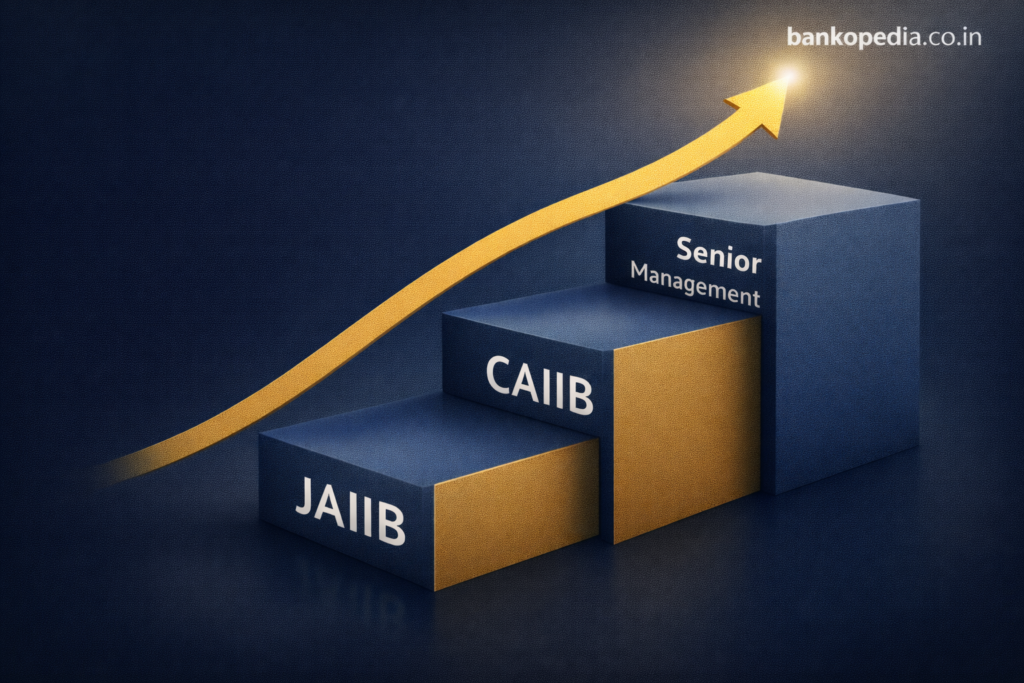
JAIIB certification delivers measurable, compounding career benefits across all Indian banking institutions.
Immediate Financial and Promotional Benefits
In public sector banks, clearing JAIIB grants you one advance increment in your salary scale. For a newly joined clerk or probationary officer, this translates to thousands of rupees in additional lifetime earnings due to the compounding effect on basic pay, DA, and superannuation benefits. Furthermore, JAIIB is explicitly mentioned in the promotion policy circulars of major banks (like SBI, PNB, and Bank of Baroda) as a mandatory requirement or a heavily weighted scoring metric for fast-track promotions.
Private sector banks leverage JAIIB to identify talent for specialized desks. Banks like HDFC, ICICI, and Axis frequently prioritize JAIIB-certified personnel when filling coveted roles in credit underwriting, forex, or corporate banking, often paired with performance bonuses.
The Gateway to CAIIB
JAIIB is merely the first step. It serves as the mandatory prerequisite for appearing in the Certified Associate of Indian Institute of Bankers (CAIIB) examination. While JAIIB focuses on basic operations, CAIIB dives into Advanced Bank Management (ABM), Bank Financial Management (BFM), and Advanced Business & Financial Management (ABFM).
As per the RBI’s focus on continuous skill upgradation, scheduled commercial banks are heavily incentivizing staff to complete both certifications. Clearing CAIIB adds another increment (or two, for clerical staff) and opens pathways to senior management positions.
Practical Scenario: A Working Banker’s Journey
📋 Case Study: Priya Mehta, Scale-I Officer
Priya, a Scale-I officer at a busy urban branch with 3 years of service, registered for all four JAIIB papers in the May cycle. Working in the retail assets division from 9:30 AM to 6:30 PM, she needed a realistic, burnout-proof strategy.
Her Approach: Priya abandoned the idea of studying late at night when she was exhausted. Instead, she woke up at 5:30 AM, dedicating 90 minutes to high-focus topics like AFM and IE&IFS before leaving for the branch. During her daily commute, she listened to YouTube summary videos on PPB and RBWM.
The Tipping Point: Weekends were sacred. She locked in 6 hours every Sunday purely for mock tests and numerical practice. She tracked her errors in an Excel sheet, noticing she consistently failed Working Capital Management questions. She spent an entire weekend mastering just that module.
The Result: By utilizing the aggregate rule, she scored 65 in PPB, 68 in RBWM, 46 in AFM, and 52 in IE&IFS. Her total was 231/400. Despite narrowly passing AFM, the high scores in the theory papers pulled her aggregate well above the 200-mark requirement, earning her the JAIIB certificate in her very first attempt.
High-Yield Exam Topics to Master for 2026
To maximize your ROI on study time, ensure you have these topics committed to memory:
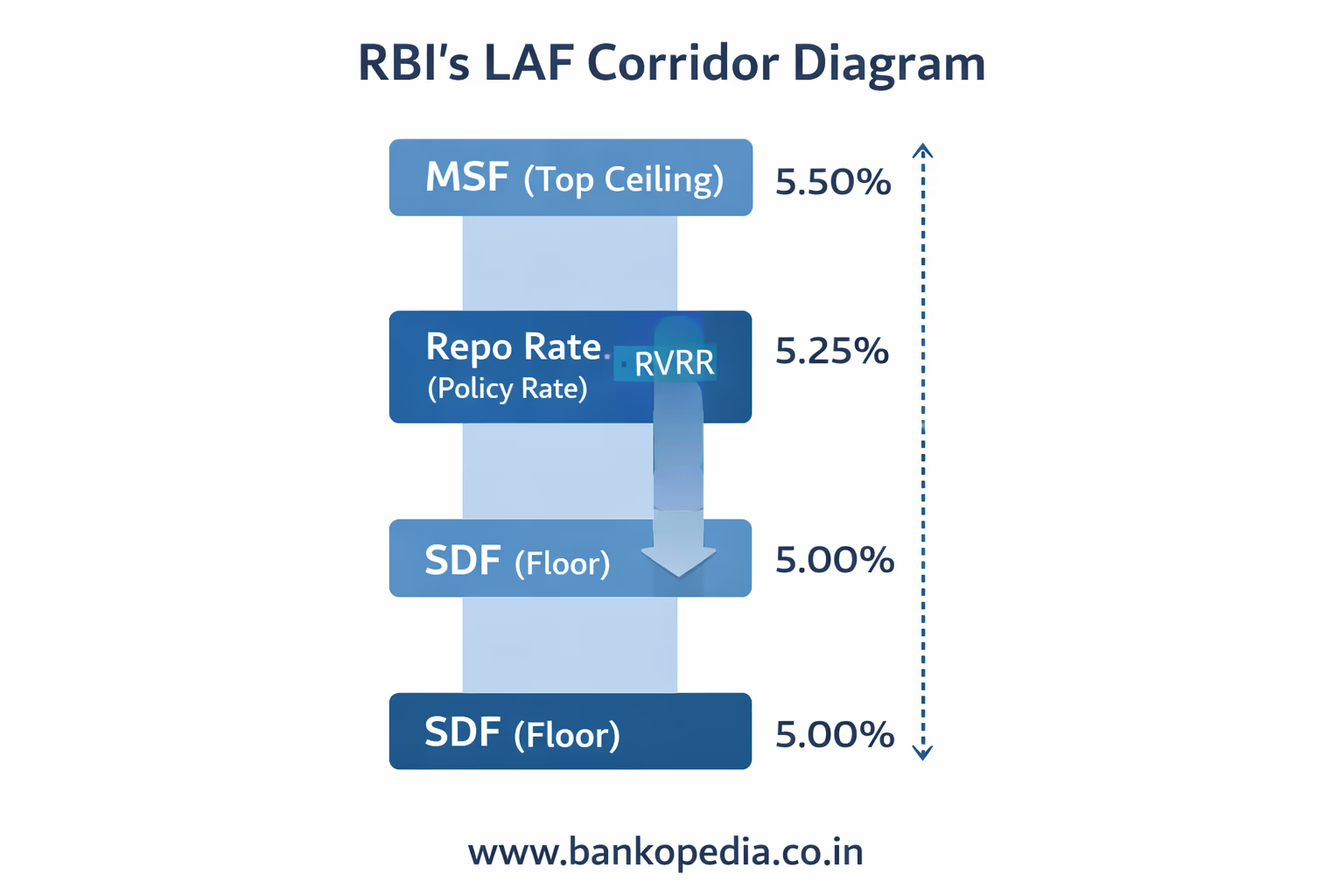
- RBI Policy Rates: Current Repo, Reverse Repo, MSF, Bank Rate, CRR, and SLR.
- Priority Sector Lending (PSL): Sub-targets for Small & Marginal Farmers, Weaker Sections, and Micro Enterprises.
- KYC/AML Guidelines: OVDs (Officially Valid Documents), risk categorization, and CTR/STR reporting timelines.
- Accounting Formulas: Current Ratio, Quick Ratio, Debt-Equity Ratio, NPV, and Break-Even Point.
- Negotiable Instruments Act, 1881: Sections dealing with Cheques, Bills of Exchange, Promissory Notes, and Section 138 (dishonor of cheque).
Practice MCQs
Test your knowledge with these updated, syllabus-aligned questions:
MCQ 1: Under the Priority Sector Lending (PSL) guidelines updated by RBI, what is the target for Micro Enterprises for Scheduled Commercial Banks?
A) 7.5% of ANBC
B) 10% of ANBC
C) 12% of ANBC
D) 18% of ANBC
✅ Answer: A
Explanation: Under RBI guidelines, the target for lending to Micro Enterprises is 7.5% of Adjusted Net Bank Credit (ANBC) or Credit Equivalent Amount of Off-Balance Sheet Exposure, whichever is higher.
MCQ 2: In Accounting & Financial Management, which of the following ratios indicates the long-term solvency of a firm?
A) Current Ratio
B) Quick Ratio
C) Debt-Equity Ratio
D) Inventory Turnover Ratio
✅ Answer: C
Explanation: The Debt-Equity ratio measures a company’s financial leverage and long-term solvency by indicating how much debt a company is using to finance its assets relative to the value of shareholders’ equity.
MCQ 3: As per IIBF guidelines, what is the maximum number of attempts allowed to pass the JAIIB examination under one registration?
A) 3 attempts within 2 years
B) 5 attempts within 3 years
C) 4 attempts within 2 years
D) Unlimited attempts
✅ Answer: B
Explanation: Candidates are allowed a maximum of 5 attempts to clear all four papers within a rolling time limit of 3 years. If they fail to do so, they must re-register and forfeit any papers previously passed.
MCQ 4: Which of the following is NOT an Officially Valid Document (OVD) for KYC purposes as per RBI guidelines?
A) Passport
B) Voter ID Card
C) Job card issued by NREGA
D) Bank Passbook with photograph
✅ Answer: D
Explanation: While commonly used for identification, a Bank Passbook is not classified as an OVD by the RBI. The six OVDs are Passport, Driving License, Voter ID, PAN card, Aadhaar letter/card, and NREGA job card.
MCQ 5: If a project has a Net Present Value (NPV) of zero, what does it signify?
A) The project will result in massive losses.
B) The project’s internal rate of return equals the required rate of return.
C) The project has infinite profitability.
D) The project’s payback period is exactly one year.
✅ Answer: B
Explanation: An NPV of zero indicates that the project generates cash flows that exactly match the cost of capital. In this state, the Internal Rate of Return (IRR) is equal to the required discount rate.
Frequently Asked Questions (FAQs)
Q1. What is the JAIIB exam?
JAIIB (Junior Associate of Indian Institute of Bankers) is a premier foundational certification examination conducted by IIBF. It validates a banker’s professional knowledge of banking operations, basic economics, accounting principles, and wealth management. It is highly valued for career progression and mandatory for certain promotions in Indian banks.
Q2. How many papers are there in the current JAIIB syllabus?
There are exactly four mandatory papers in the revised JAIIB syllabus:
- Indian Economy & Indian Financial System (IE&IFS)
- Principles & Practices of Banking (PPB)
- Accounting & Financial Management for Bankers (AFM)
- Retail Banking & Wealth Management (RBWM).
Q3. Is there negative marking in the JAIIB exam?
Currently, IIBF does not apply negative marking in the JAIIB examination. Candidates are strongly encouraged to attempt all 100 questions in every paper. (Always verify the exact rules on your specific admit card, as IIBF occasionally reviews its testing policies).
Q4. What are the passing marks for JAIIB?
To pass, you must score a minimum of 50 marks out of 100 in each of the four papers. However, if you appear for all four papers in a single attempt, you can pass by scoring a minimum of 45 in each paper, provided your total aggregate across all four papers is at least 200 (50%).
Q5. Can a non-banker appear for the JAIIB exam?
No. JAIIB is exclusively for ordinary members of IIBF, and membership is restricted to employees of recognized banking and financial establishments. Non-bankers interested in a similar credential can apply for the Diploma in Banking & Finance (DB&F), which shares the exact same syllabus.
Q6. When are the exams usually held?
IIBF typically conducts the JAIIB examinations twice a year, generally over weekends in the months of May/June and November/December.
Q7. What happens if I fail one paper but pass the other three?
You will retain the credits for the three passed papers, provided you clear the remaining failed paper within the stipulated time limit (3 years or 5 attempts from your first registration). In your next attempt, you only need to appear for the paper you failed, but you will need to score a strict 50 marks in it (the aggregate rule will no longer apply).
Conclusion
The JAIIB certification remains the foundational stepping stone for any ambitious banking professional in India. The transition to the comprehensive four-paper structure ensures that modern bankers are equipped not just to handle daily branch operations, but to navigate macroeconomic shifts, complex financial management, and the booming wealth management sector.
Success in JAIIB requires a pivot away from rote memorization toward deep conceptual clarity and strategic time management. By following a structured 16-week study plan, prioritizing high-weightage topics, and leveraging the power of mock tests, clearing this exam on your first attempt is an entirely achievable goal.
Start early, stay consistent, and remember that the knowledge gained here will pay dividends throughout your entire banking career.





3 thoughts on “JAIIB Exam 2026: Complete Preparation Guide for Banking Professionals”