Table of Contents
What is the Indian Banking System?
The Indian banking system is the backbone of the country’s economy. It is a network of financial institutions — led by the Reserve Bank of India (RBI) — that channels savings into productive investments, facilitates payments, extends credit to businesses and individuals, and implements the government’s monetary and fiscal policies.
The indian banking system is crucial for the economic development of the nation. The efficiency of the indian banking system can significantly impact various sectors.
With advancements in technology, the indian banking system is evolving rapidly, making banking services more accessible to the public.
India has one of the largest banking systems in the world. As of 2026, the Indian banking sector manages total assets exceeding ₹250 lakh crore (approximately USD 3 trillion), serves over 1.5 billion people, and operates through more than 1,50,000 bank branches and 2,50,000+ ATMs across the country.
At its heart, the Indian banking system performs three critical economic functions:
- Intermediation: Mobilising savings from households and channelling them as credit to productive sectors of the economy.
- Payments: Enabling the smooth settlement of transactions through NEFT, RTGS, IMPS, UPI and other payment infrastructure.
- Monetary Transmission: Acting as the conduit through which RBI’s monetary policy decisions — such as changes in the repo rate — flow into the broader economy.
🏦 Banker’s Perspective
In over 15 years of banking, I have seen the Indian banking sector transform from largely paper-based, branch-centric operations in the early 2000s to a system where nearly 80% of transactions by volume are now digital. Understanding this system — its structure, regulators, instruments and laws — is fundamental for every banker, whether you are preparing for JAIIB/CAIIB, appearing for a promotion interview, or simply doing your job better.
Structure of the Indian Banking System
In understanding the nuances of the indian banking system, it becomes evident that regulatory frameworks play a vital role in its stability and growth.
The Indian banking system follows a two-tier structure:
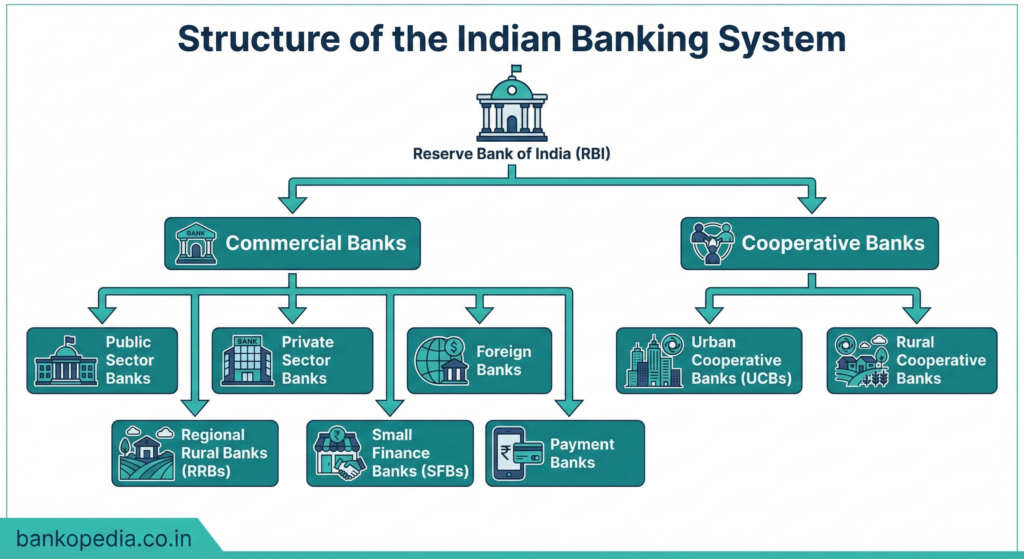
Tier 1 — The Central Bank: The Reserve Bank of India (RBI), established in 1935 under the Reserve Bank of India Act, 1934, is the apex monetary authority. It issues currency, formulates monetary policy, regulates and supervises all banks, and manages India’s foreign exchange reserves.
The structure of the indian banking system is designed to promote financial inclusion and support economic activities across various sectors.
Tier 2 — Commercial and Cooperative Banks: All scheduled and non-scheduled banks that accept deposits, extend credit, and provide payment services to individuals, businesses and the government. This includes public sector banks, private banks, foreign banks, RRBs, small finance banks, payment banks and cooperative banks.
Understanding the monetary transmission in the indian banking system helps grasp how policies affect the economy.
Scheduled vs Non-Scheduled Banks
Aspects of compliance and governance are crucial within the context of the indian banking system.
A scheduled bank is a bank included in the Second Schedule of the RBI Act, 1934. To qualify, a bank must have paid-up capital and reserves of at least ₹5 lakh and must satisfy RBI that its operations do not adversely affect depositors’ interests.
The role of cooperative banks in the indian banking system is significant, as they cater to the underserved segments of society.
Scheduled banks are entitled to borrowing facilities from RBI (repo, MSF) and clearing house membership. Virtually all major banks in India today — public sector, private, foreign and RRBs — are scheduled banks. Non-scheduled banks are very rare and operate under stricter RBI oversight.
Commercial Banks vs Cooperative Banks
Commercial banks are profit-oriented entities that accept deposits and extend loans across all sectors. They are regulated primarily by the RBI under the Banking Regulation Act, 1949.
Cooperative banks operate on a co-operative principle — owned by their members — and serve specific communities. They are jointly regulated by RBI (for banking functions) and the respective State Registrar of Co-operative Societies (for management functions). This dual regulation has historically been a source of governance challenges.
Foreign banks contribute to the diversity of the indian banking system by bringing in global practices and competition.
Types of Banks in India
Understanding the regulatory framework is key to navigating the complexities of the indian banking system.
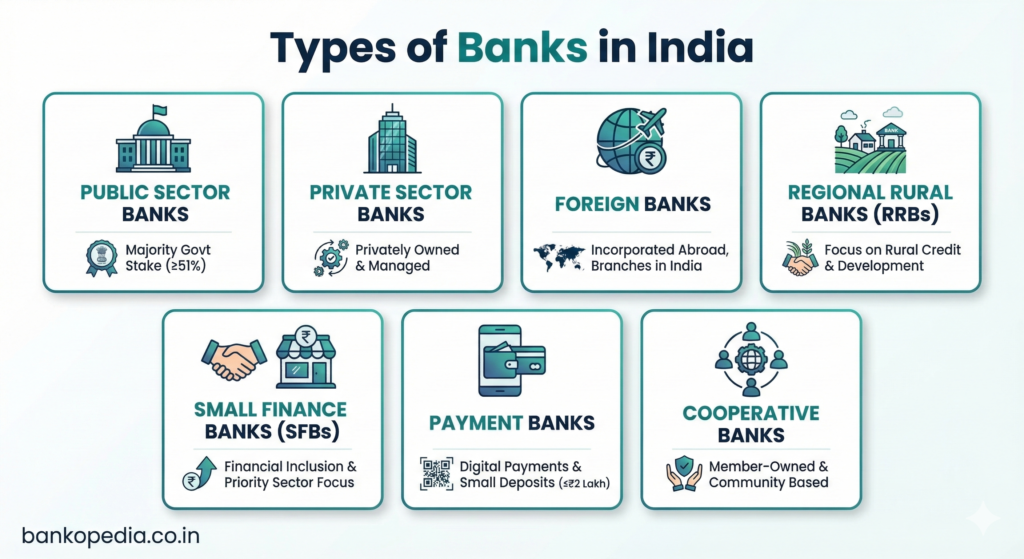
India has seven distinct categories of banks, each with a different ownership model, mandate and target segment. The table below provides a comprehensive overview:
| Bank Type | Ownership Structure | Key Examples | Market Share / Size |
|---|---|---|---|
| Public Sector Banks (PSBs) | Majority government-owned (>51%) | State Bank of India, Bank of Baroda, Punjab National Bank | ~59% of total banking assets |
| Private Sector Banks | Majority privately owned | HDFC Bank, ICICI Bank, Axis Bank, Kotak Mahindra Bank | ~37% of total banking assets |
| Foreign Banks | Incorporated outside India, branches in India | Citibank, HSBC, Standard Chartered, Deutsche Bank | ~4% of total banking assets |
| Regional Rural Banks (RRBs) | State + Central Govt + Sponsor Bank (15%+50%+35%) | Gramin Banks in rural districts across India | 43 RRBs, ~21,000+ branches |
| Small Finance Banks (SFBs) | RBI-licensed, focus on financial inclusion | AU Small Finance Bank, Equitas, Jana, ESAF | 12 licensed SFBs as of 2026 |
| Payment Banks | Limited licence — deposits ≤₹2 lakh, no lending | Airtel Payments Bank, India Post Payments Bank, Jio Payments Bank | 6 operational as of 2026 |
| Cooperative Banks | Member-owned cooperative structure | Saraswat Co-op Bank, NKGSB Co-op Bank | Urban & rural cooperative banks |
Public sector banks form the backbone of the indian banking system and are essential for implementing government policies.
Various stakeholders, including fintechs, are increasingly involved in the evolution of the indian banking system.
* Source: RBI Annual Report 2026-27. Market share figures are approximate.
Public Sector Banks (PSBs)
As the consumer base grows, private sector banks within the indian banking system are becoming increasingly competitive.
Public Sector Banks are banks where the Government of India holds more than 50% of the paid-up capital. There are currently 12 PSBs in India following a series of mergers between 2017 and 2020. The largest is State Bank of India (SBI), which alone manages assets exceeding ₹60 lakh crore and serves over 500 million customers.
PSBs dominate priority sector lending (agriculture, MSME, education) and rural banking. However, they have historically struggled with higher Non-Performing Assets (NPAs) compared to their private sector peers. Post the Asset Quality Review of 2015-16 and the introduction of IBC, 2016, PSB NPA ratios have improved significantly, dropping from a peak of ~14% in 2018 to around 3.5% in 2026.
Private Sector Banks
Consumer protection laws are vital for safeguarding the interests of customers in the indian banking system.
The Reserve Bank of India plays a pivotal role in shaping the policies that govern the indian banking system.
Private sector banks have shown consistently strong financial performance, driven by technology investment, retail focus and superior asset quality management. HDFC Bank — the largest private bank — surpassed SBI in market capitalisation in 2023 and remains India’s most valuable bank by stock value.
Private banks can be further divided into old private sector banks (incorporated before the 1991 liberalisation, e.g., Federal Bank, South Indian Bank) and new private sector banks (licensed after 1991, e.g., HDFC Bank, ICICI Bank, Axis Bank). The latter group has been more aggressive in technology adoption and retail banking.
Small Finance Banks (SFBs) and Payment Banks
Small Finance Banks were introduced by RBI in 2015 to deepen financial inclusion. They are licensed to conduct basic banking activities — accept deposits, extend credit — but must maintain at least 75% of their loan portfolio to priority sector borrowers. Of the original 10 SFBs licensed, AU Small Finance Bank converted to a universal bank in 2024, marking a milestone.
Payment Banks have a restricted licence — they can accept deposits up to ₹2 lakh per customer and offer payment services, but cannot extend loans. Their primary value proposition is last-mile digital payment access. India Post Payments Bank, leveraging India’s postal network, is the largest by branch count.
The Reserve Bank of India (RBI) — India’s Central Bank
Innovation in technology has the potential to revolutionize the operations of the indian banking system.
The Reserve Bank of India, established on 1 April 1935, is the central bank and monetary authority of India. It was nationalised in 1949 and is headquartered in Mumbai, with regional offices across major cities. The RBI Governor is appointed by the Government of India’s Cabinet Committee on Appointments.
RBI’s Core Functions
Challenges such as NPAs impact the overall health of the indian banking system and require concerted efforts for resolution.
- Monetary Authority: Formulates and implements monetary policy to maintain price stability while keeping growth in mind.
- Issuer of Currency: Has the sole right to issue banknotes in India (except ₹1 coin and ₹1 note, issued by MoF).
- Banker to the Government: Maintains accounts of the Central and State Governments, manages public debt and advises on financial matters.
- Banker to Banks: Provides repo/MSF borrowing facilities to scheduled banks, acts as lender of last resort.
- Regulator and Supervisor: Licenses and supervises commercial banks, NBFCs, and payment systems under various Acts.
- Manager of Foreign Exchange: Manages India’s forex reserves and administers FEMA, 1999.
- Developmental Role: Promotes financial inclusion, sets up payment infrastructure (RTGS, NEFT) and supports credit to priority sectors.
RBI’s Monetary Policy Framework
Since 2016, RBI has operated under a flexible inflation-targeting framework, with a mandate to keep CPI inflation at 4% (+/- 2%). The Monetary Policy Committee (MPC) — comprising three RBI officials and three government-appointed external members — votes on key policy rates every two months.
The key monetary policy tools available to the RBI are summarised in the table below:
| Monetary Tool | Definition | Current Rate |
|---|---|---|
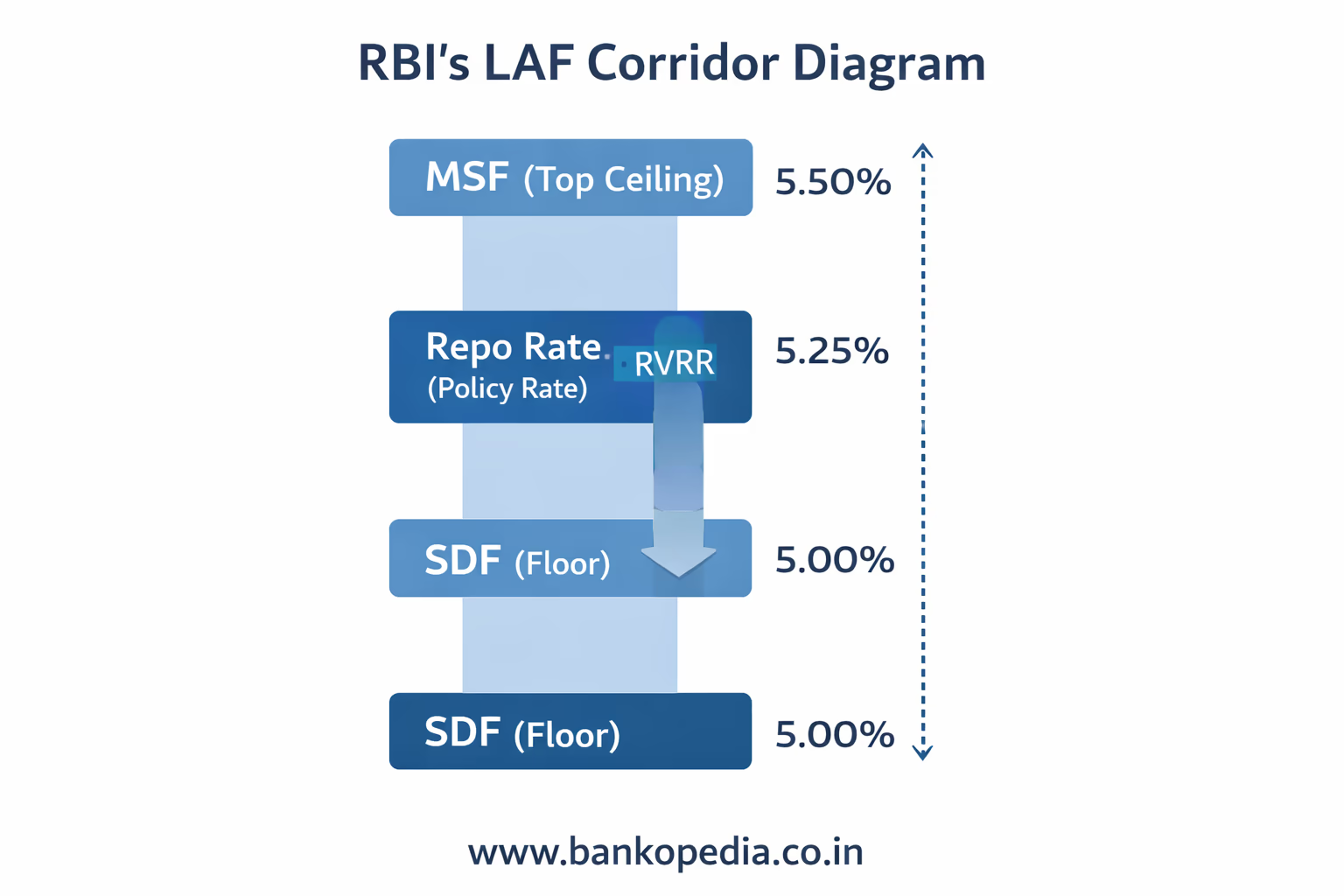
| Repo Rate | Rate at which RBI lends to banks (overnight) | 5.25%* |
| Reverse Repo Rate | Rate at which RBI borrows from banks (absorbs liquidity) | 3.35%* |
| Standing Deposit Facility (SDF) | Floor rate — RBI absorbs excess liquidity from banks without collateral | 5.00%* |
| Marginal Standing Facility (MSF) | Emergency overnight borrowing rate for banks (ceiling) | 5.50%* |
| Bank Rate | Rate for long-term lending by RBI (discounting bills) | 5.50%* |
| Cash Reserve Ratio (CRR) | % of deposits banks must hold as cash with RBI | 3.00%* |
| Statutory Liquidity Ratio (SLR) | % of deposits banks must hold in approved securities | 18.00%* |
* Rates effective as per RBI MPC decision dated 6 February 2026. CRR was cumulatively reduced by 100 bps (from 4.00% to 3.00%) during 2025-26. Repo rate has been cut by a cumulative 125 bps since early 2025. Always verify the latest rates at rbi.org.in — rates may change every two months.
Key Regulators of the Indian Financial System
India’s financial system is regulated by multiple sector-specific authorities. Banks primarily fall under the RBI’s jurisdiction, but since banks are also active in insurance, capital markets and pension distribution, they interact with all the regulators below:
| Regulator | Entities Regulated | Website |
|---|---|---|
| Reserve Bank of India (RBI) | Banks, NBFCs, Payment Systems, Forex | rbi.org.in |
| Securities & Exchange Board of India (SEBI) | Capital Markets, Mutual Funds, Stock Exchanges | sebi.gov.in |
| Insurance Regulatory & Development Authority (IRDAI) | Life & General Insurance Companies | irdai.gov.in |
| Pension Fund Regulatory & Development Authority (PFRDA) | Pension Funds, NPS | pfrda.org.in |
| National Housing Bank (NHB) | Housing Finance Companies (HFCs) | nhb.org.in |
| Ministry of Finance (MoF) | Public Sector Banks (ownership oversight) | finmin.gov.in |
Key Banking Laws and Legislation
The Indian banking system operates within a robust legal framework. The following Acts are essential for every banker to understand — they are also frequently tested in JAIIB, CAIIB and bank promotion examinations:
| Legislation | Key Purpose for Banking |
|---|---|
| Reserve Bank of India Act, 1934 | Establishes RBI; governs its constitution, functions and powers |
| Banking Regulation Act, 1949 | Primary law governing commercial banks; RBI’s regulatory powers over banks |
| SARFAESI Act, 2002 | Enables banks to recover secured loans without court intervention |
| PMLA (Prevention of Money Laundering Act), 2002 | Governs AML/KYC obligations for banks and financial institutions |
| Foreign Exchange Management Act (FEMA), 1999 | Governs foreign exchange transactions and capital account management |
| Insolvency & Bankruptcy Code (IBC), 2016 | Provides time-bound resolution framework for stressed bank assets |
| Negotiable Instruments Act, 1881 | Governs cheques, promissory notes and bills of exchange |
| Payment & Settlement Systems Act, 2007 | Governs payment systems including RTGS, NEFT, UPI |
Key Banking Concepts Every Banker Must Know
Non-Performing Assets (NPA)
A loan asset is classified as a Non-Performing Asset when interest or principal repayment remains overdue for more than 90 days. RBI classifies NPAs into three categories: Substandard (up to 12 months as NPA), Doubtful (12 months to 3 years), and Loss Assets (irrecoverable, to be written off). Managing NPA levels is the primary credit risk challenge for Indian banks.
The Gross NPA ratio of Indian banks peaked at ~11.5% in 2018 following the Asset Quality Review but has steadily declined. As of March 2026, the Gross NPA ratio of the banking system stands at approximately 3.2%, the lowest in over a decade — reflecting improvements in credit underwriting and the effectiveness of the IBC resolution framework.
Capital Adequacy — CRAR and Basel III
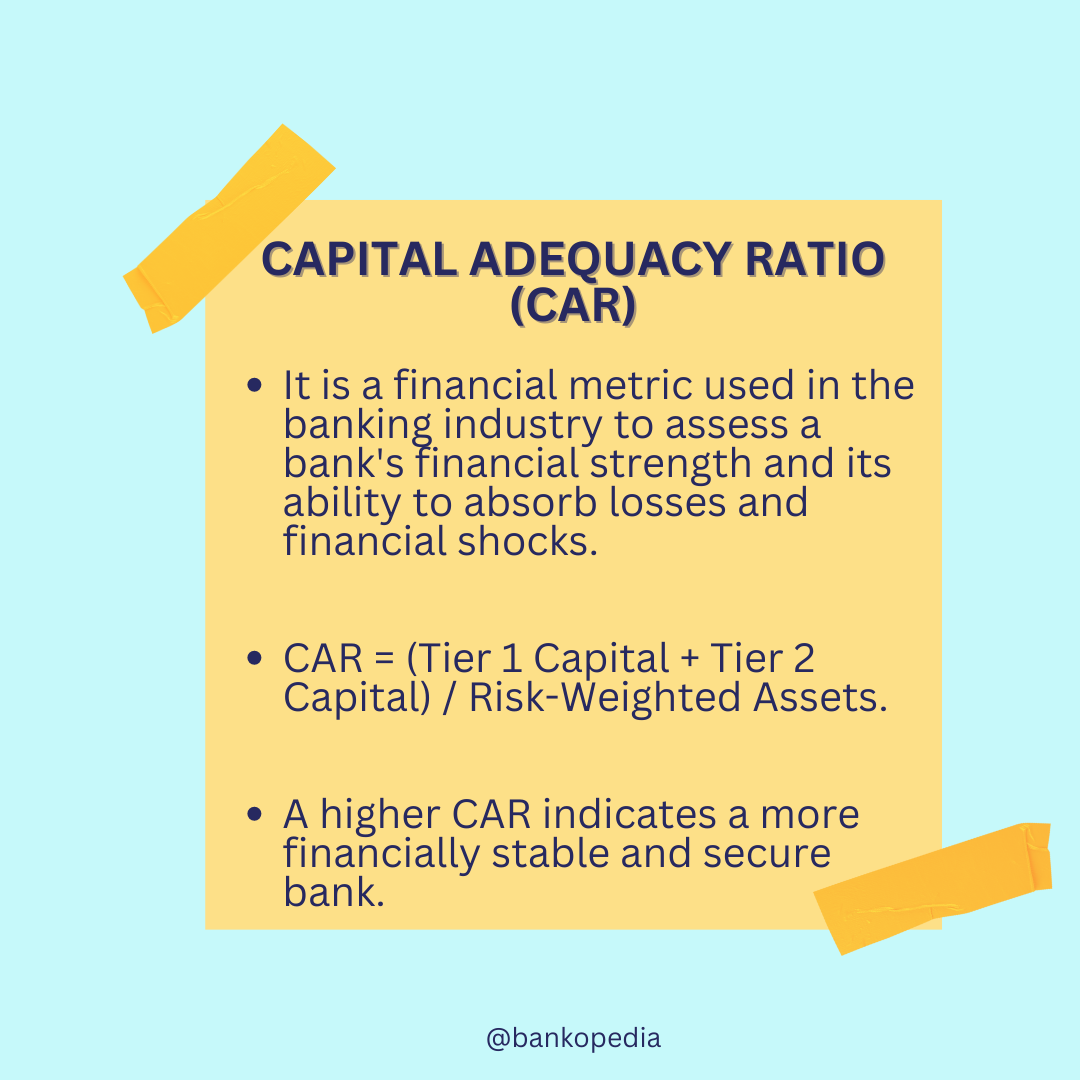
Banks must maintain a minimum Capital to Risk-Weighted Assets Ratio (CRAR) as prescribed by RBI. Under Basel III norms, Indian banks are required to maintain a minimum total CRAR of 11.5% (including the Capital Conservation Buffer of 2.5%). This ensures that banks have adequate capital to absorb losses and continue operations even in stressed conditions.
RBI has implemented Basel III in phases since 2013, with full implementation achieved by April 2019 for all scheduled commercial banks. Public sector banks, which typically have lower capital buffers, received capital infusion from the government through recapitalisation bonds to meet these requirements.
Priority Sector Lending (PSL)
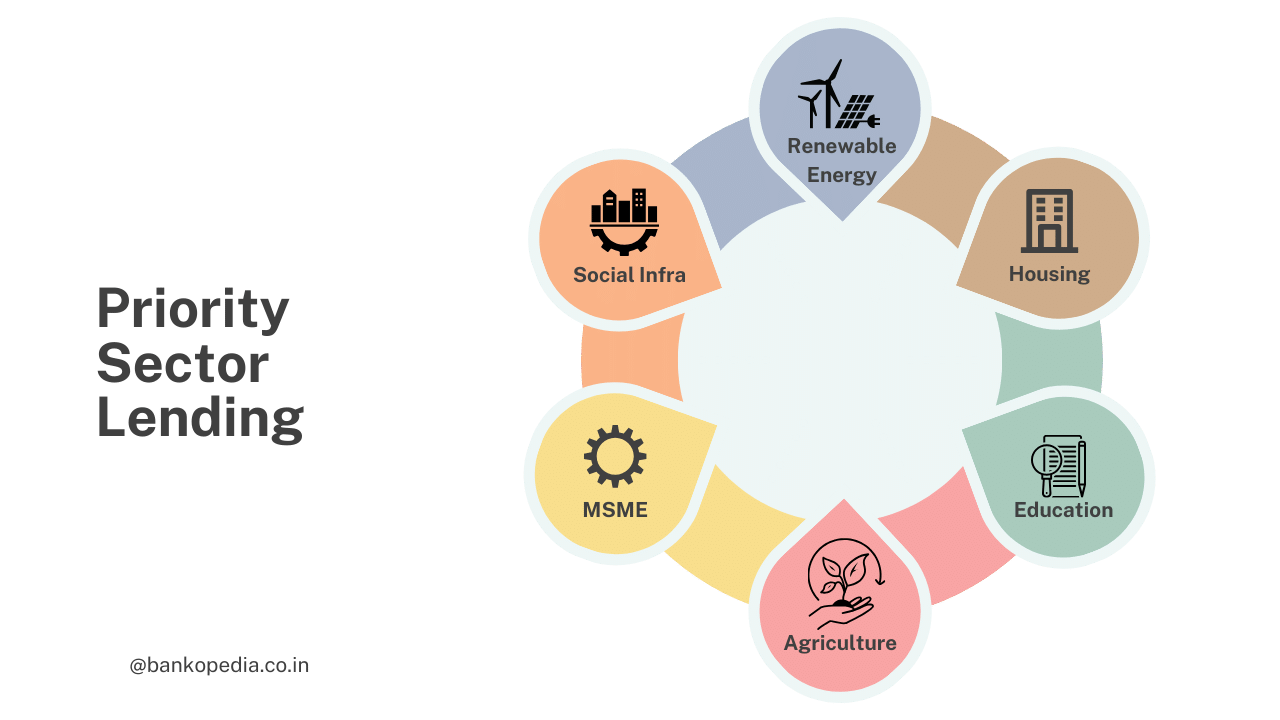
RBI mandates that domestic scheduled commercial banks lend at least 40% of their Adjusted Net Bank Credit (ANBC) to priority sectors — defined as agriculture, MSMEs, education, housing, social infrastructure, renewable energy and weaker sections. Foreign banks with fewer than 20 branches have a lower target of 40% phased in, while RRBs and SFBs have a target of 75%.
Banks that fail to meet PSL targets must deposit the shortfall amount with NABARD/NHB/SIDBI under Rural Infrastructure Development Fund (RIDF) and similar funds, which earns a below-market return — effectively a penalty for not directing credit to priority sectors.
Digital Banking and Payment Systems
India’s payment ecosystem has undergone a revolution in the last decade. The Unified Payments Interface (UPI), launched by NPCI in 2016, processed over 17 billion transactions in a single month in 2026, making India one of the world’s largest real-time payment markets.
The four major interbank payment systems are:
- NEFT (National Electronic Fund Transfer): Batch-based, settled in half-hourly intervals, available 24×7.
- RTGS (Real Time Gross Settlement): For large-value transactions (minimum ₹2 lakh), settled in real time, available 24×7.
- IMPS (Immediate Payment Service): Instant, available 24×7, transfer limit ₹5 lakh.
- UPI (Unified Payments Interface): Mobile-first, real-time, interoperable, transfer limit ₹1 lakh (₹2 lakh for verified merchants).
Indian Banking Sector — Performance in 2026
The Indian banking sector entered 2026 in its strongest financial position in over a decade, supported by a high credit growth cycle, improved asset quality and a surge in digital banking adoption.
Credit Growth
Bank credit grew at approximately 14-16% year-on-year in FY2026, driven by retail loans (home loans, personal loans, vehicle loans) and credit to the services sector. The MSME segment showed strong recovery post-COVID, supported by government guarantee schemes (ECLGS). Agricultural credit continued to meet PSL targets.
Asset Quality Improvement
As the indian banking system continues to evolve, understanding its dynamics becomes increasingly important for stakeholders.
The Gross NPA ratio declined to approximately 3.2% by March 2026, from a peak of 11.5% in 2018. Net NPA ratios for most large PSBs are now below 1%, indicating adequate provisioning. This improvement reflects better credit discipline, use of the IBC resolution framework, and the recovery of the economy post-pandemic.
Profitability
The resilience of the indian banking system can be attributed to its strong regulatory environment and risk management strategies.
The digital transformation has reshaped the landscape of the indian banking system, making it more efficient and user-friendly.
The combined net profit of PSBs crossed ₹1.7 lakh crore in FY2026, representing a historic high. Return on Assets (RoA) for the banking system as a whole improved to around 1.2%, and Return on Equity (RoE) rose above 14% for several large banks — levels not seen since the pre-NPA crisis years of 2012-13.
Digital Adoption
As of 2026, over 80% of banking transactions by volume in India are digital. Mobile banking users exceeded 600 million, and the UPI ecosystem has made India a global benchmark for digital payments. The number of bank branches has remained broadly stable while ATM and digital channel infrastructure has expanded significantly.
Key Challenges Facing Indian Banks in 2026
- Cybersecurity Risks: As digital transactions multiply, so do cyber threats. RBI’s IT security framework for banks and the growing importance of RegTech make cybersecurity the top operational risk for Indian banks.
- Climate and ESG Risk: RBI has begun issuing guidance on climate-related financial risks. Banks are expected to disclose climate risk exposure and align their lending portfolios with sustainability goals.
- Rising Competition from Fintechs: Digital lenders, neobanks, Buy Now Pay Later (BNPL) players and Account Aggregators are chipping away at traditional bank revenue streams — particularly in personal lending and payments.
- Rural and Financial Inclusion Gap: Despite progress, a significant portion of India’s rural population remains underbanked. Jan Dhan accounts have improved access but usage remains low in many districts.
- Talent and HR Transformation: Public sector banks face the dual challenge of retiring experienced bankers and recruiting digitally skilled talent to drive transformation.
Investment in skill development is crucial for enhancing the workforce within the indian banking system.
Profitability in the indian banking system has shown remarkable recovery, particularly in the wake of recent economic challenges.
Future of Indian Banking — What Lies Ahead
The Indian banking system is at an inflection point. Several structural shifts will define the next decade:
- Central Bank Digital Currency (CBDC): RBI’s digital rupee (e₹) pilot, launched in 2022, is being expanded. A full-scale CBDC rollout could fundamentally change how money is issued and circulated.
- Open Banking and Account Aggregator: The AA framework enables consent-based financial data sharing, enabling more accurate credit scoring, personalised banking products and cross-institution financial planning.
- AI and Machine Learning: Banks are deploying AI for fraud detection, credit underwriting, customer service (chatbots) and regulatory compliance. The RBI has begun issuing guidance on responsible AI use.
- Bank Consolidation: The merger wave among PSBs (10 banks merged into 4 between 2017-2020) is likely to continue, creating stronger, better-capitalised institutions. Universal bank licences for select SFBs are also on the horizon.
- Banking-as-a-Service (BaaS): Embedded finance — where banking products are offered through non-bank platforms — is growing. This will blur the lines between banks and technology companies.
Frequently Asked Questions (FAQ)
The following questions are commonly asked about the Indian banking system in bank promotion exams, JAIIB/CAIIB, and general banking knowledge tests.
Future challenges for the indian banking system will require innovative solutions and proactive regulatory measures.
Q: How many banks are there in India in 2026?
A: As of 2026, India has 12 Public Sector Banks, approximately 22 private sector banks, 46 foreign bank branches, 43 Regional Rural Banks, 12 Small Finance Banks, 6 Payment Banks, and over 1,500 urban cooperative banks. The total number of Scheduled Commercial Banks is around 90-95.
Q: What is the difference between a scheduled bank and a non-scheduled bank?
A: A scheduled bank is included in the Second Schedule of the RBI Act, 1934, has paid-up capital and reserves of at least ₹5 lakh, and is eligible for RBI borrowing facilities and clearing house membership. Non-scheduled banks do not meet these criteria and operate under more restricted conditions. Almost all major banks in India are scheduled banks.
Q: Which is the largest bank in India?
A: State Bank of India (SBI) is the largest bank in India by assets, branches, deposits and employee count. SBI’s total assets exceed ₹60 lakh crore and it has over 22,000 branches and 60,000+ ATMs across India.
Q: What is RBI’s main function?
A: RBI’s primary function is to formulate and implement monetary policy to maintain price stability (targeting 4% CPI inflation). Beyond this, RBI issues currency, regulates and supervises banks and NBFCs, manages India’s foreign exchange reserves, acts as banker to the government and banks, and develops payment infrastructure.
Q: What is the difference between CRR and SLR?
A: CRR (Cash Reserve Ratio) is the percentage of a bank’s net demand and time liabilities (NDTL) that must be kept as cash with RBI — it earns no interest. SLR (Statutory Liquidity Ratio) is the percentage of NDTL that banks must maintain in liquid assets (cash, gold, and approved government securities) — these earn interest. The current CRR is 3% and SLR is 18%.
Q: What is an NPA in banking?
A: A Non-Performing Asset (NPA) is a loan or advance where interest or principal repayment has remained overdue for more than 90 days (for term loans). RBI classifies NPAs into Substandard, Doubtful and Loss categories for provisioning purposes. High NPA levels reduce a bank’s profitability and capital adequacy.
Q: Who regulates Non-Banking Financial Companies (NBFCs)?
Improving customer service in the indian banking system is crucial for maintaining public trust and engagement.
As the world evolves, the adaptability of the indian banking system will determine its future success.
Training programs for employees are vital for maintaining a high standard of service within the indian banking system.
Sustainability initiatives are increasingly becoming part of the operational framework of the indian banking system.
A: NBFCs are primarily regulated by the Reserve Bank of India under the RBI Act, 1934. RBI classifies and supervises NBFCs based on their size, activity and systemic importance. Certain types of NBFCs (e.g., housing finance companies) are additionally overseen by the National Housing Bank (NHB).
Q: What are the payment systems available in India for fund transfer?
A: India has four main interbank fund transfer systems: NEFT (batch settlement, no minimum), RTGS (real-time, minimum ₹2 lakh), IMPS (instant, up to ₹5 lakh), and UPI (instant, up to ₹1-2 lakh). All four systems are available 24×7 and are operated/overseen by NPCI and RBI.
Summary — Key Takeaways
- The Indian banking system is a two-tier structure: RBI (central bank) and scheduled/non-scheduled commercial and cooperative banks.
- There are 7 types of banks in India: PSBs, private banks, foreign banks, RRBs, small finance banks, payment banks and cooperative banks.
- RBI is the apex monetary authority — it controls inflation through repo rate, CRR, SLR and other tools; regulates all banks; and manages foreign exchange.
- Key banking laws include RBI Act 1934, Banking Regulation Act 1949, SARFAESI Act 2002, PMLA 2002, FEMA 1999 and IBC 2016.
- As of 2026, the banking sector is in its healthiest state in a decade — low NPAs, record profitability and strong digital adoption.
- The future of Indian banking will be defined by CBDC, open banking, AI, further consolidation and competition from fintech.
About the Author
| Senior Banking Professional | CAIIB | 15+ Years in Indian Banking |
| The author is a senior banker with over 15 years of experience in credit, risk management and retail banking at leading Indian public sector banks. Cleared JAIIB in 2009 and CAIIB in 2012 (first attempt). Specialises in credit underwriting, NPA management and Basel III compliance. All articles on Bankopedia are written from direct professional experience and verified against RBI/IIBF official sources. |
| Expert Review: This article was reviewed by a CAIIB-certified Senior Manager with specialisation in monetary policy and banking regulation. Reviewed: March 2026. |
Sources & References
1. Reserve Bank of India — Annual Report 2026-27. rbi.org.in
2. Reserve Bank of India Act, 1934 (as amended). indiacode.nic.in
3. Banking Regulation Act, 1949 (as amended). indiacode.nic.in
4. RBI — Report on Trend and Progress of Banking in India 2026-27. rbi.org.in
5. National Payments Corporation of India (NPCI) — UPI Ecosystem Statistics 2026. npci.org.in
As the landscape of the financial sector changes, the indian banking system must evolve to meet new demands.
6. RBI — Financial Stability Report, January 2026. rbi.org.in
In conclusion, the future of the indian banking system will be shaped by technology, regulatory frameworks, and consumer needs.
7. RBI — Master Circular on Basel III Capital Regulations. rbi.org.in
8. RBI — Priority Sector Lending — Targets and Classification (Master Direction). rbi.org.in






1 thought on “Indian Banking System — Complete Guide 2026”