Table of Contents
Introduction
Understanding Supply Chain Finance India
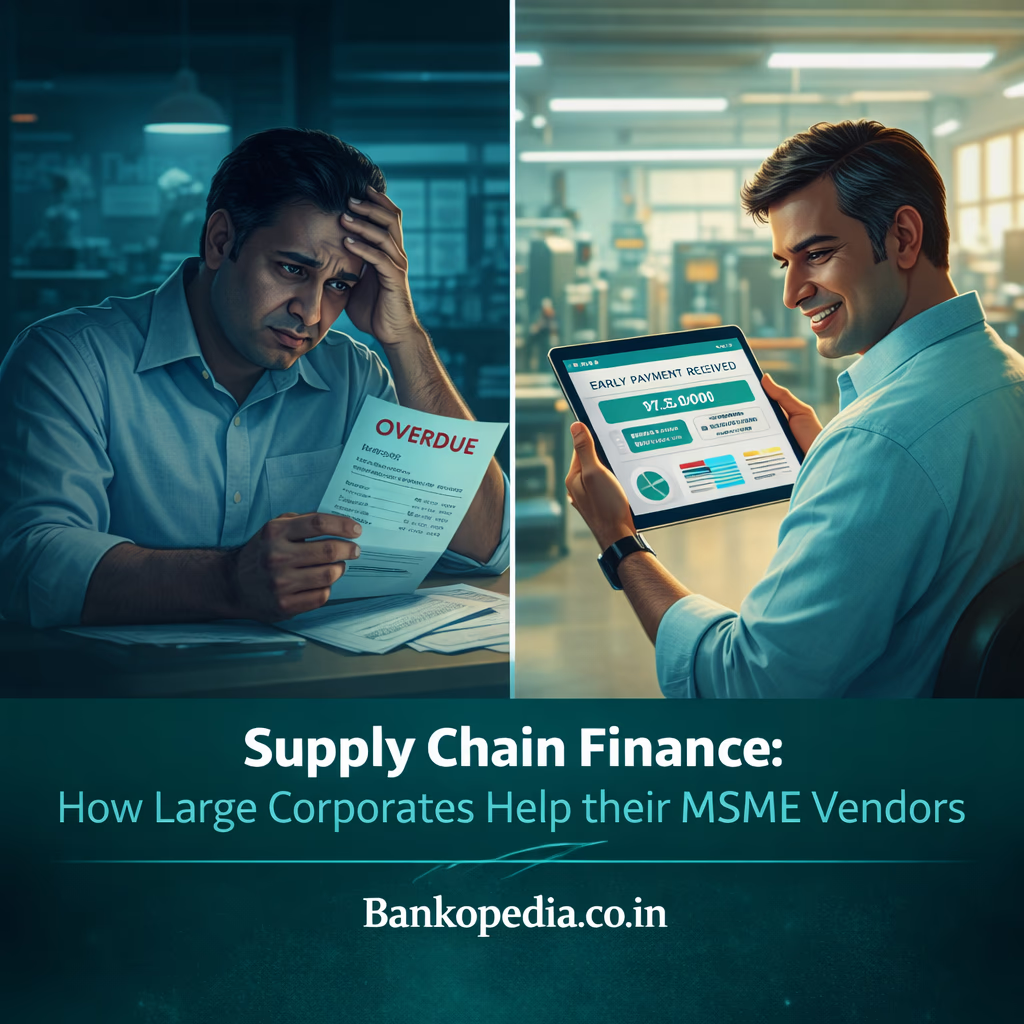
Supply chain finance in India is transforming how large corporates support their MSME vendors — turning unpaid invoices into immediate working capital. Imagine completing a large order for a Fortune 500 company in October and receiving payment only in January. For a large corporate, a 90-day payment cycle is routine treasury management. For the MSME vendor supplying the goods or services, those 90 days can mean borrowing at punishing interest rates, delaying salaries, or turning down new orders for lack of working capital

Delayed payments remain the single biggest financial stressor for India’s Micro, Small, and Medium Enterprises. According to the Ministry of MSME, outstanding dues to MSMEs from buyers — including large corporates and government entities — run into hundreds of thousands of crores of rupees at any given point in time.
Supply Chain Finance (SCF) has emerged as a powerful, market-driven solution to this chronic problem — one where large corporates actively enable their MSME vendors to access affordable, early-stage liquidity, without taking on additional debt on their own balance sheets. When deployed through regulated digital infrastructure like TReDS (Trade Receivables Discounting System), SCF becomes scalable, transparent, and transformative.
| 📌 This article is a supporting explainer for our pillar article:What is TReDS? MSME Invoice Discounting Explained — a comprehensive guide to India’s RBI-regulated digital platform for MSME receivables financing. Read it to get the complete picture. |
In this article, we walk through exactly how Supply Chain Finance works, how large corporates structure these programs for their vendor ecosystems, and why TReDS has become India’s preferred infrastructure for MSME supply chain financing.
What is Supply Chain Finance (SCF)?

Supply Chain Finance is an umbrella term for a set of technology-enabled financing solutions that optimise cash flow for buyers, sellers, and financiers across a supply chain. Unlike traditional working capital loans — where an MSME approaches a bank based on its own creditworthiness — SCF leverages the credit strength of the large corporate buyer to unlock faster, cheaper financing for the smaller supplier.
The core mechanic is straightforward: once a corporate buyer approves an MSME’s invoice, a financier (bank, NBFC, or factor) can fund that invoice at a rate reflecting the buyer’s credit rating rather than the MSME’s. The MSME gets paid early; the buyer retains its preferred payment terms; the financier holds a low-risk, buyer-approved receivable.
SCF vs. Traditional Lending: Key Differences
- Traditional Working Capital Loan: Based on MSME’s credit profile, collateral, financials. Often slow, expensive, collateral-heavy.
- Invoice Discounting (Recourse): MSME sells its receivable to a financier, but remains liable if the buyer defaults.
- Supply Chain Finance / Reverse Factoring: Buyer-initiated or buyer-approved. Financier takes comfort from the buyer’s credit. MSME is freed from credit risk.
- TReDS (without recourse): RBI-regulated platform where MSME sells approved invoices and has no liability if the buyer later defaults. This is the gold standard for MSME protection.
The term “reverse factoring” is widely used in SCF literature — it signals that the process is initiated from the buyer’s side, not the supplier’s. The buyer anchors the transaction; the MSME benefits from that anchor.
How Large Corporates Support MSME Vendors through Supply Chain Finance Programs
Progressive large corporates — particularly those with sprawling MSME vendor bases — have increasingly moved beyond ad hoc early payment requests to structured, institutional SCF programs. Here is how a well-designed corporate SCF programme typically operates:

Step 1: Corporate Anchor Onboarding
The corporate buyer (anchor) partners with one or more banks, NBFCs, or TReDS platforms to establish a vendor financing program. The anchor’s credit rating, financial statements, and payment track record are evaluated once — upfront — by the financiers. This avoids repetitive due diligence on each MSME supplier.
Step 2: MSME Vendor Onboarding
Vendors are enrolled onto the platform through a simplified KYC and digital on-boarding process. On TReDS platforms like RXIL, M1Xchange, and InvoiceMart, MSME suppliers complete a one-time registration and can then access financing from multiple financiers simultaneously, improving competition and driving down rates.
Step 3: Invoice Upload and Approval
After delivering goods or services, the MSME raises an invoice and uploads it to the platform. The corporate buyer reviews and approves the invoice digitally — this approval is the critical event that triggers financing eligibility. An approved invoice from a high-rated corporate is a near-liquid instrument for financiers.
Step 4: Auction / Bid by Financiers
On TReDS, approved invoices are auctioned to registered financiers (banks, NBFCs). Financiers bid competitively, which means MSME suppliers benefit from market-driven rates. As per RBI’s design mandate, these transactions are structured without recourse to the MSME — meaning if the corporate buyer later defaults, the MSME is not liable.
Step 5: Early Payment to MSME
The winning financier disburses funds — minus a small discount — directly to the MSME’s bank account, typically within 24–48 hours of bid acceptance. The MSME converts a 60–90 day receivable into immediate working capital, typically at rates significantly lower than an unsecured overdraft or MSME loan.
Step 6: Settlement from Corporate Buyer
On the original invoice due date, the corporate buyer settles the full invoice amount directly to the financier. The working capital cycle is complete.
| 🔗 Deep Dive:For a detailed walkthrough of TReDS mechanics, participant roles, and platform comparison (RXIL, M1Xchange, InvoiceMart), read our pillar article: What is TReDS? MSME Invoice Discounting Explained. |
The Role of TReDS in Indian Supply Chain Finance
India’s SCF landscape has been fundamentally shaped by the RBI’s introduction of the Trade Receivables Discounting System (TReDS) — a regulated, digital, multi-financier platform specifically designed to address MSME payment delays.
Launched under the RBI’s Payment and Settlement Systems Act, 2007, TReDS is operated by three licensed entities: RXIL (a SIDBI–NSE joint venture), M1Xchange (operated by Mynd Solutions), and InvoiceMart (a SIDBI–Axis Bank joint venture). Each platform connects MSME suppliers, corporate/government buyers, and banks/NBFCs in a regulated, transparent ecosystem.
Mandatory Registration for Large Corporates
A landmark policy shift has made corporate participation in TReDS a legal obligation, not merely a best practice. The Ministry of MSME, via a notification effective for companies with a turnover above ₹250 crore (implemented in 2024–25), mandated registration on at least one TReDS platform. This directly connects India’s largest corporates and PSUs with the TReDS ecosystem, creating a structural boost to MSME vendor financing.
Without-Recourse Protection for MSMEs
One of TReDS’s defining features — and a critical protection for MSME suppliers — is that all transactions are without recourse to the MSME. This means once the MSME receives early payment from a financier, it has no further liability even if the corporate buyer defaults on the due date. The credit risk rests entirely with the buyer and the financier, not the small supplier.
Interoperability and Multi-Financier Access
Unlike bilateral supply chain finance arrangements, TReDS gives MSME suppliers access to multiple competing financiers in a single marketplace. According to RXIL, multiple banks and NBFCs participating on their platform have created a genuine competitive market for MSME receivables, driving down the effective cost of financing for suppliers.
For a complete understanding of TReDS platform features, eligibility, on-boarding steps, and RBI regulations, visit our comprehensive guide: What is TReDS? MSME Invoice Discounting Explained.
Key Benefits for Large Corporate Buyers
Large corporates are not passive participants in SCF — they are strategic beneficiaries. Well-structured supply chain finance programs deliver measurable operational and financial value to buyer organisations:
- Supply chain resilience: Financially healthy MSME vendors are less likely to default on deliveries, miss quality standards, or shut operations due to cash stress. A stable vendor base reduces supply disruption risk.
- Extended payment terms: By enabling MSME vendors to access early payment from financiers, corporates can negotiate extended payment terms for themselves without harming vendor relationships. This optimises Days Payable Outstanding (DPO) and improves the corporate’s own working capital.
- Balance sheet neutrality: On-platform TReDS transactions are typically off-balance-sheet for the buyer until settlement date, avoiding additional leverage.
- Regulatory compliance: With mandatory TReDS registration applicable to companies with turnover above ₹250 crore, onboarding vendors onto TReDS fulfils compliance requirements and avoids penalties.
- ESG and CSR alignment: MSME vendor financing is increasingly tracked as part of responsible supply chain governance under ESG frameworks. Corporates with formal SCF programs demonstrate commitment to supplier wellbeing.
- Vendor retention and loyalty: Access to affordable working capital is a tangible benefit that strengthens vendor relationships and reduces the risk of key suppliers shifting to competitors.
Major Benefits for MSME Suppliers
For MSME vendors, supply chain finance — particularly through TReDS — is among the most powerful working capital tools available today:
- Faster access to cash: Convert approved invoices into cash within 24–48 hours, against typical credit periods of 60–120 days. This dramatically improves cash flow predictability.
- Lower borrowing costs: Financing rates are anchored to the corporate buyer’s credit rating, not the MSME’s. This can result in rates 3–6 percentage points lower than unsecured MSME loans.
- No collateral required: TReDS-based financing is collateral-free for MSME suppliers. The approved invoice itself is the underlying asset.
- Without-recourse protection: As mandated by RBI, TReDS transactions carry no liability to the MSME if the corporate buyer defaults. This is a transformative risk protection unavailable in most bilateral arrangements.
- Diversified financier access: Through platforms like RXIL, M1Xchange, and InvoiceMart, MSMEs can access competitive bids from multiple banks and NBFCs simultaneously, ensuring best-price discovery.
- Improved creditworthiness: Regular on-time repayment of TReDS-funded invoices builds a positive financial track record, potentially improving the MSME’s credit profile for future borrowings.
- Working capital for growth: Freed-up capital can be reinvested in raw materials, capacity expansion, or new orders — breaking the growth-strangling cycle of waiting for large-buyer payments.
Current Landscape & Growth Statistics of SCF & TReDS in India (2024–2026)
The TReDS ecosystem has seen exponential growth since its inception, reflecting both policy push and market pull for MSME supply chain finance:
- Cumulative financing crosses ₹7 lakh crore: According to official TReDS platform data and SIDBI reports, cumulative financing through TReDS platforms has crossed ₹7 lakh crore — a figure that underscores the system’s scale and growing adoption by MSMEs and corporates alike.
- FY18 to FY25 — a 245x growth story: TReDS financing grew from a modest ₹950 crore in FY2017–18 to over ₹2.33 lakh crore in FY2024–25, reflecting the dramatic mainstreaming of digital invoice discounting for MSMEs.
- M1Xchange crosses ₹1 lakh crore: M1Xchange (operated by Mynd Solutions) became one of the first TReDS platforms to cross ₹1 lakh crore in cumulative transaction throughput, demonstrating the depth of the market opportunity.
- Mandatory registration push: The Ministry of MSME’s directive mandating TReDS registration for companies with turnover above ₹250 crore (effective 2024–25) has significantly expanded the pool of corporate anchors available to MSME vendors on TReDS.
- Union Budget 2026–27 support: The Union Budget 2026–27 included continued support for MSME credit access and digital financing infrastructure, including policy measures to deepen penetration of TReDS-based financing for manufacturing and services MSMEs.
- SIDBI’s institutional role: SIDBI — India’s apex financial institution for MSMEs — is a shareholder and financier participant in TReDS platforms, lending institutional credibility and liquidity depth to the ecosystem.
The trajectory is clear: India’s MSME supply chain finance market is transitioning from fragmented, bilateral arrangements to regulated, digital, multi-party platforms — with TReDS at the centre of this transformation.
Challenges in Adoption and the Road Ahead
Despite impressive growth, the SCF and TReDS ecosystem still faces meaningful adoption challenges:
Low Awareness Among MSMEs
A significant proportion of India’s 6.3 crore registered MSMEs are still unaware of TReDS or supply chain finance programs. Many continue to rely on informal credit or high-cost NBFCs. Targeted outreach by SIDBI, banks, and industry associations remains critical.
Corporate Buyer Reluctance
Some large corporates — particularly privately held companies — have been slow to register on TReDS and discipline their invoice approval processes to enable timely SCF access for vendors. The mandatory registration requirement is expected to address this structural gap progressively.
Vendor On-boarding Friction
Digital KYC and on-boarding processes, while improving, still present friction for MSMEs in Tier 2 and Tier 3 cities with limited digital literacy or document readiness. Platform investments in vernacular interfaces and simplified on-boarding workflows are ongoing.
GST and Invoice Integrity
Ensuring alignment between uploaded invoices on TReDS and GST-filed invoices remains an operational challenge. Regulatory moves toward deeper GST-TReDS data integration are expected to reduce financing risk and improve throughput quality in coming years.
Government and Regulatory Support
The policy environment has been consistently supportive. Key enablers include: RBI’s framework for TReDS operations, mandatory corporate registration notifications from the Ministry of MSME, and continued budgetary emphasis on MSME credit access. The RBI has also progressively expanded the category of eligible financiers on TReDS — including NBFCs — to deepen liquidity on the platforms.
Conclusion
Supply chain finance — powered by India’s regulated TReDS infrastructure — represents a structural shift in how large corporates can fulfil their responsibility towards their MSME vendors. It is no longer just a financing tool; it is an ecosystem enabler that aligns the interests of buyers, suppliers, financiers, and regulators in creating a more equitable and resilient supply chain.
For MSME vendors, the message is clear: your approved invoice with a large corporate is not just a receivable — it is a financial asset. With TReDS, you can mobilise it at competitive rates, without collateral, and without credit risk, often within a single business day.
For corporate treasurers and procurement heads, building a structured SCF program for your MSME vendor base is no longer optional — it is a strategic imperative for supply chain resilience, regulatory compliance, and ESG leadership.
To understand the full mechanics of TReDS — including platform comparison, on-boarding process, eligible participants, and RBI regulations — read our comprehensive pillar guide: What is TReDS? MSME Invoice Discounting Explained.
© Bankopedia.co.in — India’s trusted platform for banking and finance knowledge. All statistics cited from publicly available RBI, Ministry of MSME, SIDBI, and TReDS platform reports. This article is for educational purposes only.