A note on sourcing: Every fact, process step, participant definition, and regulatory detail in this article is drawn exclusively from the Reserve Bank of India’s official TReDS FAQs (rbi.org.in) and the RBI’s Guidelines for Trade Receivables Discounting System dated July 2, 2018. No information has been assumed, extrapolated, or invented. If a detail is not confirmed in those official sources, it has been omitted.
About the Author
I spent over a decade inside Indian banking — as a Probationary Officer, Credit Head, and later as a Risk Data Engineer — before moving into financial technology. During my banking years, I sat across the table from hundreds of MSME owners who were creditworthy, hardworking, and cash-strapped — not because their business was failing, but because large buyers simply hadn’t paid yet. I have seen firsthand how delayed payments can cripple an otherwise healthy small business.
TReDS was designed precisely to fix this. This article draws on both my banking domain experience and a careful reading of RBI’s official documentation to give you an accurate, practical understanding of how this system works.
Table of Contents
1. Introduction
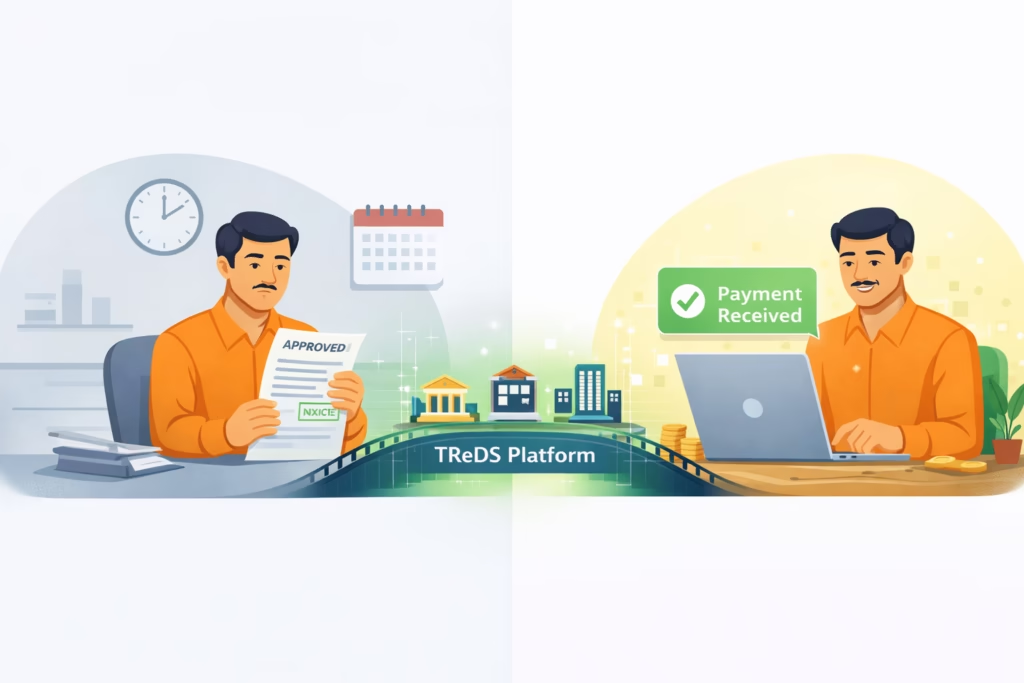
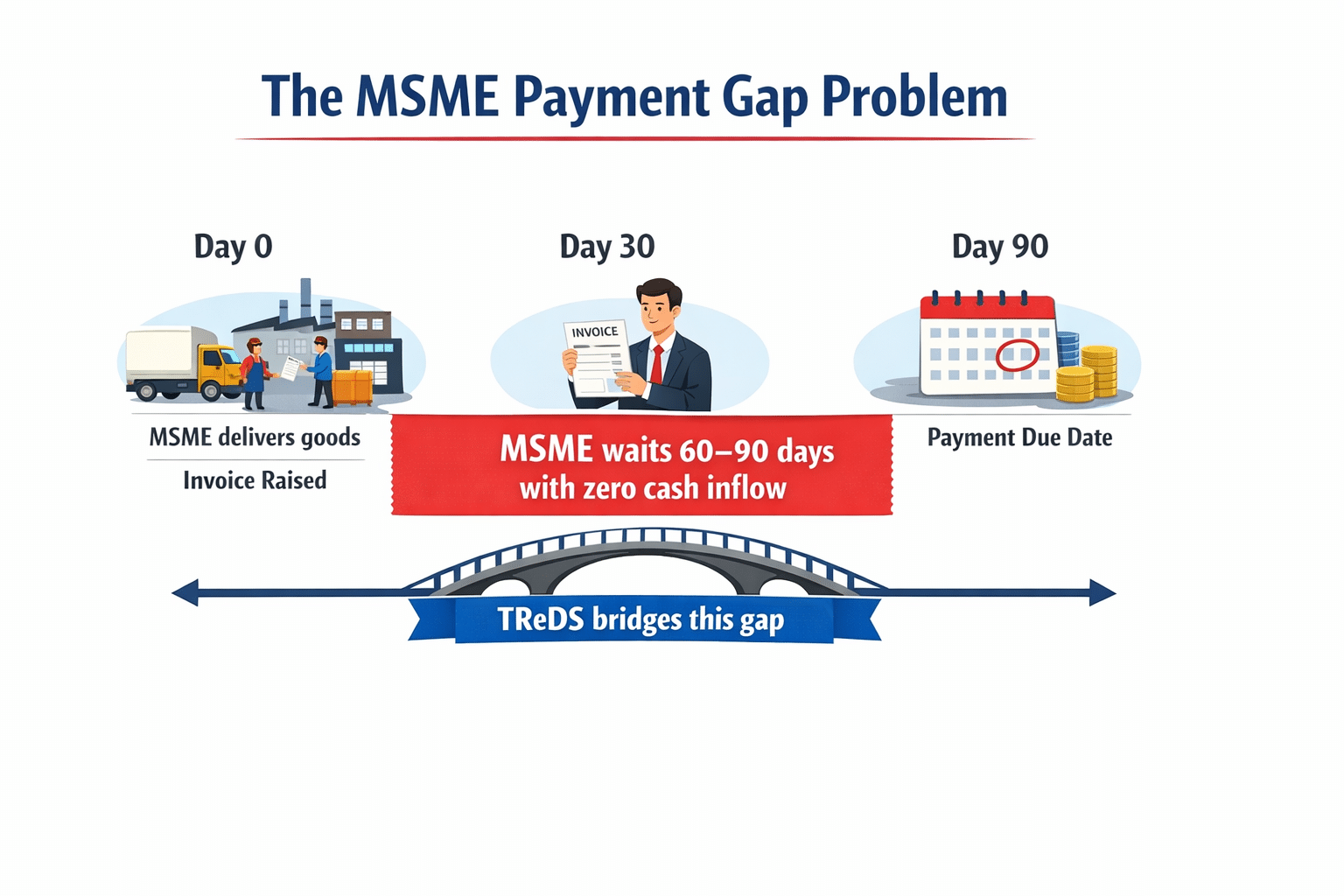
Picture this: You run a small manufacturing unit in Pune. You supplied machine components worth ₹15 lakh to a large automotive company in January. The delivery is complete, the invoice is approved, and the buyer has acknowledged the debt. But the payment terms say 90 days — which means you will not see that money until April.
Meanwhile, your raw material supplier wants payment this week. Your workers’ salaries are due at the end of the month. Your next production order needs funding now.
This is not a hypothetical. It is the daily reality for millions of Micro, Small, and Medium Enterprises (MSMEs) across India. Delayed payments from large buyers are one of the most persistent structural challenges in the Indian MSME ecosystem.
The Reserve Bank of India (RBI) recognised this problem at a systemic level and designed a solution: the Trade Receivables Discounting System — commonly known as TReDS. This is not a loan. It is not a subsidy. It is a regulated digital marketplace where MSMEs can convert approved, unpaid invoices into immediate working capital — at competitive rates, without collateral, and critically, without any liability if the buyer defaults. For businesses without collateral, the CGTMSE Guarantee Scheme provides government-backed credit coverage up to ₹5 crore
This guide explains exactly how TReDS works, who can use it, and how you can get started — all grounded in official RBI sources.
One of the key aspects of this system is that it facilitates TReDS MSME invoice discounting, allowing small businesses to access funds more rapidly. This method is crucial for improving cash flow and ensuring operational efficiency. The importance of TReDS MSME invoice discounting cannot be overstated in today’s financial landscape. TReDS MSME invoice discounting offers a lifeline for many businesses facing cash flow challenges.
2. What is TReDS?
TReDS stands for Trade Receivables Discounting System. It is an electronic platform — authorised and regulated by the Reserve Bank of India — that enables MSMEs to finance their trade receivables (unpaid invoices from buyers) through a competitive bidding process involving multiple financiers.
In plain English: an MSME that is owed money by a large buyer can upload that approved invoice onto a TReDS platform. Registered banks and financial institutions then compete to fund that invoice. The MSME receives an immediate payment — slightly less than the full invoice value — and the financier waits for the buyer to pay them back on the original due date.
Key terms explained:
- Trade Receivable: The money a seller (MSME) is owed by a buyer for goods or services already delivered. It is essentially an asset — a future cash inflow that can be monetised today.
- Invoice Discounting: The practice of selling a receivable at a small discount to get immediate cash, rather than waiting for the full amount later.
- Discounting Rate: The small percentage the financier deducts as their fee for providing early payment.
As the RBI defines it in its official FAQs, TReDS is a platform that facilitates the financing and discounting of trade receivables of MSMEs through multiple financiers [RBI FAQs on TReDS, https://www.rbi.org.in/commonman/English/scripts/FAQs.aspx?Id=3138].
3. Background and Regulatory Framework
The RBI conceptualised TReDS as part of its broader mandate to improve credit flow to the MSME sector. The system is governed by formal guidelines, with the consolidated version issued on July 2, 2018 [RBI Guidelines for TReDS, July 2, 2018].
Legal Foundation
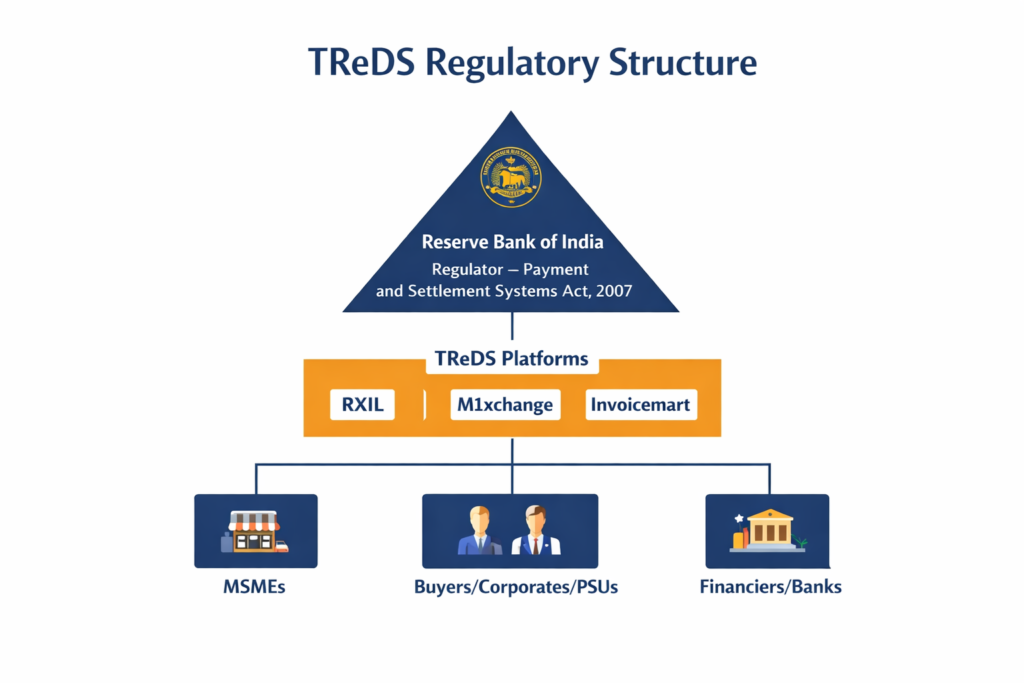
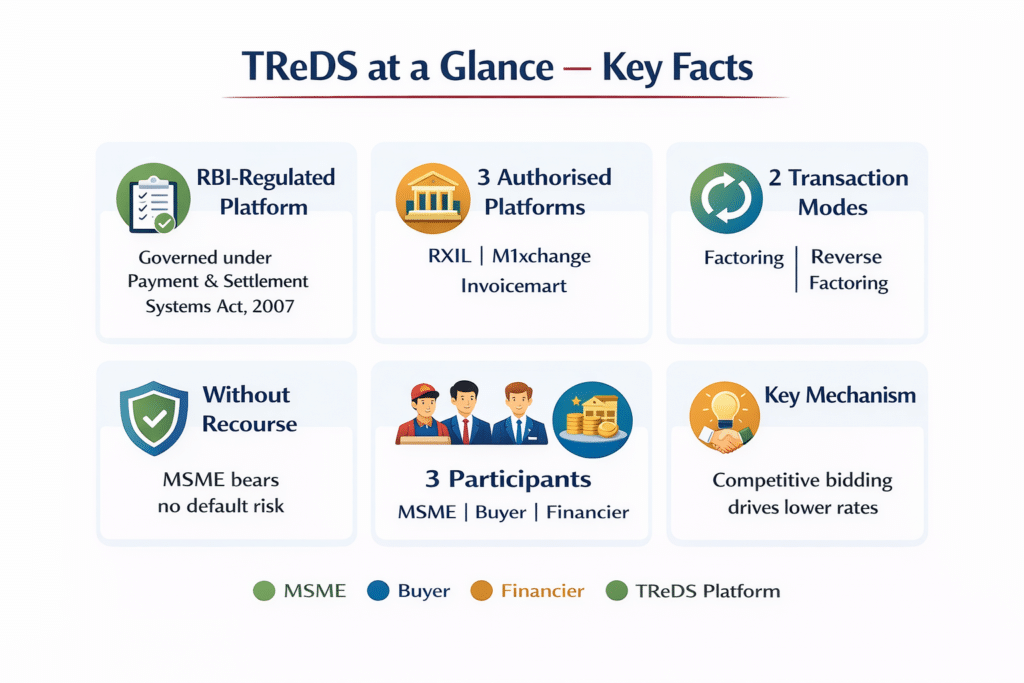
TReDS entities operate as authorised payment systems under the Payment and Settlement Systems Act, 2007. This means the RBI directly regulates and supervises these platforms — they are not informal fintech products or unregulated marketplaces.
Who Grants the Licence?
The Reserve Bank of India grants authorisation to entities to set up and operate TReDS platforms. As of the time of writing, the RBI has authorised three platforms to operate in India [RBI FAQs on TReDS]:
| Platform | Website |
|---|---|
| RXIL (Receivables Exchange of India Ltd.) | https://www.rxil.in/ |
| M1xchange | https://www.m1xchange.com/ |
| Invoicemart (A.TREDS Ltd.) | https://www.invoicemart.com/ |
All three operate under the identical RBI regulatory framework. There is no official hierarchy between them — MSMEs and buyers may register on one or more platforms.
Author’s Note: During my banking career, I worked closely with large corporate credit files where supply chain financing was discussed at board level. What struck me consistently was how the risk of non-payment fell entirely on the smallest players — the MSME suppliers — even when the buyer was a large, highly-rated corporation. TReDS structurally corrects this asymmetry by anchoring the credit risk to the buyer, where it logically belongs.
4. Key Participants in TReDS
The RBI’s guidelines define three distinct categories of participants in the TReDS ecosystem [RBI FAQs on TReDS, https://www.rbi.org.in/commonman/English/scripts/FAQs.aspx?Id=3138]. All three must be present for a transaction to occur.
Participant 1: Sellers — MSMEs
These are Micro, Small, and Medium Enterprises — as defined under the MSMED Act (Micro, Small and Medium Enterprises Development Act, 2006) — that have supplied goods or services on credit to a buyer and hold outstanding invoices.
The MSME is the party that benefits most directly from TReDS. They get early payment without taking on debt and without providing collateral.
Participant 2: Buyers — Corporates, PSUs, and Government Entities
These are the large organisations that purchase goods or services from MSMEs — private corporates, Public Sector Undertakings (PSUs), government departments, and similar entities.
The buyer’s role is critical: they must formally accept the invoice on the TReDS platform. This acceptance is what gives the receivable its legitimacy and makes it eligible for financing. Without buyer acceptance, an invoice cannot be financed on TReDS.
Participant 3: Financiers — Banks and Financial Institutions
These are RBI-authorised banks and financial institutions that participate on TReDS platforms to bid for and fund accepted invoices. They compete against each other in real time, which drives down financing costs for MSMEs.
5. How MSME Invoice Discounting Works on TReDS
This is the heart of the article. Let us walk through the complete process with precision, using official RBI definitions at each step.
Two Transaction Modes: Factoring and Reverse Factoring
TReDS supports two ways of initiating a financing transaction [RBI Guidelines for TReDS, July 2, 2018]:
Factoring (Seller-initiated): The MSME uploads the invoice onto the platform and requests financing. The buyer then accepts the invoice, and financiers bid to fund it.
Reverse Factoring (Buyer-initiated): The buyer uploads or initiates acknowledgement of the invoice on the TReDS platform. This is typically used when buyers proactively want to support their MSME supplier base — for example, when a large PSU or corporate wants to offer its suppliers access to early payment as a supply chain management strategy.
In both cases, the outcome is identical: the MSME gets paid early, and the financier collects from the buyer on the due date.
Understanding the Factoring Unit (FU)
Each eligible invoice on TReDS is represented as a Factoring Unit (FU). As defined in the RBI guidelines, an FU is the minimum unit of a trade receivable that is created, accepted, and offered for bidding on the platform. It is a legally valid, transferable instrument [RBI Guidelines for TReDS, July 2, 2018].
Think of it this way: the FU is like a standardised “token” representing the accepted receivable. When a financier bids and wins, they are essentially purchasing this FU — acquiring the legal right to collect the full invoice amount from the buyer on the due date.
Step-by-Step Process
Step 1 — Registration
All three participants — the MSME, the buyer, and the financier — must register separately on a TReDS platform. Registration involves KYC (Know Your Customer) verification and agreement to platform terms. An MSME and its buyer must be registered on the same platform for a transaction to occur.
Step 2 — Invoice Upload
After delivering goods or services, the MSME logs into the TReDS platform and uploads the invoice details. In reverse factoring, this step is initiated by the buyer instead.
Step 3 — Buyer Acceptance
The buyer logs in and formally accepts the invoice, confirming that:
- The goods or services were received
- The payment obligation is valid
- The amount is correct
This step is non-negotiable. Buyer acceptance converts the invoice into an FU (Factoring Unit) that is eligible for financing. An invoice that is disputed or unaccepted by the buyer cannot be financed on TReDS.
Step 4 — Financier Bidding
Once the FU is live on the platform, registered financiers can see it and submit competitive bids. They quote a discount rate — the annualised percentage they will charge for providing early payment. Multiple financiers bid simultaneously, creating a transparent auction environment.
Step 5 — MSME Selects a Bid
The MSME reviews the bids and selects the most favourable one — typically the lowest discount rate. This competitive bidding is one of TReDS’s most significant advantages over traditional working capital borrowing, where interest rates are fixed and non-negotiable.
Step 6 — Disbursement to the MSME
The winning financier transfers the discounted amount directly to the MSME’s registered bank account. The MSME receives immediate working capital. The small amount deducted is the financier’s fee — this is the “discount.”
Step 7 — Buyer Repays the Financier
On the original invoice due date, the buyer pays the full invoice amount directly to the financier — not to the MSME. The financier earns their return through the difference between what they paid the MSME and what they collected from the buyer.
Step 8 — Settlement
The TReDS platform manages settlement through its RBI-approved clearing mechanism, ensuring secure and timely fund movement among participants.
The Without-Recourse Principle — The MSME’s Most Important Protection
This is the single most important feature of TReDS financing, and it deserves special emphasis.
Under TReDS, all financing is without recourse to the MSME [RBI FAQs on TReDS, https://www.rbi.org.in/commonman/English/scripts/FAQs.aspx?Id=3138].
This means: if the buyer fails to pay the financier on the due date, the financier has no legal right to recover the money from the MSME.
The credit risk rests entirely with the buyer.
Why this matters: In my banking experience, one of the biggest fears small business owners had about any form of invoice financing was: “What if the buyer doesn’t pay — will I still owe the bank?” On TReDS, the answer is clearly no. The MSME has already been paid and bears no further obligation. This fundamentally changes the risk profile of MSME financing.
Compare this to a traditional working capital loan: the MSME borrows money, provides collateral, and is fully liable for repayment regardless of whether their own customers pay them. TReDS inverts this — it puts the repayment obligation on the large buyer, where the creditworthiness actually resides.
6. Benefits for MSMEs, Buyers, and Financiers
Benefits for MSMEs
- Immediate liquidity: Convert an accepted invoice into cash within days, rather than waiting 60–90 days for the buyer to pay.
- No collateral required: Financing is based entirely on the accepted invoice and the buyer’s creditworthiness — not on the MSME’s land, machinery, or fixed assets.
- Without-recourse protection: If the buyer defaults, the MSME has no liability. The financial risk does not come back to the small business.
- Competitive financing rates: Multiple financiers bid for each invoice, driving down the cost of financing compared to traditional borrowing.
- Digital and transparent process: The entire transaction — from invoice upload to payment — happens on a regulated digital platform, reducing paperwork, delays, and information asymmetry.
- No additional debt on balance sheet: TReDS financing is a sale of receivables, not a loan. This means the MSME’s debt levels do not increase, which is important for maintaining a clean balance sheet.
Benefits for Buyers
- Stronger supplier ecosystem: When MSME suppliers can access early payment, they are financially healthier and better able to maintain supply quality and continuity.
- No change in payment schedule: Buyers pay on the original due date — they do not have to release funds earlier than planned, preserving their own working capital cycle.
- Regulatory compliance: As per government policy directions, certain categories of buyers — including large companies and PSUs — are required to register on TReDS platforms, making participation a compliance necessity as well.
Benefits for Financiers
- High-quality, low-risk assets: TReDS receivables are backed by large, typically creditworthy buyers — reducing default risk significantly compared to direct MSME lending.
- Diversified exposure: Financiers can fund many small invoices across sectors and geographies, spreading their risk widely.
- Digitally efficient operations: Standardised platform processes reduce manual effort and operational costs compared to traditional trade finance.
7. Who Can Participate and How to Get Started
Eligibility — As Defined by the RBI
Sellers (MSMEs): Entities classified as Micro, Small, or Medium Enterprises under the MSMED Act, 2006. If your enterprise falls within the official MSME definition based on investment and turnover criteria, you are eligible to participate as a seller on TReDS [RBI FAQs on TReDS, https://www.rbi.org.in/commonman/English/scripts/FAQs.aspx?Id=3138].
Buyers: Corporates, government departments, PSUs, and similar entities that procure goods and services from MSMEs. The government has issued policy directives requiring certain large buyers to mandatorily register on TReDS platforms — making this a regulatory obligation for many large companies, not just an option.
Financiers: Banks and RBI-authorised financial institutions. Individual MSMEs or buyers do not need to worry about this category — financiers onboard directly with the platform under RBI supervision.
How to Get Started — A Practical Roadmap
Step 1 — Verify your MSME classification Confirm your enterprise qualifies as an MSME under current government criteria. Your Udyam Registration Certificate is the relevant document.
Step 2 — Choose a TReDS platform Review the three RBI-authorised platforms: RXIL, M1xchange, and Invoicemart. All are regulated identically. You may register on more than one platform — there is no restriction on multi-platform participation.
Step 3 — Complete registration and KYC Visit the official website of your chosen platform and submit the required documents: KYC documents, business registration details, bank account information, and MSME registration proof.
Step 4 — Confirm your buyer is registered TReDS only works when your buyer is also registered on the same platform. Check with your buyer — many large PSUs and corporates are already registered. If your buyer is not yet on the platform, most TReDS platforms provide support to assist with buyer onboarding.
Step 5 — Upload your first invoice Once both parties are registered and linked, upload your approved invoice. The platform will guide you through the process of creating a Factoring Unit and initiating the bidding process.
8. Recent Developments
Important editorial note: This section includes only information that can be confirmed from official RBI sources and policy communications. No specific statistics, volume figures, or platform-level claims have been included to avoid the risk of presenting unverified data.
The RBI has been progressively expanding the scope and reach of TReDS since its initial launch. Based on information available from official RBI communications at rbi.org.in:
- The RBI has issued subsequent circulars following the July 2018 guidelines to expand the categories of participants and strengthen the operational framework of TReDS.
- The government has mandated that certain categories of large buyers — including PSUs and government entities — must register on TReDS platforms, significantly expanding the pool of buyers available to MSMEs on these platforms.
- The RBI has explored and communicated on the inclusion of additional types of financiers — including insurance companies — within the TReDS ecosystem, as referenced in official RBI guidance.
For the most current regulatory updates, circulars, and policy changes related to TReDS, always refer directly to:
- RBI Official Website: https://www.rbi.org.in
- Ministry of MSME Portal: https://msme.gov.in
9. Conclusion
Delayed payments are not just an inconvenience — they are a structural risk that kills otherwise viable small businesses. The Trade Receivables Discounting System is India’s most significant institutional response to this problem: a regulated, transparent, and digitally-enabled marketplace where MSME invoices can be converted into working capital quickly, competitively, and safely.
Having worked in Indian banking for over a decade — processing credit files, managing branch operations, and later building risk technology systems — I can say that TReDS represents a genuine structural improvement over the traditional credit products available to small businesses. It does not require collateral. It does not burden the MSME with debt. And it places credit risk where it logically belongs: with the large buyer, not the small supplier.
If you are an MSME owner, TReDS is worth understanding and exploring — not as a last resort, but as a proactive working capital strategy.
Your immediate next steps:
- Visit the RBI’s official TReDS FAQ page: https://www.rbi.org.in/commonman/English/scripts/FAQs.aspx?Id=3138
- Explore all three authorised platforms (RXIL, M1xchange, Invoicemart) before deciding where to register.
- Check whether your key buyers are already registered — this is the single fastest way to activate TReDS for your business.
- Speak with your bank’s trade finance desk — many banks are registered financiers on TReDS and can guide you through the onboarding process.
- Monitor the Ministry of MSME portal (msme.gov.in) for policy updates on mandatory buyer registration that may apply to your sector.
Sources
All facts, definitions, process steps, and regulatory details in this article are drawn exclusively from the following official sources. No other sources were used.
- Reserve Bank of India — Official FAQs on TReDS
- RBI Guidelines for Trade Receivables Discounting System (TReDS) — July 2, 2018
- RXIL — Receivables Exchange of India Ltd.
- M1xchange
- Invoicemart (A.TREDS Ltd.)
This article is for informational and educational purposes only. It is based on publicly available RBI guidelines and official sources as of the date of publication. Readers are advised to consult official RBI communications and qualified financial advisors before making any financial decisions.




7 thoughts on “What is TReDS? How MSME Invoice Discounting Works”