Table of Contents
What does it take to keep a $4 trillion economy on course while the global order fractures around it? Finance Minister Nirmala Sitharaman answered that question on 1 February 2026 — this time from the historic halls of Kartavya Bhawan (the newly renamed North Block), making it the first Union Budget prepared and presented from the nation’s redesigned seat of governance. The Union Budget 2026-27, presented on the auspicious occasion of Magha Purnima and the birth anniversary of Guru Ravidas, carries a singular mission: transform aspiration into achievement, and potential into performance.
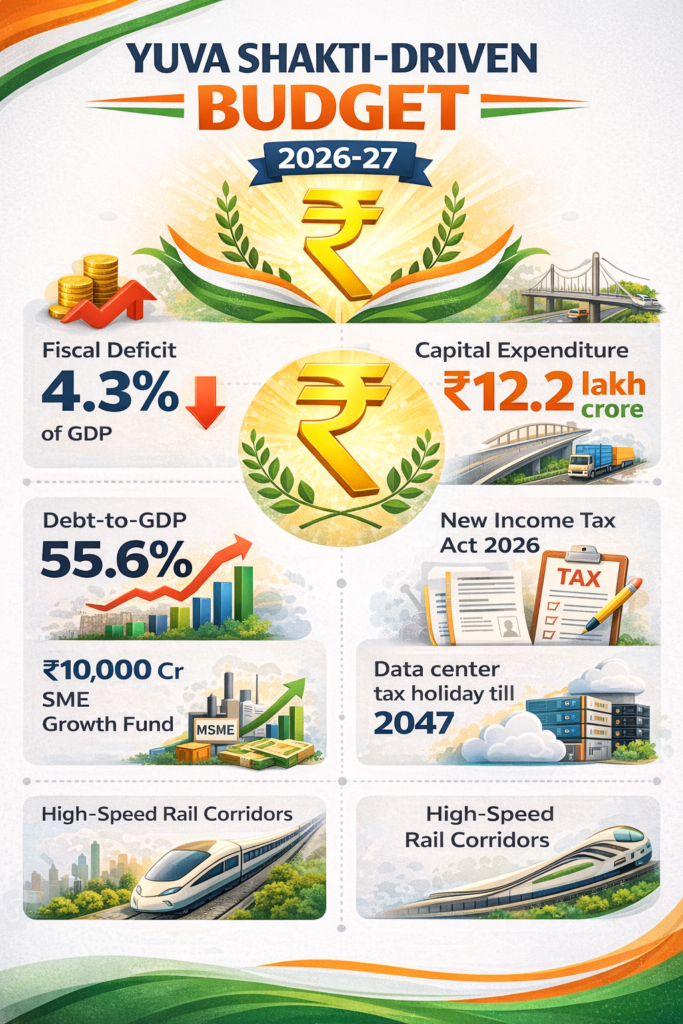
The Budget 2026-27 key features reflect a government walking a carefully calibrated tightrope — sustaining public investment and capital expenditure at record levels, consolidating the fiscal deficit to 4.3% of GDP, and simultaneously delivering meaningful structural reforms across manufacturing, services, agriculture, and social infrastructure. While last year’s Budget introduced sweeping individual income tax relief, Budget 2026-27 builds on that foundation with an emphasis on simplification, structural reform, and long-term institutional capacity.
According to the official Budget Highlights PDF (indiabudget.gov.in), total expenditure is pegged at ₹53.5 lakh crore for FY 2026-27, with non-debt receipts at ₹36.5 lakh crore — numbers that signal an economy confidently stepping into its next phase of growth.
The Guiding Philosophy: Three Kartavyas for Viksit Bharat
The Nirmala Sitharaman Budget 2026 is not themed around a single buzzword — it is structured around a tripartite philosophy of “Sankalp” (resolve), articulated as three Kartavyas (duties):
The First Kartavya is to accelerate and sustain economic growth by enhancing productivity, competitiveness, and building resilience against volatile global dynamics. The Second Kartavya is to fulfil the aspirations of the people — building their capacity and making them strong partners in India’s prosperity. The Third Kartavya, aligned with the vision of Sabka Sath, Sabka Vikas, is to ensure that every family, community, region, and sector has access to resources, amenities, and opportunities for meaningful participation.
The broader tagline — “Yuva Shakti-driven Budget” — underscores that this is a Budget that bets on India’s young workforce, its demographic dividend, and its ability to leapfrog older industrial economies through technology, skills, and innovation.
Importantly, the Finance Minister acknowledged the headwinds squarely: trade and multilateralism are “imperilled,” supply chains are disrupted, new technologies are transforming production systems, and pressure on water, energy, and critical minerals is intensifying. India’s Budget 2026-27 is, in part, a strategic response to these global fault lines.
Macro Fiscal Numbers: The Big Picture
For anyone tracking India’s fiscal journey, the Budget Estimates 2026-27 tell an encouraging story of disciplined consolidation. According to the official PIB summary and Budget at a Glance, here are the headline numbers:
| Fiscal Indicator | 2025-26 (RE) | 2026-27 (BE) |
|---|---|---|
| Total Expenditure | ₹49.6 lakh crore | ₹53.5 lakh crore |
| Non-Debt Receipts | ₹34 lakh crore | ₹36.5 lakh crore |
| Centre’s Net Tax Receipts | ₹26.7 lakh crore | ₹28.7 lakh crore |
| Capital Expenditure (Public) | ₹11 lakh crore | ₹12.2 lakh crore |
| Fiscal Deficit (% of GDP) | 4.4% | 4.3% |
| Debt-to-GDP Ratio | 56.1% | 55.6% |
| Net Market Borrowings | — | ₹11.7 lakh crore |
| Gross Market Borrowings | — | ₹17.2 lakh crore |
A few observations stand out. First, public capital expenditure has risen from ₹2 lakh crore in FY2014-15 to ₹12.2 lakh crore in FY2026-27 — a more than six-fold increase in a decade, reflecting a fundamental shift in the government’s approach to growth through infrastructure investment. Second, the government has set an ambitious medium-term target of bringing the debt-to-GDP ratio down to 50±1% by 2030, from the current 55.6%. This gradual glide path would free up significant resources currently consumed by interest payments (which account for 20 paise of every rupee spent, according to the Budget at a Glance).
India’s GDP growth trajectory is assumed at approximately 7% for FY2026-27, maintaining the “high growth, moderate inflation, fiscal discipline” triad that has characterised recent budgets.
Where Does the Rupee Come From?
According to the official Budget documents, India’s revenue receipts in FY2026-27 are sourced as follows:
- Income Tax: 21 paise
- Corporation Tax: 18 paise
- GST and Other Taxes: 15 paise
- Borrowings and Liabilities: 24 paise
- Non-Tax Revenues: 10 paise
- Union Excise Duties: 6 paise
- Customs: 4 paise
- Non-Debt Capital Receipts: 2 paise
Where Does the Rupee Go?
- Interest Payments: 20 paise
- States’ Share of Taxes: 22 paise
- Central Sector Schemes: 17 paise
- Defence: 11 paise
- Centrally Sponsored Schemes: 8 paise
- Finance Commission & Other Transfers: 7 paise
- Major Subsidies: 6 paise
- Civil Pension: 2 paise
- Other Expenditures: 7 paise
Top 15 Key Highlights of Union Budget 2026-27
According to the official Budget Highlights document, here are the most impactful announcements:
- Public Capex raised to ₹12.2 lakh crore — the highest ever, up from ₹11.2 lakh crore in BE 2025-26.
- Biopharma SHAKTI — ₹10,000 crore outlay to build India into a global biopharma manufacturing hub over 5 years.
- ₹10,000 crore SME Growth Fund — dedicated fund to create “Champion MSMEs” of the future.
- Seven High-Speed Rail Corridors — Mumbai-Pune, Pune-Hyderabad, Hyderabad-Bengaluru, Hyderabad-Chennai, Chennai-Bengaluru, Delhi-Varanasi, and Varanasi-Siliguri as environmentally sustainable “Growth Connectors.”
- New Income Tax Act, 2025 — comes into effect from April 2026, reducing sections from 819 to ~536, replacing the old “previous year / assessment year” terminology with “Tax Year.”
- IT Safe Harbour threshold raised from ₹300 crore to ₹2,000 crore; common safe harbour margin of 15.5% for all IT services.
- Tax holiday till 2047 for foreign cloud service providers delivering services to global customers through India-based data centres.
- Carbon Capture Utilization and Storage (CCUS) scheme with an outlay of ₹20,000 crore.
- Bharat-VISTAAR — multilingual AI tool integrating AgriStack portals and ICAR agricultural practices with AI systems.
- STT on Futures raised from 0.02% to 0.05%; STT on options premium raised from 0.1% to 0.15%.
- ₹2 lakh crore support to states under the SASCI Scheme for infrastructure development.
- Girls’ hostels in every district for STEM higher education institutions through VGF/capital support.
- NIMHANS-2 to be set up; National Mental Health Institutes in Ranchi and Tezpur upgraded as Regional Apex Institutions.
- Dedicated Freight Corridors connecting Dankuni (East) to Surat (West); 20 new National Waterways to be operationalised in 5 years.
- Finance Commission grants of ₹1.4 lakh crore to states for FY2026-27; vertical devolution share retained at 41%.
Direct and Indirect Tax Proposals: What Changes for You
New Income Tax Act, 2025 — A Generational Reform
Perhaps the most structurally significant announcement is that the New Income Tax Act, 2025 will come into effect from April 2026. According to the official PIB summary, this replaces the Income Tax Act of 1961 — a six-decade-old legislation that had accumulated 819 sections, thousands of provisos, and an almost impenetrable web of cross-references.
The new Act reduces the number of sections to approximately 536, introduces the concept of a “Tax Year” to replace the confusing parallel framework of “previous year” and “assessment year,” and consolidates related provisions to reduce ambiguity and litigation. Simplified Income Tax Rules and Forms are to be notified shortly, redesigned for the compliance comfort of ordinary citizens.
Individual Income Tax — Existing Relief Maintained
Under the new tax regime (already in effect from the previous year’s Budget), the tax slabs remain:
| Income Slab | Tax Rate |
|---|---|
| Up to ₹4 lakh | Nil |
| ₹4 lakh – ₹8 lakh | 5% |
| ₹8 lakh – ₹12 lakh | 10% |
| ₹12 lakh – ₹16 lakh | 15% |
| ₹16 lakh – ₹20 lakh | 20% |
| ₹20 lakh – ₹24 lakh | 25% |
| Above ₹24 lakh | 30% |
For most salaried taxpayers, after standard deduction and applicable rebates, the effective tax burden remains very low up to ₹12.75 lakh — continuing the substantial middle-class relief delivered last year.
TCS Rationalisation — Major Relief for Travellers and Students
Budget 2026-27 delivers meaningful compliance relief through TCS reductions:
- Overseas tour packages: TCS reduced from 5%/20% to a flat 2%, regardless of amount.
- Education remittances under LRS: TCS reduced from 5% to 2%.
- Medical purposes under LRS: TCS reduced from 5% to 2%.
- Sale of immovable property by non-residents: TDS to be deducted through resident buyer’s PAN instead of TAN — a welcome simplification.
IT Sector — Landmark Safe Harbour Reforms
The Budget transforms the transfer pricing landscape for India’s ₹225+ lakh crore IT industry. According to the official Budget Highlights:
- All IT-related services (software development, IT-enabled services, KPO, contract R&D) clubbed under a single category with a common safe harbour margin of 15.5%.
- Safe harbour threshold raised from ₹300 crore to ₹2,000 crore — dramatically reducing compliance burden for mid-to-large exporters.
- Safe harbour applicable through automated rule-driven approval and extendable for 5 consecutive years at the company’s choice.
- Unilateral APA (Advanced Pricing Agreement) process for IT services to be concluded within 2 years (extendable by 6 months).
This is transformative for India’s IT majors and mid-tier exporters alike, reducing costly transfer pricing disputes that have plagued the industry for years.
Data Centres — Tax Holiday Till 2047
In a globally significant announcement, foreign companies providing cloud services to global customers through India-based data centres will receive a tax holiday until 2047. Related entities providing data centre services from India will benefit from a safe harbour of 15% on cost. This positions India as a premier destination for global cloud infrastructure investment over the next two decades.
Financial Markets — STT Increases
The Budget increases Securities Transaction Tax (STT) to curb speculative trading:
- STT on Futures: raised from 0.02% to 0.05%
- STT on options premium: raised from 0.1% to 0.15%
- STT on exercise of options: raised from 0.125% to 0.15%
Key Customs Duty Changes
- 17 drugs and medicines for cancer patients — exempted from Basic Customs Duty.
- Lithium-Ion cell battery manufacturing capital goods — BCD exemption extended.
- Critical minerals processing capital goods — BCD exempted.
- Aircraft manufacturing components and parts — BCD exempted.
- Personal use imports: tariff rate reduced from 20% to 10%.
- Seafood exports: duty-free import limit on specified inputs raised from 1% to 3% of FOB value.
- Nuclear Power Projects: BCD exemption extended to 2035 and expanded to all nuclear plants regardless of capacity.
Prosecution Reforms and Penalty Rationalisation
Budget 2026-27 takes a materially softer approach to tax enforcement:
- Assessment and penalty proceedings will be integrated through a common order.
- Pre-payment quantum reduced from 20% to 10% (calculated only on core tax demand).
- Taxpayers can update returns even after reassessment proceedings, at an additional 10% tax rate.
- Immunity from prosecution for non-immovable foreign assets below ₹20 lakh with retrospective effect from 1 October 2024.
- One-time 6-month foreign asset disclosure scheme for students, NRIs, young professionals, and tech employees.
- Non-production of books of account and TDS payment (where payment is in kind) decriminalised.
Sector-Wise Allocations and New Schemes
Infrastructure — The Cornerstone of Growth
According to the official Budget Highlights, transport commands the single largest Ministry allocation at ₹5,98,520 crore, even eclipsing Defence. Key infrastructure announcements include:
- Seven High-Speed Rail Corridors as “Growth Connectors” between major city pairs.
- New Dedicated Freight Corridors connecting Dankuni (East) to Surat (West).
- 20 new National Waterways operationalised over 5 years, beginning with NW-5 in Odisha connecting Talcher-Angul mineral areas to Paradeep and Dhamra ports.
- Coastal Cargo Promotion Scheme targeting increase of inland waterways and coastal shipping share from 6% to 12% by 2047.
- Seaplane VGF Scheme to indigenise manufacturing.
- ₹2 lakh crore SASCI Scheme support to states.
- Infrastructure Risk Guarantee Fund to provide partial credit guarantees to lenders.
- City Economic Regions (CER): ₹5,000 crore per CER over 5 years to amplify economic agglomeration potential of Tier II and Tier III cities.
- Recycling of real estate assets of CPSEs through dedicated REITs.
Manufacturing — Seven Strategic Sectors
The Budget lays out an ambitious manufacturing agenda across seven frontier sectors:
Biopharma SHAKTI: ₹10,000 crore over 5 years to build India’s biologics and biosimilars ecosystem, including 3 new NIPERs, upgrading 7 existing ones, and a network of over 1,000 accredited clinical trial sites.
India Semiconductor Mission (ISM) 2.0: Next phase of India’s semiconductor self-reliance push.
Electronics Components Manufacturing Scheme: Targeting deep electronics manufacturing capability.
Integrated Programme for Textiles: Five sub-programmes including the National Fibre Scheme, Textile Expansion and Employment Scheme, National Handloom and Handicraft Programme, Tex-Eco Initiative, and Samarth 2.0.
Scheme to revive 200 legacy industrial clusters, breathing life into India’s traditional manufacturing heartlands.
Container Manufacturing Scheme and a dedicated Affordable Sports Goods manufacturing initiative round out the frontier manufacturing push.
Rare Earth Permanent Magnets — a dedicated scheme covering research, mining, processing and manufacturing to reduce critical import dependency.
MSME — Three-Pronged “Champion” Strategy
The Budget treats MSMEs — which employ over 11 crore people — with particular ambition through a three-pronged approach: equity support via the ₹10,000 crore SME Growth Fund; liquidity support through TReDS (mandating TReDS as the transaction settlement platform for all CPSE purchases from MSMEs); and professional support through “Corporate Mitras” — compliance advisory centres in Tier II and III towns.
Additional MSME measures include:
- Self-Reliant India Fund (2021) topped up with ₹2,000 crore
- GeM linked with TReDS for cheaper, quicker MSME financing
- TReDS receivables as asset-backed securities to develop a secondary market
- Removal of the ₹10 lakh per consignment value cap on courier exports for MSMEs
Agriculture — Bharat-VISTAAR and Beyond
Agriculture and Allied Activities receives ₹1,62,671 crore in Budget 2026-27. The marquee announcement is Bharat-VISTAAR (Virtually Integrated System to Access Agricultural Resources) — a multilingual AI tool integrating AgriStack portals with ICAR’s comprehensive package on agricultural best practices, designed to provide customised, real-time advisory to farmers in their own language.
Other agriculture measures include:
- Integrated development of 500 reservoirs and Amrit Sarovars
- Dedicated Indian Cashew and Cocoa Programme
- Coconut Promotion Scheme for production and productivity enhancement
- Sandalwood focused cultivation and post-harvest processing programme
- Horticultural rejuvenation for walnuts, almonds, and pine nuts
- Loan-linked capital subsidy for veterinary colleges, hospitals, and diagnostic laboratories
- Fisheries: Fish caught by Indian vessels in EEZ or High Seas made duty-free; landing at foreign ports treated as export of goods
Energy and Environment
₹20,000 crore CCUS Scheme to adopt Carbon Capture Utilization and Storage technology positions India as a serious climate economy player. Customs duty measures support:
- Lithium-Ion cell battery manufacturing (BCD exemption extended)
- Solar glass manufacturing (BCD on sodium antimonate exempted)
- Critical minerals processing (BCD on capital goods exempted)
- Nuclear Power Projects (BCD exemption extended to 2035, expanded to all plants)
- Biogas excise duty: Entire value of biogas excluded from Central Excise duty on biogas-blended CNG
Defence and Security
Defence receives ₹5,94,585 crore — the second-largest Ministry allocation. The Budget also includes:
- BCD exemption on components and parts for aircraft manufacturing
- BCD exemption on raw materials imported for manufacture of aircraft parts used in MRO by defence units
- Hi-Tech Tool Rooms in CPSEs supporting defence manufacturing
Education and Skill Development
Education receives ₹1,39,289 crore. Major announcements include:
- AVGC Content Creator Labs in 15,000 secondary schools and 500 colleges, supported by the Indian Institute of Creative Technologies, Mumbai — targeting the 2 million professionals the sector will need by 2030.
- 5 University Townships near major industrial and logistics corridors.
- Girls’ hostels in every district for STEM higher education institutions.
- High-Powered ‘Education to Employment and Enterprise’ Standing Committee focused on Services Sector.
- Four Telescope Infrastructure facilities set up or upgraded.
Health and Social Welfare
Health receives ₹1,04,599 crore. Major measures:
- NIMHANS-2 to be established; National Mental Health Institutes in Ranchi and Tezpur upgraded as Regional Apex Institutions.
- Emergency and Trauma Care Centres in district hospitals.
- 1.5 lakh multiskilled caregivers trained for geriatric and allied care services.
- Five Regional Medical Hubs for medical value tourism in partnership with private sector.
- Divyangjan Kaushal Yojana for skill development of persons with disabilities.
- Divyang Sahara Yojana for timely access to high-quality assistive devices.
- 3 new All India Institutes of Ayurveda; upgraded AYUSH pharmacies and Drug Testing Labs.
- BCD exempted on 17 drugs for cancer patients.
Financial Sector
- High Level Committee on Banking for Viksit Bharat to align the banking sector with India’s next growth phase.
- Market making framework and total return swaps introduced for corporate bonds.
- Incentive of ₹100 crore for single issuance of municipal bonds exceeding ₹1,000 crore.
- AMRUT Scheme continues.
- Comprehensive Review of FEMA (Non-debt Instruments) Rules.
- Restructuring of Power Finance Corporation (PFC) and Rural Electrification Corporation (REC).
- Individual PROIs permitted to invest in listed Indian companies through Portfolio Investment Scheme (PIS).
Tourism and Culture
- 15 archaeological sites to be developed into vibrant cultural destinations.
- National Destination Digital Knowledge Grid to digitally document all significant places.
- Ecologically sustainable Mountain trails, Turtle Trails, and Bird watching trails in select states.
- India to host the first-ever Global Big Cat Summit.
- National Institute of Hospitality to be set up by upgrading NHMC.
- Upskilling of 10,000 guides at 20 iconic tourist sites through a 12-week IIM-partnered training programme.
- Buddhist Circuits in the North-East — covering Arunachal Pradesh, Sikkim, Assam, Manipur, Mizoram, and Tripura.
Purvodaya and North-East Development
- Integrated East Coast Industrial Corridor — Purvodaya — with a connected node at Durgapur.
- 5 tourism destinations in 5 Purvodaya States.
- 4,000 e-buses for the region.
- Development of North-East receives ₹6,812 crore.
Impact Analysis: Who Gains, Who Should Watch
The Common Man and Salaried Class
The continuation of near-zero effective tax for incomes up to ₹12.75 lakh under the new regime, combined with simplified TDS/TCS rules and extended return filing deadlines (now up to 31 March), makes compliance significantly less burdensome for ordinary taxpayers. The reduction in TCS on overseas travel to a flat 2% means less cash blockage for the growing Indian travelling class. Cancer drug exemptions from customs duty offer direct relief to families dealing with critical illness.
Middle Class and Salaried Professionals
While no fresh income tax cuts were announced (major relief was delivered last year), the structural improvements are real: the new Income Tax Act, automated certificate processes, decriminalisation of technical defaults, and the one-time foreign asset disclosure scheme all reduce the anxiety of compliance for young professionals, NRIs returning to India, and tech employees with foreign assets.
Businesses and Corporates
The IT sector wins big on safe harbour reforms — a ₹2,000 crore threshold means many mid-sized IT exporters can now access simplified transfer pricing compliance for five years without annual battles. The data centre tax holiday until 2047 creates a 21-year runway for investment decisions. For manufacturers, the Biopharma SHAKTI, ISM 2.0, Electronics Components scheme, and CCUS investments signal long-term policy continuity. The MSME Growth Fund and TReDS liquidity measures directly address the chronic working capital constraint.
Farmers and Rural India
Bharat-VISTAAR represents the most technologically ambitious intervention in Indian agriculture — AI-driven, multilingual, and integrated with existing AgriStack infrastructure. The ICAR agricultural package, combined with real-time crop advisory, could meaningfully improve farm-level decisions on inputs, weather, and markets. The 500-reservoir integrated development, fisheries value chain strengthening, and animal husbandry capital subsidy programme directly address the income diversification needs of rural households.
Youth, Students, and the Aspirational Class
The AVGC lab rollout in 15,000 secondary schools is genuinely transformative — it puts animation, VFX, and digital content creation tools in the hands of students at the secondary level, aligned with India’s requirement for 2 million creative professionals by 2030. Girls’ hostels in every district for STEM institutions address a structural barrier that has kept women away from science education. The Khelo India Mission’s decadal roadmap gives competitive sports a policy anchor it has long lacked.
Investors and Financial Market Participants
The higher STT on futures and options is a direct intervention to dampen the staggering volumes India has accumulated in derivatives — the country now accounts for over 80% of global options contracts by volume. The increase from 0.02% to 0.05% on futures and from 0.1% to 0.15% on options premium may cool speculative activity but should have limited impact on serious hedgers and institutional investors. The introduction of total return swaps and market making frameworks for corporate bonds is a welcome step for deepening India’s bond market.
Budget 2026-27 vs Budget 2025-26: Key Comparisons
| Parameter | Budget 2025-26 (BE) | Budget 2026-27 (BE) | Change |
|---|---|---|---|
| Total Expenditure | ₹50.65 lakh crore* | ₹53.5 lakh crore | +₹2.85 lakh crore |
| Capital Expenditure | ₹11.2 lakh crore | ₹12.2 lakh crore | +₹1 lakh crore (+8.9%) |
| Fiscal Deficit (% GDP) | 4.4% | 4.3% | ↓0.1 pp |
| Centre’s Net Tax Receipts | ~₹25.6 lakh crore* | ₹28.7 lakh crore | +₹3.1 lakh crore |
| IT Safe Harbour Threshold | ₹300 crore | ₹2,000 crore | +566% |
| New IT Act | Introduced 2025 | Effective April 2026 | Implemented |
| Debt-to-GDP | ~56.1% (RE) | 55.6% (BE) | ↓0.5 pp |
*Approximate figures based on publicly available prior Budget documents. Official Budget 2025-26 BE figures from indiabudget.gov.in.
The dominant thread connecting both budgets is continuity with acceleration: the capital expenditure march continues, fiscal consolidation is on track, and the tax simplification agenda is now entering implementation from conceptualisation.
Expert Reactions and Balanced Criticisms
The Budget has been broadly welcomed by industry and economists, with particular appreciation for the structural reforms and capital expenditure commitment.
The IT industry has understandably celebrated the safe harbour overhaul — a measure long demanded by mid-tier exporters who found the old ₹300 crore threshold and complex annual compliance process deeply inefficient.
The MSME community has responded positively to the SME Growth Fund and TReDS mandates, though some economists note that access to formal credit remains structurally challenging for micro enterprises, and the fund’s actual deployment will require careful monitoring.
The agriculture sector’s AI push through Bharat-VISTAAR is viewed as visionary, but analysts point out that last-mile digital connectivity in rural India — particularly for farmers above 50 years of age — remains an execution challenge that technology alone cannot resolve.
On fiscal consolidation, bond market participants have reacted positively to the 4.3% fiscal deficit target, noting that the government has broadly maintained credibility on its glide path. However, some economists raise concerns about whether the ambitious expenditure of ₹53.5 lakh crore is feasible given historical revenue shortfalls in the second half of the year.
The increase in STT on futures and options has divided market observers. Some see it as a necessary measure to reduce household savings at risk from speculative F&O trading. Others argue it could push volumes to off-shore derivatives markets, potentially reducing domestic liquidity.
The absence of any restructuring of the old tax regime (which still exists as an option) means the government is clearly pushing taxpayers toward the new regime, but has stopped short of formally abolishing the old system — a transition that was widely expected in some quarters.
Conclusion: Long-Term Implications for Viksit Bharat
The Union Budget 2026-27 is a Budget of institutional architecture. It does not promise dramatic rate cuts or large-headline populist schemes. Instead, it lays girders — a new Income Tax Act for legal clarity, a High Level Banking Committee for financial sector alignment, Biopharma SHAKTI for healthcare manufacturing self-reliance, High-Speed Rail corridors for connectivity-driven agglomeration, and Bharat-VISTAAR for AI-powered agricultural productivity.
The numbers tell a consistent story: India is a country that has expanded its public capital investment six-fold in a decade, is delivering consistent 7% growth against a backdrop of global disruption, and is systematically reducing its fiscal deficit and debt-to-GDP ratio even as it invests aggressively in future capacity.
The three Kartavyas — growth, aspiration, and inclusion — form a useful lens through which to evaluate the Budget’s ambitions. On growth, the capex push and manufacturing agenda are credible and well-funded. On aspiration, the education, skills, and services sector investments address supply-side constraints meaningfully. On inclusion, the Divyangjan schemes, SHE Marts, NIMHANS-2, and Purvodaya focus demonstrate that the Budget has not forgotten the margins.
Whether the Yuva Shakti-driven Budget fulfils its promise will depend on the quality of execution — and in that sense, every Budget’s verdict is written not on Budget Day, but on the 364 days that follow. If India can deliver on even two-thirds of what Budget 2026-27 announces, the country will be measurably closer to the Viksit Bharat 2047 vision.
Frequently Asked Questions (FAQ) — Union Budget 2026-27
1. What is the theme of Union Budget 2026-27? The theme of Union Budget 2026-27 is “Yuva Shakti-driven Budget,” organised around three Kartavyas: accelerating economic growth, fulfilling people’s aspirations, and ensuring inclusive development aligned with Sabka Sath, Sabka Vikas.
2. What is the fiscal deficit target in Budget 2026-27? The fiscal deficit target for FY 2026-27 is 4.3% of GDP, down from 4.4% in RE 2025-26, according to the official Budget Highlights.
3. What is the total expenditure in Union Budget 2026-27? Total expenditure for FY 2026-27 is estimated at ₹53.5 lakh crore, up from ₹49.6 lakh crore in RE 2025-26.
4. What is the capital expenditure in Budget 2026-27? Public capital expenditure has been enhanced to ₹12.2 lakh crore, up from ₹11.2 lakh crore in BE 2025-26 — a ₹1 lakh crore increase.
5. What are the income tax slab changes in Budget 2026-27? No new income tax slab changes were announced in Budget 2026-27. The new tax regime slabs introduced last year (nil tax up to ₹4 lakh, 5% up to ₹8 lakh, 10% up to ₹12 lakh, etc.) continue unchanged. The major tax development is the coming into effect of the New Income Tax Act, 2025 from April 2026.
6. What is Biopharma SHAKTI announced in Budget 2026-27? Biopharma SHAKTI is a ₹10,000 crore scheme over 5 years to develop India’s ecosystem for domestic production of biologics and biosimilars. It includes 3 new NIPERs, upgrades to 7 existing ones, and over 1,000 accredited clinical trial sites.
7. What are the seven High-Speed Rail corridors announced? The seven corridors are: Mumbai-Pune, Pune-Hyderabad, Hyderabad-Bengaluru, Hyderabad-Chennai, Chennai-Bengaluru, Delhi-Varanasi, and Varanasi-Siliguri, developed as environmentally sustainable “Growth Connectors.”
8. What is Bharat-VISTAAR? Bharat-VISTAAR (Virtually Integrated System to Access Agricultural Resources) is a multilingual AI tool that integrates AgriStack portals and ICAR agricultural practices with AI systems to provide customised advisory support to farmers.
9. What is the IT safe harbour change in Budget 2026-27? The IT safe harbour threshold has been raised from ₹300 crore to ₹2,000 crore. All IT services are clubbed under a single category with a common safe harbour margin of 15.5%, approved through automated processes and extendable for 5 years.
10. What is the New Income Tax Act, 2025? The New Income Tax Act, 2025, effective from April 2026, replaces the 1961 Act. It reduces sections from 819 to ~536, introduces the concept of “Tax Year” replacing “previous year/assessment year,” and simplifies compliance through consolidated, clearer provisions.
11. What are the customs duty changes for cancer drugs? Basic Customs Duty has been exempted on 17 drugs and medicines for cancer patients, providing direct relief to patients and reducing treatment costs.
12. What is the debt-to-GDP target announced in Budget 2026-27? The government has set a medium-term target to bring the debt-to-GDP ratio to 50±1% by 2030, from the current estimate of 55.6% in BE 2026-27.






2 thoughts on “Union Budget 2026-27: Complete Analysis & Key Highlights”