
Table of Contents
After governing India’s direct tax landscape for over six decades, the Income-tax Act, 1961 is finally being replaced. The New Income Tax Act 2025 received Presidential assent on August 21, 2025, and comes into force on April 1, 2026. For the first time since independence, India’s income tax law is being rewritten from the ground up — not to change what you pay, but to change how clearly you understand what you owe.
The New Income Tax Act 2025 aims to simplify the tax experience for various stakeholders. Understanding the New Income Tax Act 2025 is crucial as it impacts individuals and businesses alike. The clear structure of the New Income Tax Act 2025 will facilitate easier navigation through tax obligations.
If you are a salaried employee, a small business owner, an NRI, or simply someone who files an ITR every year, this guide will walk you through everything that changes, everything that stays the same, and what you should do right now to be ready.
Background & Timeline: How the New Act Came to Be
The Income-tax Act, 1961 had been amended over 60 years into a sprawling, complex document — one that had grown from its original form to contain nearly 298 sections and hundreds of sub-clauses, provisos, and explanations layered over one another. Courts, tribunals, and taxpayers routinely struggled with its interpretation, leading to persistent litigation and compliance uncertainty.
With the New Income Tax Act 2025, taxpayers can expect enhanced clarity and more user-friendly provisions. The New Income Tax Act 2025 represents a pivotal shift in how tax laws are structured and applied.
As highlighted in the New Income Tax Act 2025, the goal is to streamline compliance and improve taxpayer experiences. The New Income Tax Act 2025 is designed to be more accessible and understandable.
Understanding provisions under the New Income Tax Act 2025 will be essential for planning and compliance. The New Income Tax Act 2025 is a reflection of modern tax administration principles.
This comprehensive guide covers everything you need to know about the New Income Tax Act 2025, including key changes and implications for taxpayers.
The push for a comprehensive rewrite gained formal momentum in the Union Budget 2025-26, presented on February 1, 2025. Finance Minister Nirmala Sitharaman announced the formation of an internal committee to undertake a complete review of the 1961 Act with the objective of making it “concise, clear, and easy to understand,” according to the official PIB release dated February 1, 2025.
The journey from announcement to law unfolded as follows:
- February 2025: Finance Minister announces comprehensive review in Budget Speech; internal CBDT committee constituted.
- April–July 2025: Draft circulated internally; stakeholder consultations conducted with tax professionals, industry bodies, and CBDT officials.
- August 2025: The revised Income-tax (No. 2) Bill, 2025 introduced and passed by Parliament.
- August 21, 2025: Presidential assent received; the Income-tax Act, 2025 officially enacted.
- April 1, 2026: The Act comes into force and applies to income earned in Tax Year 2026-27 onwards.
Through the New Income Tax Act 2025, individuals and businesses alike can better understand their tax obligations. The New Income Tax Act 2025 will bring about a change in how taxpayers engage with tax authorities.
The 1961 Act does not disappear overnight — it continues to apply to assessments, disputes, and proceedings relating to income earned before April 1, 2026. But for all income earned from April 1, 2026 onward, the new Act is the governing law.
This clarity will be provided to all stakeholders involved and is a major feature of the New Income Tax Act 2025. The New Income Tax Act 2025 aims to reduce litigation by making provisions clearer.
Core Objectives of the New Act
The Income-tax Act, 2025 was not designed to overhaul India’s tax policy. Its objectives are structural, linguistic, and administrative in nature. As articulated in official CBDT communications and confirmed by analyses from firms such as EY, KPMG, and PwC, the core goals are:
The transition to the New Income Tax Act 2025 will be critical for all taxpayers in India. The New Income Tax Act 2025 is expected to make the tax compliance process more efficient.
1. Simplification of language. The Act eliminates convoluted sentence structures, excessive provisos, and nested sub-clauses. Concepts are now explained in plain English, with definitions clearly front-loaded.
2. Reduction of volume. The 1961 Act had grown to approximately 819 sections across 47 chapters. The 2025 Act consolidates this to 536 sections across 23 chapters — a reduction of more than one-third in structural complexity, according to the Income-tax Act, 2025 text published on indiabudget.gov.in.
The advantages of the New Income Tax Act 2025 extend to clearer communication from the tax authorities as well. The New Income Tax Act 2025 aligns with global best practices for tax administration.
It is essential for taxpayers to familiarize themselves with the New Income Tax Act 2025 to take full advantage of its provisions. The New Income Tax Act 2025 will influence future tax planning strategies.
3. Eliminating obsolete provisions. Decades of amendments had left behind dormant sections that applied to abolished entities, expired schemes, or superseded treaties. These have been removed.
4. Introducing tables and formulae. Where the 1961 Act described computations in dense prose, the 2025 Act uses 57 tables and 46 formulae to represent the same calculations visually and mathematically. This is particularly helpful for computing depreciation, MAT, and surcharge.
As the New Income Tax Act 2025 takes effect, we anticipate better compliance rates among taxpayers. The New Income Tax Act 2025 is designed to facilitate easier reporting and tracking of income.
5. Reducing litigation. Clearer language reduces scope for contradictory interpretations, which is one of the primary drivers of tax litigation in India.
6. Digital-era alignment. The Act formally incorporates digital compliance norms, faceless assessment frameworks, and provisions for virtual digital assets (VDAs) — areas where the 1961 Act had been patched through amendments rather than integrated organically.
Structural & Language Simplifications Explained
From 47 Chapters to 23: A Leaner Architecture
The most immediately visible change is the reorganization of the law itself. The 1961 Act had grown organically, with chapters added over decades without a coherent master architecture. The 2025 Act starts fresh: 23 chapters, logically sequenced from definitions and scope, through computation of income under each head, to deductions, international taxation, procedural law, and penalties.
For practitioners and taxpayers, this means that finding the relevant provision for a specific situation — say, the treatment of perquisites for a salaried employee — requires navigating far fewer cross-references.
536 Sections: Quality Over Quantity
The reduction from ~819 to 536 sections is achieved primarily by:
- Merging related provisions that were unnecessarily split across multiple sections in the 1961 Act.
- Removing sunset provisions that had already expired.
- Eliminating redundant definitions that were duplicated across chapters.
The total volume of operative text is also reduced, though the Act remains comprehensive in its coverage of all income sources.
The “Tax Year” Concept: The Biggest Terminology Change
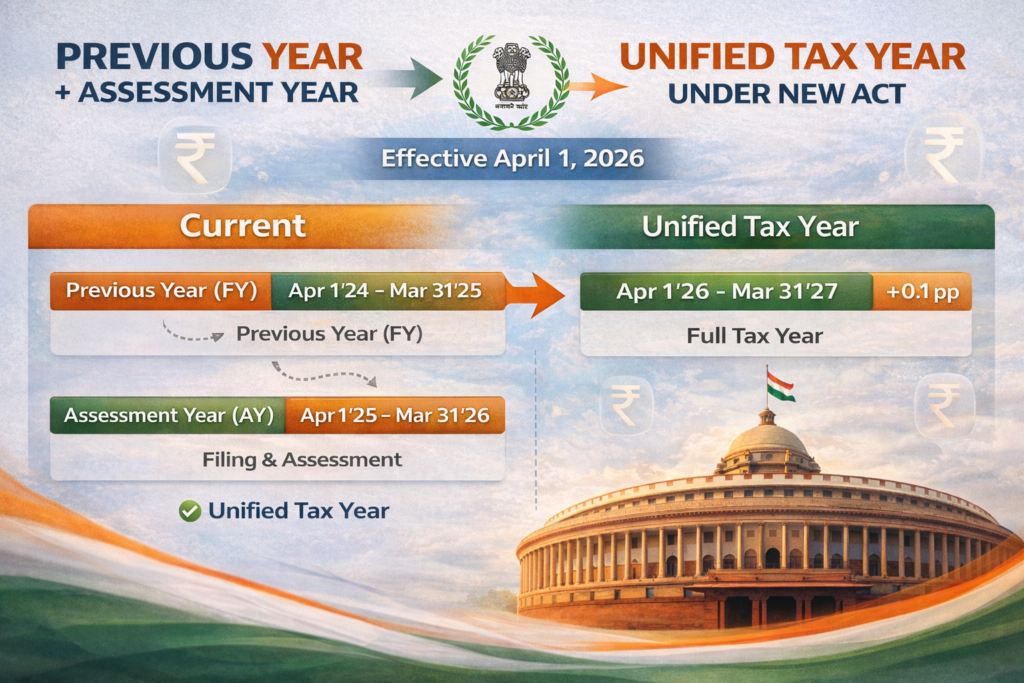
Perhaps the single most discussed structural change is the replacement of the “Previous Year” and “Assessment Year” framework with a single unified concept: “Tax Year.”
Under the 1961 Act, income earned during the Previous Year (e.g., April 1, 2025 to March 31, 2026) was assessed and taxed in the Assessment Year (e.g., April 1, 2026 to March 31, 2027). This two-year construct confused millions of taxpayers — particularly when filling ITR forms that asked for the “Assessment Year.”
The Income-tax Act, 2025 replaces both terms with a single “Tax Year,” defined as the twelve-month period beginning April 1. Income earned in Tax Year 2026-27 (April 1, 2026 to March 31, 2027) is assessed and filed for Tax Year 2026-27. The ITR for Tax Year 2026-27 will be filed in the period following March 31, 2027.
This change is purely terminological and procedural — it does not affect when you file your return or how income is computed. But it does make the law significantly more intuitive for ordinary taxpayers.
Understanding the New Income Tax Act 2025 will benefit taxpayers and their advisors. The New Income Tax Act 2025 emphasizes transparency and accountability in tax reporting.
What Remains Completely Unchanged
One of the most important messages for taxpayers is what the new Act does not change. Despite the sweeping structural overhaul, the following elements are carried forward unchanged: <!– Suggested image: Side-by-side table infographic – “Changed vs. Unchanged” under the new Act –>
Tax Slabs and Rates
| Tax Slab (New Regime, FY 2026-27) | Rate |
|---|---|
| Up to ₹4,00,000 | Nil |
| ₹4,00,001 – ₹8,00,000 | 5% |
| ₹8,00,001 – ₹12,00,000 | 10% |
| ₹12,00,001 – ₹16,00,000 | 15% |
| ₹16,00,001 – ₹20,00,000 | 20% |
| ₹20,00,001 – ₹24,00,000 | 25% |
| Above ₹24,00,000 | 30% |
Note: These slabs reflect the new tax regime as revised in Union Budget 2025. The Act itself does not alter these figures. Always verify current slabs on the Income Tax Department’s official portal (incometax.gov.in).
The new tax regime remains the default for individual taxpayers. Taxpayers who wish to claim deductions under the old regime must explicitly opt into it when filing their return — this arrangement carries forward unchanged.
Surcharge and Health & Education Cess
Surcharge rates and the 4% Health and Education Cess remain unchanged under the Income-tax Act, 2025.
Corporate Tax Rates
Domestic corporate tax rates (22% for existing companies under Section 115BAA equivalent; 15% for new manufacturing companies under the corresponding provision) are preserved. The Minimum Alternate Tax (MAT) continues to apply, though the rate has been adjusted to 14% in certain cases pursuant to Budget 2026 proposals — this is a Budget-linked change rather than a structural change in the Act itself.
Deductions Framework
All major deductions that taxpayers rely upon — including standard deduction for salaried individuals, house rent allowance rules, deductions for NPS contributions, home loan interest under the old regime, and Chapter VI-A deductions (80C, 80D equivalents in the new Act’s numbering) — are preserved in substance, though they may carry renumbered section references.
Old vs. New Regime Choice
The choice between the old and new tax regime continues to exist. The new regime remains default; the old regime remains available on opt-in basis for individuals and HUFs. Nothing in the Income-tax Act, 2025 eliminates or modifies the substantive entitlements of either regime.
Old Act vs. New Act: Structural Comparison
| Feature | Income-tax Act, 1961 | Income-tax Act, 2025 |
|---|---|---|
| Sections | ~819 | 536 |
| Chapters | 47 | 23 |
| Presentation style | Dense prose, provisos | Tables, formulae, plain language |
| Tables | Minimal | 57 tables |
| Formulae | Scattered | 46 standardized formulae |
| Key terminology | Previous Year + Assessment Year | Tax Year (unified) |
| Obsolete provisions | Present | Removed |
| Effective date | April 1, 1962 | April 1, 2026 |
Key Modernizations and New Concepts
Virtual Digital Assets (VDAs)
The 1961 Act’s treatment of crypto and other virtual digital assets was introduced through Finance Act 2022 as a patch — Section 115BBH and related provisions were inserted without deep structural integration. The Income-tax Act, 2025 incorporates VDA taxation as a first-class provision within its framework. The 30% flat tax rate on VDA gains and the 1% TDS framework for VDA transfers are retained and now embedded more coherently within the new law’s structure.
Faceless Assessment and Digital Compliance
The faceless assessment regime, introduced through amendments to the 1961 Act in 2020-21, is now natively built into the 2025 Act’s procedural architecture. The Act formally recognizes electronic communication, digital notices, e-filing, and centralized processing as the primary mode of compliance — not an exception to a paper-based default. This reflects the reality of how tax administration already operates in India and provides clearer legal grounding for CBDT’s digital initiatives.
Consolidation of TDS/TCS Provisions
The TDS and TCS provisions in the 1961 Act were scattered across dozens of sections (194A, 194C, 194H, 194I, 194J, and so on). The 2025 Act consolidates these into a more logical grouping, making it easier for businesses to identify applicable rates and thresholds without cross-referencing multiple disconnected sections.
Cleaner International Tax Framework
Transfer pricing rules, POEM (Place of Effective Management) provisions, GAAR, and India’s BEPS-aligned measures are reorganized into a dedicated international taxation chapter. For multinational companies and NRIs, this consolidation reduces the risk of missing cross-referenced provisions and improves the overall coherence of India’s international tax framework.
Impact on Different Taxpayers
Salaried Individuals
For the average salaried taxpayer, day-to-day tax obligations do not change materially on April 1, 2026. Your employer will continue to deduct TDS based on the same regime choices and slab rates. The ITR form you file in 2027 for Tax Year 2026-27 will look similar in substance, though the form itself may be updated to reflect new section numbering and the “Tax Year” terminology.
The primary benefit for salaried individuals is reduced confusion over the Assessment Year vs. Previous Year distinction — a change that sounds small but has been a genuine source of errors in ITR filing, particularly for first-time filers.
CBDT is expected to notify simplified ITR forms for Tax Year 2026-27 ahead of the filing season. These forms will use the new Act’s language and section numbering, and are expected to be more streamlined than current forms.
Small and Medium Businesses
For business owners and self-employed professionals, the key benefit is clearer computation schedules. The 57 tables in the new Act lay out depreciation blocks, presumptive income computations, and other business-side calculations in a format that is far easier to follow than the current narrative sections.
Tax audit thresholds, presumptive taxation limits (under Sections 44AD, 44ADA equivalents), and advance tax obligations remain unchanged.
Non-Resident Indians (NRIs)
The consolidated international taxation chapter is particularly relevant for NRIs. Residency rules, income deemed to accrue or arise in India, treaty override provisions, and DTAA applicability are now presented in a unified section of the law. No new tax obligation is introduced for NRIs — the reorganization is purely structural. However, NRIs who rely on legal opinions or CA advice will benefit from their advisors being able to reference a cleaner, more logical set of provisions.
Corporates and Large Businesses
Corporates will need to update their internal tax manuals and ERP configurations to reflect the new section numbering. Transfer pricing documentation, MAT computation schedules, and deferred tax calculations will reference new section numbers from April 1, 2026. Tax departments in large companies are already working with their advisors on this cross-reference mapping exercise.
Related Changes from Budget 2026: What’s Connected
While the Income-tax Act, 2025 is primarily a simplification exercise, the Union Budget 2026-27 (presented February 1, 2026) introduced several changes that work alongside the new Act:
TCS Rationalization: The Budget 2026 proposals include rationalization of Tax Collected at Source (TCS) rates. Notably, TCS on certain specified foreign remittances and purchases has been adjusted to 2% in specific categories, down from higher rates under the Liberalized Remittance Scheme (LRS) framework. Taxpayers who remit money abroad or purchase foreign travel packages should note these changes. Verify final rates as notified by CBDT post-Budget.
Extended ITR Deadlines: Budget 2026 also signaled a review of ITR filing deadlines in the context of the new Act’s rollout, with the possibility of extended timelines in specific circumstances to ease transition. Formal notifications from CBDT are awaited.
Simplified ITR Forms: The CBDT is in the process of notifying revised ITR forms aligned with the 2025 Act’s structure and terminology. These forms are expected to drop the “Assessment Year” field and replace it with “Tax Year,” along with updated section references throughout. Taxpayers and tax professionals should watch the Income Tax Department portal (incometax.gov.in) for these notifications.
As we approach the implementation of the New Income Tax Act 2025, it is vital to prepare adequately. The New Income Tax Act 2025 will be a significant focus for the year ahead.
MAT Rate Adjustment: As noted above, Budget 2026 proposed an adjustment to the MAT rate to 14% in specified cases. This is a rate-level change introduced through the Finance Act, 2026 rather than through the Income-tax Act, 2025 itself — but it is relevant context for corporate taxpayers from April 1, 2026.
Taxpayers should stay informed about the New Income Tax Act 2025 to ensure they remain compliant. The New Income Tax Act 2025 will require ongoing education for tax professionals.
How to Prepare: A Practical Checklist
The transition to the new Act is largely handled at the institutional level — by CBDT, tax software providers, and your employer’s payroll system. However, there are practical steps taxpayers at all levels should take:
For Salaried Individuals
- No immediate action required for Tax Year 2025-26 (ending March 31, 2026). File your ITR for FY 2025-26 as usual using existing forms and the 1961 Act’s framework.
- Watch for updated ITR forms for Tax Year 2026-27, expected to be notified by CBDT before June 2026. Your tax filing software will be updated automatically by providers like ClearTax, Quicko, and others.
- Understand the Tax Year terminology. When your employer’s Form 16 for TY 2026-27 arrives, it will reference “Tax Year 2026-27” instead of “Assessment Year 2027-28.”
- Inform yourself on section renumbering if you claim specific deductions — particularly if you reference sections in tax-saving investment proofs or legal documents.
For Business Owners and Self-Employed Professionals
- Work with your CA or tax advisor to cross-reference relevant provisions from the 1961 Act to the 2025 Act before April 1, 2026.
- Update accounting software and ERP configurations if they hard-code section references (common in larger accounting systems).
- Review TDS compliance calendars — while rates and thresholds are unchanged, consolidated section references in the new Act mean your internal compliance checklists need to be updated.
- Attend professional development sessions. Most major CA firms and industry associations (ICAI, ASSOCHAM, CII) are running briefing sessions on the transition.
For Corporates and Tax Departments
- Commission a formal section cross-reference mapping from 1961 Act to 2025 Act, covering all provisions relevant to your business (TDS, transfer pricing, depreciation, MAT).
- Update tax position documentation, tax notes, and deferred tax workings to reference the new section numbering before closing FY 2026-27 accounts.
- Coordinate with your legal and compliance teams — contracts that reference specific sections of the Income-tax Act, 1961 (e.g., tax indemnity clauses, facility agreements) may need to be amended or have cross-reference schedules attached.
For Everyone
- Do not assume your tax liability changes on April 1, 2026 — it does not. Slabs, rates, deductions, and regimes are unchanged.
- Rely on official sources: incometax.gov.in, CBDT notifications, and pib.gov.in for authoritative updates.
- Be sceptical of misinformation. The overhaul of the Act has unfortunately generated significant misinformation about “new slabs” and “abolished deductions” — none of which is accurate.
Conclusion
The Income-tax Act, 2025 represents the most significant structural reform of India’s direct tax law since independence — not because it changes what Indians pay, but because it fundamentally changes how that law is written, organised, and understood. By cutting sections from 819 to 536, collapsing 47 chapters into 23, and introducing plain language backed by 57 tables and 46 formulae, the government has built a law that is genuinely easier to read and navigate.
The introduction of the unified “Tax Year” concept alone will save millions of ordinary taxpayers from the perennial confusion of Previous Year vs. Assessment Year. The digital-era alignment of the new Act reflects how tax administration already works in India — and provides a stronger legal foundation for its continued evolution.
The core promise of the new Act — that your tax burden does not change, but your burden of understanding the law does — is one that taxpayers across India have every reason to welcome. From April 1, 2026, India’s income tax law enters a new era. The numbers stay the same. The clarity is new.
Frequently Asked Questions (FAQs)
1. Does the Income-tax Act, 2025 change my income tax slabs or rates? No. Tax slabs, rates, surcharge, and cess remain exactly the same as under the 1961 Act. The new Act is a structural and language reform, not a rate change.
2. From when does the new Income Tax Act 2025 apply? The Income-tax Act, 2025 applies from April 1, 2026, covering income earned in Tax Year 2026-27 (April 1, 2026 to March 31, 2027) onwards.
3. What is “Tax Year” and how is it different from Assessment Year? “Tax Year” is a new unified term that replaces the earlier two-part system of “Previous Year” (the year income is earned) and “Assessment Year” (the year it is filed and assessed). Under the new Act, both concepts are merged into a single “Tax Year.” This is a terminological change only — it does not affect your filing timeline or tax computation.
4. Can I still claim deductions like 80C, 80D under the new Act? Yes. All existing deductions are preserved in substance. They may carry new section numbers in the 2025 Act, but the entitlements are unchanged. Your CA or tax software will reflect the updated references.
5. Is the new tax regime still the default from April 2026? Yes. The new (concessional) tax regime continues to be the default for individual taxpayers. You must explicitly opt in to the old regime if you wish to claim exemptions and deductions available under it.
6. Does the new Act affect how I file my ITR? The process of filing is unchanged. CBDT is notifying updated ITR forms for Tax Year 2026-27 that will use new Act terminology and section references. Your filing software will handle these updates automatically.
7. What happened to the Income-tax Act, 1961? The 1961 Act is replaced by the 2025 Act for income earned from April 1, 2026. However, the 1961 Act continues to apply to assessments, appeals, and proceedings relating to income earned before that date.
8. How many sections does the new Income Tax Act 2025 have? The Income-tax Act, 2025 contains 536 sections organised in 23 chapters, compared to approximately 819 sections in 47 chapters under the 1961 Act.
9. Does the new Act change corporate tax rates? No. Corporate tax rates, including the 22% rate for existing domestic companies and the 15% rate for eligible new manufacturing companies, remain unchanged. A separate Budget 2026 proposal adjusts the MAT rate to 14% in certain cases.
Finally, the New Income Tax Act 2025 marks a new beginning in India’s tax administration. All stakeholders must adapt to the changes brought about by the New Income Tax Act 2025.
10. Where can I find the official text of the Income-tax Act, 2025? The official text is available on indiabudget.gov.in and the Income Tax Department’s portal at incometax.gov.in. CBDT notifications are published on cbdt.gov.in and pib.gov.in.









1 thought on “New Income Tax Act 2025: What Changes from April 2026 – A Complete Guide for Taxpayers”